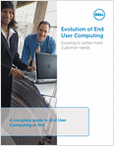
Evolution of End User Computing

End user computing as we know it is undergoing a huge transformation; it’s no longer about the device or technology, it’s about the overall experience. Wise CIOs should embrace and proactively respond to these changing trends.Dell recommends Windows 10…

Simplify Your Data Center with Hyper-Convergence

The time for 21st century data center architectures is here. Software controllable hyper‐converged data center appliances enable new levels of flexibility, reliability and performance that companies of all sizes and types can now start to take advantage of.

Learn about Pivot3’s attributes, such as their:

  • vSTAC OS
  • Their single, unified cache
  • How they have leveraged patented and well‐proven Scalar Erasure Coding (SER) to deliver over 90% storage efficiency

With these kinds of solutions, companies can spend less time focusing on the nitty‐gritty and complications of their data centers and focus more on their business objectives.

Request Free!

IT Executive’s Guide to Big Data and Hadoop

Big data has the potential to transform the way you run your organization, and a conversation about big data is incomplete without mentioning Apache Hadoop. Large and small enterprises alike use Hadoop to store, manage and analyze large amounts of data to gain better understanding of their business. In this highly dynamic field, nonstop innovation goes beyond the original batch processing scenarios to influence new use cases like streaming and real-time analysis – but where do you start?

Download The IT Executive’s Guide to Big Data and Hadoop to learn:

  • When “plain old” data turns into big data and a basic understanding of database sizes
  • Implications of not handling big data correctly
  • 10 things to look for when evaluating Hadoop technology

Request Free!

SQL-on-Hadoop Engines Explained

Hadoop is regarded as one of the best platforms for storing and managing big data – but Hadoop APIs like HDFS, MapReduce and HBase can be quite complex for non-technical users. A programming interface must be put into place to retain Hadoop’s performance and scalability while being leveraged by reporting and analytics tools non-technical users understand and recognize. SQL is a high‐ level, declarative, and standardized database language, it’s familiar to countless BI specialists, it’s supported by almost all reporting and analytical tools, and has proven its worth over and over again.

Download SQL-on-Hadoop Engines Explained to learn about:

  • Real world SQL-on-Hadoop use cases
  • How to solve some challenges that come with leveraging an SQL-on-Hadoop engine
  • Details about Apache Drill, the SQL-on-Hadoop engine that supports HDFS and HBase access

Request Free!

2016 Cloud Technology Kit (a $19.99 value) FREE for a limited time!

You’ll get down-to-earth information about cloud technology, questions to consider, and how to plan and deliver your move to a hybrid environment.

  • Constructing the cloud — learn the basic concepts of the hybrid cloud from both a technical and business perspective
  • Delivering cloud services — dive deeper into the actual foundational elements of the hybrid cloud
  • Identifying business value — determine your hybrid cloud needs based on your business objectives
  • Unified hybrid environments — find out what it means to create a computing environment that brings elements of the data center together with public and private cloud services

Download this exclusive kit to learn how to efficiently deliver and manage cloud services, understand the impact of emerging cloud standards, and identify the value for your business!

The following kit contents will help you continue your research on Cloud Technology:

  • Virtualization Best Practices Guide
  • Hybrid Cloud for Dummies
  • Top 5 Uses for Private Cloud
  • 4 Best Practices for Monitoring Cloud Infrastructure You Don’t Own

Request Free!

Sharpening the Edge of Organizations

The rapid increase of cloud-based services, and dynamic business expectations to enable customers is redefining the “edge” of organizations — branch offices, storefronts, remote locations.

Both the volume of data moving between the edge and the datacenter and the types of applications being deployed at the edge are placing ever greater stress on existing networks and IT teams tasked with deploying, protecting, and managing IT assets at edge locations.

Request Free!