Winning in the API Economy

Application programming interfaces (APIs) can fuel internal innovation, reach new customers, extend products and create vibrant partner ecosystems. This shift in the way business works is creating huge opportunities for both individual organizations an…

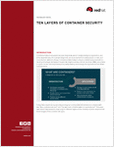
Ten layers of container security

Containers make it easy to ensure consistency across environments and multiple deployment targets like physical servers, virtual machines, and private or public clouds. But, enterprises require strong security. This paper describes 10 key elements…

Why install a world-class CRM system?

Frustrations caused by home-grown CRM systems are numerous: cost, support, flexibility, training and integration – just to name a few.  A world-class CRM system, when installed correctly, will supercharge your business.   This ebook c…

NetSuite for Nonprofits, Accounting for your Mission

Not-for-profits operate in a world of significant complexity, limited resources and software solutions that were built for a different time. With the increasing need to accurately measure outcomes, rising donor expectations and changes in not-for-profit business models, these organisations can no longer afford to use obsolete technologies that can’t provide real-time visibility and insight into their operations and mission.

Request Free!

2018 Global Supply Chain Risk Report

Experts from Cranfield’s Centre for Logistics and Supply Chain Management have analysed data supplied by Dun & Bradstreet, drawing conclusions from around 600,000 anonymous transactions between European buyers and their suppliers located in more than 150 countries worldwide.

The report looks at four key metrics (Supplier Criticality, Supplier Financial Risk, Global Sourcing Risk and Foreign Exchange risk) to assess supply chain risk and provide businesses with a view of trends within their industry sector, and across the wider economy. The focus industry sectors are Construction, Manufacturing, Retail, Transportation and Wholesale.

By analysing trends by sector, the report highlights areas for monitoring and consideration in procurement decisions.

Key highlights: Q1 2018

  • The construction sector reduced its overall supply chain risk in Q1 2018, while transportation saw increased risk across all four metrics measured
  • Overall, 10% more buyer relationships were with suppliers located in high-risk countries than in the previous quarter, with an 18% increase in the transportation sector
  • Dependency on key suppliers increased 3% in Q1 over Q4, marking a 10% increase in the past two quarters, with the retail sector scoring highest level of dependency at 75.2%
  • Supplier financial risk remained relatively stable across most industry sectors

Request Free!

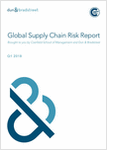
Global Supply Chain Risk Report

Experts from Cranfield’s Centre for Logistics and Supply Chain Management have analysed data supplied by Dun & Bradstreet, drawing conclusions from around 600,000 anonymous transactions between European buyers and their suppliers located in more than 150 countries worldwide.

The report looks at four key metrics (Supplier Criticality, Supplier Financial Risk, Global Sourcing Risk and Foreign Exchange risk) to assess supply chain risk and provide businesses with a view of trends within their industry sector, and across the wider economy. The focus industry sectors are Construction, Manufacturing, Retail, Transportation and Wholesale.

By analysing trends by sector, the report highlights areas for monitoring and consideration in procurement decisions.

Key highlights: Q1 2018

  • The construction sector reduced its overall supply chain risk in Q1 2018, while transportation saw increased risk across all four metrics measured
  • Overall, 10% more buyer relationships were with suppliers located in high-risk countries than in the previous quarter, with an 18% increase in the transportation sector
  • Dependency on key suppliers increased 3% in Q1 over Q4, marking a 10% increase in the past two quarters, with the retail sector scoring highest level of dependency at 75.2%
  • Supplier financial risk remained relatively stable across most industry sectors

Request Free!