
How Smarter Signals Are Predicting Buyer Readiness Before the First Conversation
 Imagine a mid-level procurement manager at a manufacturing company. For three weeks, she has been quietly doing her homework. She has read comparison articles, watched product demo videos, visited three vendor websites, and downloaded a whitepaper on supply chain automation. She has not filled out a single contact form, and she has not responded to any outreach emails. From the outside, she looks like every other anonymous visitor on the internet. But she is not browsing casually; she is building a business case, and she is close to a decision. The vendor that figures this out first, and reaches her with the right message at the right moment, wins the deal. The ones that wait for her to raise her hand will likely never get the chance. This is the problem that AI-powered intent data was built to solve.
What Is Intent Data, and Why Does It Matter?
Intent data refers to behavioral signals that indicate how likely a prospect is to make a purchase. These signals include things like which topics a company is researching online, which competitor pages they are visiting, how frequently they are consuming content in a particular category, and how deeply they are engaging with specific pieces of information. Think of it as a digital trail that reveals what a buyer is thinking about, even when they are not talking to anyone.
There are two primary types of intent data. First-party data comes directly from your own channels, such as website visits, email engagement, and content downloads. Third-party data is collected from across the broader web, tracking research activity on external sites, review platforms, and industry publications. Together, they paint a much richer picture of buyer behavior than any single source could provide alone. According to The Insight Collective, over half of B2B marketers, specifically 55%, use a combination of both types to get the most complete view of buyer intent.
The Problem with Waiting for Buyers to Reach Out
For years, B2B sales teams operated on a reactive model. They waited for prospects to fill out a form, book a demo, or respond to a cold email before initiating a real conversation. The problem with this approach is that by the time a buyer makes contact, most of the decision has already been made. According to 6sense’s 2025 B2B Buyer Experience Report, which surveyed thousands of buyers across roles, regions, and industries, buyers do not typically engage with sellers until they are about two thirds of the way through their buying journey. By that point, 95% of deals are won by a vendor that was already on the buyer’s shortlist from day one.
This means that for most B2B vendors, the window to influence a buying decision is not during the sales conversation. It is during the research phase that happens long before any conversation takes place. The vendor that shows up with relevant, well-timed content during that early research phase earns a spot on the shortlist. The vendor that waits is playing catch-up from the start.
How AI Transforms Raw Signals into Actionable Intelligence
Collecting intent signals is not new. What is new is the ability to make sense of them at scale, and that is where artificial intelligence fundamentally changes the game. Raw behavioral data on its own is noisy and difficult to interpret. A single website visit could mean anything. But when AI analyzes hundreds of signals simultaneously, looking for patterns, surges in research activity, and combinations of behaviors that have historically preceded a purchase, it can identify in-market buyers with a level of accuracy that no human analyst could match manually.
AI-powered intent platforms do several things that traditional tools cannot. They identify anonymous website visitors and match them to company profiles in real time. They track content consumption patterns across thousands of external websites to detect surges in research activity around specific topics. They score accounts based on the strength and recency of their intent signals, so sales teams know exactly which prospects to prioritize on any given day. And they integrate this intelligence directly into CRM and marketing automation platforms, so the insight does not sit in a dashboard that no one checks; it shows up in the workflow where action actually happens.
The Market Is Responding Quickly
The adoption of intent data tools is accelerating rapidly, and the market size reflects that momentum. According to Verified Market Reports, the global B2B Buyer Intent Data Tools Market was valued at $1.5 billion in 2024 and is forecasted to reach $4.2 billion by 2033, growing at a compound annual growth rate of 12.5%. This kind of sustained growth signals that intent data is not a passing trend; it is becoming a core part of how B2B companies build their go-to-market strategies.
Despite this momentum, adoption is far from universal. The Insight Collective reports that only about 25% of B2B businesses are currently using intent data and monitoring tools in a meaningful way. However, among large enterprises, the picture is very different: 99% of large corporations are leveraging intent data in some form. This gap represents a significant opportunity for mid-market companies that move quickly. The early adopters in this space are already building competitive advantages that will be difficult to close later.
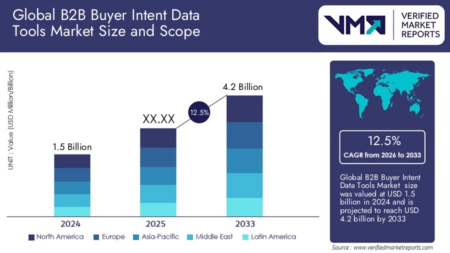
Verified Market Reports. (2025). B2B Buyer Intent Data Tools Market Size, Industry Growth, Trends and Forecast 2033
Turning Intent into Better Targeting
When intent data is combined with AI, targeting becomes far more precise than traditional demographic or firmographic segmentation alone can achieve. Instead of reaching out to every company in a target industry and hoping a few are ready to buy, marketing and sales teams can direct their energy toward the accounts that are showing active research signals right now. This shift from broad targeting to in-market targeting has a direct impact on efficiency, conversion rates, and return on marketing investment.
Intent data also improves the relevance of outreach. When a sales rep knows that a prospect has been researching supply chain automation for three weeks and recently visited a competitor’s pricing page, the outreach they send can be tailored to that specific context. That kind of relevance is far more likely to generate a response than a generic cold email that ignores everything the prospect has already been doing. According to The Insight Collective, B2B buyers conduct an average of 12 online searches before visiting a specific brand’s website, and 81% of sales representatives confirm that buyers are researching more independently than ever before.
Going forward the direction is clear. B2B buyers are doing more of their research earlier and more independently. They are forming their shortlists before they ever speak to a sales rep, and the vendors on those shortlists are the ones who showed up during the research phase with the right content and the right message. AI-powered intent data makes it possible to identify those moments of early-stage research and act on them before the window closes.
This means rethinking where and how early in the funnel your efforts are focused. It means investing in tools that surface in-market accounts in real time, building content strategies designed to capture buyers during their independent research phase, and integrating intent signals into your lead scoring and prioritization frameworks. The companies that do this well will consistently earn a spot on the buyer’s Day One shortlist. The ones that do not will keep arriving too late for the conversation.
AI-powered intent data is changing the fundamental logic of B2B marketing. It shifts the model from reactive to proactive, from broad to precise, and from guesswork to evidence. The procurement manager doing her quiet research does not have to remain invisible. With the right tools, she is one of the most identifiable and reachable buyers in your pipeline. The question is whether your marketing strategy is built to find her.
Interested in reaching more in-market buyers before your competitors do? Visit knowledgehubmedia.com to learn how Knowledge Hub Media helps B2B companies connect with the right audiences at the right time.
