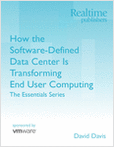
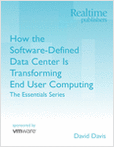
How the Software-Defined Data Center is Transforming End User Computing

Thanks to the rising importance of business mobility, the BYOD trend, and improvements in the underlying technology, the rate of adoption of desktop virtualization is faster today than ever before. Virtual desktop infrastructure (inclusive of both desktop and application virtualization) is becoming foundational to end user computing strategy. And increasingly, that foundation is being built on a more agile, intelligent, high-performance infrastructure—known as the Software-Defined Data Center (SDDC).

Request Free!

Transforming the Desktop to Align with Today’s Mobile Reality

In order for desktop computing to evolve past its limitations and successfully enter the modern age, the next generation desktop must be inspired by mobility. The key attributes of mobile and cloud computing need to be incorporated within or supported by the desktop architecture, including:

  • Real-time application delivery
  • End-user freedom
  • Secure access to services at the lowest cost
  • IT agility in meeting changing business needs

When this happens – and it is starting to happen now in forward-looking organizations – an enterprise can look forward to a wave of hard savings, workplace productivity, and business innovation that can catapult it ahead of the competition.

Request Free!

The Office 365 Test Drive

It’s a quick and easy way to test drive new enterprise capabilities, including: advanced collaboration, analytics, and security features.Step through common enterprise scenarios to see how Office 365 can support your business needsSee the latest in-pro…

Bridging the Communication Gap Between CFOs and Their Security Teams

Your enterprise’s security issues are not solely the responsibility of the Chief Security Officer. Business decision makers like CFOs are responsible for managing risk, and cybersecurity should be top of mind when it comes to protecting an organization’s financial assets. In fact, the average consolidated total cost of a data breach in 2015 was $3.8 million—a 23% increase since 2013.

Many CFOs don’t know what to ask their security teams, to help them get what they need to protect their organization. Looking at everything from budget concerns to the financial efficiency of BYOD policies, we’ve compiled five key questions that CFOs (and business decision makers alike) can use to start the conversation with their CSO and build a fully supported security plan.

Opening the lines of communication between you and your security team is the first step to improving your security plan. Learn how through our free eBook.

Request Free!