
Quick Definition
Cybersecurity focuses on preventing attacks and protecting systems, while cyber resilience ensures organizations can continue operating and recover quickly when attacks occur.
AI Summary
As cyber threats grow more advanced and unavoidable, organizations are shifting from a prevention-only mindset to a resilience-driven approach. While cybersecurity remains essential for protecting systems and data, cyber resilience focuses on maintaining business continuity, minimizing disruption, and enabling rapid recovery during and after an attack. This article explores the key differences between cybersecurity and cyber resilience, why resilience is becoming critical for modern enterprises, and how Absolute Security stands out by delivering persistent, self-healing endpoint capabilities that ensure systems remain operational even when traditional security tools fail.
Key Takeaways
- Cybersecurity focuses on preventing attacks, but cyber resilience ensures business continuity when those attacks succeed.
- Modern threat environments make it impossible to rely on prevention alone, making resilience a critical component of enterprise security strategies.
- Absolute Security differentiates itself by providing firmware-level persistence and self-healing endpoints, enabling continuous control and rapid recovery.
Who Should Read This
CISOs, IT security leaders, infrastructure teams, and enterprise decision-makers looking to strengthen their security strategy with resilience-focused solutions.
The Shift from Protection to Continuity
 For years, cybersecurity strategies have been built around a single objective: preventing attacks. Organizations invested heavily in firewalls, endpoint protection, identity management, and threat detection tools, all designed to stop breaches before they happen.
However, the modern threat landscape has changed. Cyberattacks are more sophisticated, more persistent, and increasingly capable of bypassing even the most advanced defenses. As a result, enterprises are beginning to recognize a critical reality: prevention alone is no longer enough.
This shift is driving the rise of cyber resilience, a concept that focuses not just on stopping attacks, but on ensuring that businesses can continue operating even when those attacks succeed.
Cybersecurity vs Cyber Resilience: What’s the Difference?
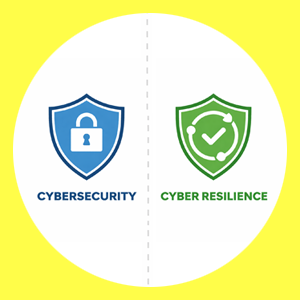
While the terms are often used interchangeably, cybersecurity and cyber resilience serve different purposes.
Cybersecurity focuses on protecting systems, networks, and data from unauthorized access and malicious activity. It is centered on reducing risk and blocking threats before they cause damage.
Cyber resilience, on the other hand, is focused on maintaining operations during and after an attack. It ensures that systems can recover quickly, minimize disruption, and return to a trusted state without significant downtime.
In simple terms, cybersecurity is about protection, while cyber resilience is about survival. Both are essential, but resilience addresses the reality that not every attack can be prevented.
Why Cyber Resilience Is Becoming Essential
Several key factors are accelerating the shift toward resilience. The first is the increasing complexity of cyber threats. Ransomware, supply chain attacks, and AI-driven exploits are becoming more difficult to detect and stop. Attackers are no longer just targeting vulnerabilities; they are exploiting gaps in processes, identities, and systems.
The second factor is the rising cost of downtime. For many organizations, the biggest impact of a cyber incident is not the breach itself, but the disruption to operations. Lost productivity, revenue interruptions, and damage to customer trust can far exceed the cost of the attack.
Additionally, the expansion of remote and hybrid work has significantly increased the attack surface. Endpoints are now distributed across locations and networks that are often outside of direct IT control, making consistent enforcement of security policies more challenging.
Finally, security tools themselves are not immune to failure. Agents can be disabled, configurations can drift, and visibility can be lost during critical moments. Cyber resilience is designed to address these gaps by ensuring that systems can recover and continue functioning even when controls break down.
What Defines a Cyber Resilience Strategy
A strong cyber resilience strategy goes beyond traditional security measures and focuses on continuity and recovery.
This includes the ability to maintain business operations during an incident, rapidly detect and respond to threats, and restore systems to a secure and trusted state as quickly as possible. It also involves learning from incidents and adapting defenses to reduce future risk. Ultimately, resilience is about preparedness. It assumes that disruptions will occur and ensures that organizations are equipped to handle them without significant impact.
How Absolute Security Approaches Cyber Resilience
 This is where Absolute Security differentiates itself from traditional cybersecurity vendors. Rather than focusing solely on prevention or detection, Absolute is built around the concept of maintaining control and ensuring recovery at the endpoint level. Its platform is designed to keep devices secure, visible, and operational even when other security tools fail. This positions Absolute not just as a security solution, but as a foundational layer of cyber resilience.
Firmware-Level Persistence: A Unique Advantage
One of Absolute Security’s most distinctive capabilities is its persistence technology. Unlike most security tools that operate at the operating system level, Absolute is embedded directly into device firmware. This allows it to remain active even if the operating system is reinstalled or the device is compromised.
This firmware-level presence creates a persistent control layer that cannot be easily removed or disabled, giving organizations continuous visibility and management capabilities regardless of device state.
Self-Healing Endpoints and Continuous Control
Building on this foundation, Absolute enables self-healing endpoints. If a security agent is disabled, a policy is altered, or a critical application is removed, the platform can automatically detect the issue and restore it. This reduces the need for manual intervention and significantly shortens recovery times.
In addition, Absolute provides continuous visibility and control across endpoints, whether they are on or off the corporate network. IT and security teams can monitor device health, enforce policies, and take action remotely, ensuring that endpoints remain compliant and secure.
Extending Resilience to Access and Connectivity
Absolute also incorporates secure access capabilities based on Zero Trust principles. By combining endpoint intelligence with access controls, organizations can enforce policies that ensure only trusted users and compliant devices can access critical applications and data. This strengthens overall security while supporting modern, distributed work environments.
The integration of endpoint resilience with secure access creates a more comprehensive approach to protection, one that addresses both prevention and recovery.
Why the Difference Matters for Enterprises
The distinction between cybersecurity and cyber resilience becomes most apparent during an incident. A traditional security approach focuses on whether an attack was stopped. A resilience-focused approach considers whether the business was able to continue operating despite the attack.
Organizations that rely solely on prevention may find themselves vulnerable when defenses fail, leading to extended downtime and costly recovery efforts. Those that incorporate resilience into their strategy are better positioned to maintain continuity, recover quickly, and minimize disruption.
The Future of Enterprise Protection
Cybersecurity remains a critical component of any enterprise strategy, but it is no longer sufficient on its own. The future lies in combining cybersecurity with cyber resilience to create a more complete and realistic approach to protection. Prevention reduces risk, while resilience ensures continuity when that risk becomes reality.
Absolute Security exemplifies this shift by addressing one of the most important gaps in modern security strategies: maintaining control and enabling recovery when traditional defenses fall short. As cyber threats continue to evolve, organizations will increasingly measure success not just by how well they prevent attacks, but by how effectively they withstand and recover from them.
Frequently Asked Questions
What is the difference between cybersecurity and cyber resilience?
Cybersecurity focuses on preventing and detecting threats, while cyber resilience ensures that systems can continue operating and recover quickly even if a breach occurs.
Why is cyber resilience important for modern enterprises?
Because cyberattacks are increasingly unavoidable, resilience helps organizations minimize downtime, maintain operations, and reduce the overall impact of security incidents.
How does Absolute Security support cyber resilience?
Absolute Security provides firmware-embedded persistence and self-healing endpoint capabilities, allowing organizations to maintain control of devices and automatically restore critical security tools and configurations even after compromise.
