
Quick Definition
Edge AI infrastructure refers to computing systems that process artificial intelligence workloads directly at or near the location where data is generated, such as IoT devices, sensors, manufacturing equipment, or robotics systems. By performing AI inference locally rather than sending data to centralized cloud environments, organizations can enable real-time decision making, reduce latency, and improve operational efficiency.
AI Summary
Edge AI infrastructure enables artificial intelligence processing to occur directly where data is generated, such as on IoT devices, industrial machines, robotics systems, and edge gateways. By moving AI inference closer to the source of data rather than relying entirely on centralized cloud systems, organizations can dramatically reduce latency and enable real-time decision making. This approach is becoming increasingly important for applications that require immediate responses, including manufacturing automation, autonomous systems, healthcare monitoring, and smart city infrastructure. As enterprises deploy more connected devices and sensors, edge AI infrastructure is emerging as a critical component of modern AI architectures, helping organizations process data faster, lower bandwidth costs, and improve operational efficiency.
Key Takeaways
- Edge AI enables real-time inference by processing data closer to its source.
- It reduces latency and bandwidth costs compared to cloud-only AI architectures.
- Industries such as manufacturing, robotics, healthcare, and autonomous systems are leading adopters.
Who Should Read This
IT leaders, AI engineers, infrastructure architects, and enterprise technology strategists exploring real-time AI deployments.
 What Is Edge AI Infrastructure?
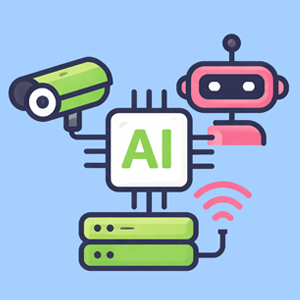
Edge AI infrastructure is a computing architecture that enables artificial intelligence models to run directly on devices or systems located near where data is created. Instead of transmitting large volumes of data to centralized cloud servers for processing, AI inference occurs locally on edge devices such as gateways, industrial computers, robotics systems, or specialized AI hardware.
By processing information at the edge of the network, organizations can dramatically reduce latency, minimize bandwidth consumption, and enable real-time decision making. This capability is especially important for applications where immediate responses are required, including industrial automation, autonomous vehicles, smart cities, and robotics. As enterprises deploy more connected sensors, cameras, and IoT devices, edge AI infrastructure is becoming a foundational component of modern AI architectures.
How Edge AI Infrastructure Works
Edge AI environments typically combine several technologies to support real-time AI processing.
First, data is generated by sensors, cameras, machines, or IoT devices operating within a physical environment. Instead of sending raw data to a centralized data center or cloud platform, the information is transmitted to a nearby edge computing node.
These edge nodes are equipped with specialized processors such as GPUs, AI accelerators, or optimized CPUs designed to run machine learning models efficiently. The models analyze incoming data streams locally and produce real-time insights or automated actions.
In many architectures, the cloud still plays an important role. Centralized environments are often used to train large AI models and manage data pipelines. Once trained, models are deployed to edge devices where they perform inference tasks continuously.
This hybrid model allows organizations to combine the scalability of cloud computing with the speed and responsiveness of edge infrastructure.
Types of Edge AI Infrastructure
Device-Level Edge AI
Device-level edge AI occurs when machine learning models run directly on the device generating the data. Examples include smart cameras performing object detection or autonomous drones analyzing sensor data in flight.
Because processing happens directly on the device, latency is extremely low and systems can operate even with limited connectivity.
Gateway Edge AI
In gateway-based architectures, multiple devices send data to a nearby edge gateway. The gateway aggregates and processes the data using AI models before sending summarized insights to central systems.
This approach is common in industrial environments where large numbers of sensors or machines generate continuous data streams.
Edge Data Centers
Edge data centers are localized computing facilities positioned close to operational environments such as factories, retail stores, or urban infrastructure. These small-scale data centers host powerful computing resources capable of running more complex AI workloads while still maintaining low latency.
Edge data centers are often used in smart city deployments, telecommunications networks, and large-scale IoT environments.
Benefits of Edge AI Infrastructure
Edge AI infrastructure delivers several advantages for organizations deploying AI-driven applications.
Real-Time Decision Making
Processing AI workloads close to the source of data enables immediate responses. This is critical for applications such as robotics, predictive maintenance, and autonomous systems.
Reduced Latency
Cloud-based AI systems may introduce delays due to network transmission. Edge AI minimizes these delays by performing inference locally.
Lower Bandwidth Costs
Sending raw sensor data to the cloud can require enormous bandwidth. Edge processing filters and analyzes data locally, transmitting only relevant insights.
Improved Reliability
Edge AI systems can continue operating even when network connectivity is limited or interrupted.
Enhanced Data Privacy
Sensitive data can remain within local environments rather than being transmitted across networks or stored in centralized cloud platforms.
Edge AI Infrastructure Examples
Edge AI is already transforming operations across multiple industries.
Manufacturing
Factories deploy edge AI systems to monitor machinery in real time, detect anomalies, and predict equipment failures before downtime occurs.
Autonomous Vehicles
Self-driving systems rely on edge AI to process camera feeds, radar signals, and sensor inputs instantly while navigating dynamic environments.
Healthcare
Medical imaging devices and monitoring systems can analyze patient data locally to assist clinicians with rapid diagnostics.
Retail
Smart cameras and analytics systems help retailers monitor store activity, optimize inventory placement, and improve customer experiences.
Smart Cities
Traffic monitoring systems, public safety infrastructure, and environmental sensors use edge AI to process large volumes of urban data in real time.
Frequently Asked Questions
What is edge AI in artificial intelligence?
Edge AI refers to the deployment of artificial intelligence models directly on devices or systems located near where data is generated. Instead of sending information to the cloud for analysis, AI models process data locally to enable faster decision making.
Why is edge AI important for real-time applications?
Real-time applications require immediate responses to incoming data. Edge AI reduces latency by eliminating the need to transmit data to remote servers for processing.
What industries use edge AI infrastructure?
Edge AI is widely used in manufacturing, robotics, autonomous transportation, healthcare, retail analytics, telecommunications, and smart city infrastructure.
How does edge AI differ from cloud AI?
Cloud AI relies on centralized computing environments for processing and analysis. Edge AI moves inference closer to the data source, enabling faster responses and reducing network dependency.
