
Quick Definition
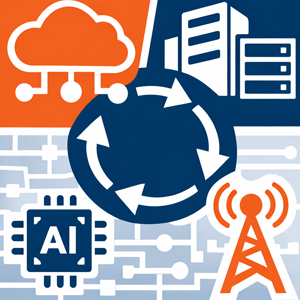
Hybrid AI infrastructure is an architecture that combines cloud, on-premises, and edge environments to run AI workloads, allowing organizations to place compute and data where it performs best in terms of cost, speed, and compliance.
AI Summary
Hybrid AI infrastructure is emerging as enterprises scale AI in production, as cloud-only models become too costly and introduce latency and compliance challenges, while data gravity makes moving large datasets impractical. Organizations are now distributing workloads across cloud, on-prem, and edge environments, keeping training in the cloud while moving inference and real-time processing closer to where data lives. This approach improves performance, reduces costs, and supports compliance, but also introduces new complexity, making orchestration across environments a critical component of the modern AI stack. Hybrid AI is no longer an optimization, it is becoming the standard for enterprise AI.
Key Takeaways
- Hybrid AI is becoming the default, not the transition Cloud-only strategies are no longer enough for modern AI workloads, pushing enterprises toward a mix of cloud, on-prem, and edge environments.
- Workload placement is now a strategic decision Organizations are optimizing where AI runs based on cost, latency, and data sensitivity rather than relying on a single infrastructure model.
- Orchestration is the new critical layer Managing AI across multi-cloud, on-prem, and edge environments requires strong orchestration to ensure performance, efficiency, and compliance.
Who Should Read This
CIOs, CTOs, and IT directors responsible for modernizing infrastructure and supporting AI initiatives.
 The Shift Away from Cloud-Only Thinking
For years, the dominant narrative in enterprise IT was simple: move everything to the cloud. It promised scalability, flexibility, and reduced operational overhead. And for many workloads, it delivered. But AI is changing that equation.
As organizations scale their AI initiatives, the limitations of a cloud-only strategy are becoming more visible. What once felt like the future is now starting to feel incomplete. In its place, a new standard is emerging: hybrid AI infrastructure. This is not a transition phase. It is the new default.
What Is Hybrid AI Infrastructure?
Hybrid AI infrastructure refers to an architecture that combines cloud environments, on-premises systems, and edge computing to support AI workloads.
Rather than relying on a single environment, organizations distribute workloads across multiple environments based on performance, cost, compliance, and latency needs. In simple terms, it is about putting the right workload in the right place.
Why Hybrid AI Is Trending Now
Several forces are pushing enterprises toward hybrid models, and they are all accelerating at the same time.
Rising Cloud Costs
AI workloads are not lightweight. Training models, running inference at scale, and storing massive datasets can quickly drive up cloud costs. Many organizations are realizing that always-on, compute-heavy workloads are often more cost-effective on dedicated or on-prem infrastructure.
Data Sovereignty and Compliance
As regulations evolve, particularly around AI and data usage, companies are facing stricter requirements on where data can be stored and processed. Industries like healthcare, finance, and government cannot always rely on public cloud environments alone. This has led to the rise of “sovereign AI” strategies, where data and models must remain within specific geographic or regulatory boundaries.
Latency and Real-Time Requirements
AI is increasingly being used in real-time applications such as fraud detection, autonomous systems, and customer interactions. These use cases cannot tolerate the latency introduced by sending data back and forth to centralized cloud environments. Edge and localized infrastructure are becoming critical to delivering real-time AI outcomes.
The Challenge of Data Gravity
One of the biggest forces shaping hybrid AI strategies is data gravity. As datasets grow larger and more complex, they become harder and more expensive to move. Instead of moving data to compute, organizations are increasingly bringing compute to where the data already lives. This shift is forcing a rethink of infrastructure design. AI pipelines are now being built around data location, not just compute availability.
Sovereign AI Is Reshaping Infrastructure Decisions
Sovereign AI is no longer just a regulatory concern. It is becoming a core design principle.
Organizations must now consider:
- Where their data is stored
- Who has access to it
- How it is processed and governed
This often means keeping sensitive workloads on-prem or within specific regional cloud environments. It also introduces new complexity in managing distributed systems while maintaining compliance.
Smarter Workload Placement Strategies
In a hybrid model, not all AI workloads are treated equally. Organizations are beginning to segment workloads based on their specific requirements:
- Training workloads may run in the cloud for scalability
- Inference workloads may run on-prem or at the edge for speed
- Sensitive data processing may remain entirely within private environments
This level of granularity allows enterprises to optimize both performance and cost, but it also requires more sophisticated planning and orchestration.
The Rise of Multi-Cloud and Orchestration Layers
Hybrid infrastructure does not just mean cloud plus on-prem. It often includes multiple cloud providers as well. Multi-cloud strategies are becoming more common as organizations look to avoid vendor lock-in and take advantage of specialized services across providers. However, this introduces a new challenge: orchestration.
Managing AI workloads across cloud, on-prem, and edge environments requires robust orchestration layers that can:
- Coordinate workloads across environments
- Manage data movement and synchronization
- Ensure consistent performance and governance
This orchestration layer is quickly becoming one of the most critical components of the modern AI stack.
What This Means for Enterprises
The move to hybrid AI infrastructure is not just a technical shift. It is a strategic one.
Organizations that continue to rely on a single environment risk:
- Escalating costs
- Performance bottlenecks
- Compliance challenges
On the other hand, those that embrace hybrid models can:
- Optimize workload performance
- Control costs more effectively
- Meet regulatory requirements
- Deliver real-time AI capabilities
Final Thoughts
The idea that the cloud would handle everything was always an oversimplification. AI has made that clear. Hybrid AI infrastructure is no longer a workaround or a temporary solution. It is the foundation for how modern AI systems are built and scaled. The question is no longer whether to adopt hybrid infrastructure. It is how quickly organizations can adapt to it.
Frequently Asked Questions
What is hybrid AI infrastructure in simple terms?
Hybrid AI infrastructure combines cloud, on-premises, and edge environments to run AI workloads. It allows organizations to choose the best location for each workload based on cost, speed, and compliance needs.
Why are companies moving away from cloud-only AI strategies?
Cloud-only models can become expensive for large-scale AI workloads, introduce latency for real-time applications, and create challenges around data sovereignty and compliance. Hybrid models provide more flexibility and control.
What is data gravity and why does it matter for AI?
Data gravity refers to the idea that large datasets are difficult and costly to move. In AI, this means it is often more efficient to bring compute to the data rather than moving data to centralized cloud environments.
How do companies decide where to run AI workloads?
Organizations use workload placement strategies. For example, training may run in the cloud for scalability, while inference may run on-prem or at the edge for speed and lower latency.
What role does orchestration play in hybrid AI?
Orchestration tools manage and coordinate AI workloads across multiple environments. They help ensure data flows correctly, workloads are optimized, and performance remains consistent across cloud, on-prem, and edge systems.
