
 One of the easiest ways to misread B2B marketing performance is to look at the top of the funnel and stop there.
You spend money. You generate leads. Most of them do not immediately convert. A few say they are not interested. Others go quiet. Sales starts to feel frustrated. Marketing starts questioning the campaign. On the surface, it can look like the whole thing underperformed.
But that is often not what is actually happening.
B2B conversion math looks very different from B2C. In B2B, deals are larger, buying cycles are longer, more people are involved, and most leads will never move forward. That does not automatically mean those leads were wasted. It means you are operating in a market where a small number of the right conversions can carry the economics of the entire program.
The B2B Conversion Problem Is Often a Perception Problem
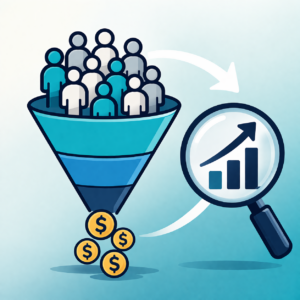
Let’s say you spend $3,000 to generate 100 leads.
At first glance, it does not look promising.
- Some leads say they are not interested.
- Some do not respond at all.
- Some engage once and disappear.
That is usually the point where teams start labeling the campaign a disappointment.
But then you look further down the funnel.
- 10 of those 100 leads become real opportunities.
- 5 of those 10 opportunities close.
If your solution costs $20,000, those 5 closed deals represent $100,000 in revenue from a $3,000 investment.
That is not a failed campaign. That is a campaign that produced a 33-to-1 revenue-to-spend multiple.
The problem is not always performance. Sometimes the problem is where people choose to stop measuring.
Why Low Conversion Rates Can Still Produce Strong Outcomes
In B2B, conversion rates do not tell the full story on their own. A low percentage can still be commercially meaningful if the downstream value is high enough.
This is where many teams get tripped up. They see the 95 leads that did not close and treat them as waste. But B2B is not a category where every lead is supposed to become a customer. In many cases, that would be unrealistic.
The real question is not, “Did every lead convert?”
The real question is, “Did enough of the right leads convert to justify the spend?”
That is a very different lens, and a much more useful one.
Most Leads Will Not Be Ready When They First Engage
Another reason B2B conversion data gets misread is that marketers often expect immediate buying behavior from people who are still in research mode.
A lead may download content, attend a webinar, or engage with an ad long before they are willing to talk to sales. That does not make the lead bad. It usually means the person is early, cautious, gathering information, or not the final decision-maker.
In B2B, that is normal.
Some leads are evaluating options for a project six months out. Some are collecting ideas to bring back to a broader buying group. Some are simply validating whether a problem is worth solving at all. Others may be a perfect fit, but they are waiting for budget, internal alignment, or executive approval.
When teams forget that context, they tend to overreact to the natural drop-off that happens between first engagement and final sale.
The Funnel Always Looks Harsh at the Top
Almost every B2B funnel looks inefficient if you only judge it at the lead level.
That is because “lead” is a very broad category. It can include someone who is deeply in-market, someone casually researching, someone who fits your ICP but is too early, or someone who engaged once and will never return.
Those are all very different people, but they often get grouped into the same reporting bucket.
That is part of why top-of-funnel numbers can create so much confusion. They compress different levels of interest, fit, urgency, and buying power into one metric.
So when someone says, “We generated 100 leads and only 5 became customers,” that can sound weak until you connect those 5 conversions to deal value.
In a high-value B2B sale, 5 customers can be a huge win.
Why “Wasted Leads” Is Usually the Wrong Conclusion
The phrase “wasted leads” gets thrown around a lot in B2B marketing, but it is often too simplistic.
Yes, some leads are truly low-quality. Some are poor fits. Some should never have been passed along in the first place.
But many so-called wasted leads fall into more nuanced categories:
- They were too early.
- They were interested but not empowered to buy.
- They needed more touches before taking the next step.
- They were part of a buying group, not the entire buying decision.
- They influenced pipeline without becoming the final signer.
This is why B2B teams need to be careful about judging campaigns too quickly. A lead that does not convert immediately is not always lost value. In many cases, it is delayed value, assisted value, or signal value.
What Good B2B Conversion Analysis Looks Like
Instead of stopping at cost per lead or raw lead volume, stronger teams look at the full progression of performance.
That means asking questions like:
- How many leads became qualified conversations?
- How many turned into opportunities?
- How many opportunities turned into revenue?
- How quickly did deals move once they reached opportunity stage?
- What was the average revenue per converted lead?
When you evaluate performance this way, the story becomes much clearer.
A campaign with a messy-looking top of funnel can still be extremely successful if it creates real pipeline and closes high-value business.
The Math Matters More Than the Emotion
A lot of B2B campaign analysis becomes emotional too quickly.
Teams see non-responses, objections, or stalled conversations and assume the campaign is failing. But those reactions are often driven by anecdote, not economics.
The better move is to go back to the math.
In the example above:
- $3,000 spent
- 100 leads generated
- 10 opportunities created
- 5 customers closed
- $100,000 in revenue produced
If you only focus on the fact that 95 leads did not become customers, you miss the much more important fact that the campaign still produced meaningful business results.
That is why B2B reporting needs to be grounded in outcomes, not optics.
Not Every Campaign Needs the Same Conversion Profile
It is also important to remember that not every program is designed to behave the same way.
A highly targeted, bottom-funnel campaign may generate fewer leads at a higher cost and convert faster.
A broader awareness or mid-funnel program may generate more leads at a lower cost, require more nurturing, and convert later.
Neither model is automatically better. They serve different purposes.
The mistake is applying the same expectations to both.
If you judge a top-of-funnel program by bottom-funnel conversion standards, it will almost always look worse than it really is. If you judge a bottom-funnel program only by CPL, you may undervalue how efficient it is at producing revenue.
What Teams Should Measure Instead
If you want a more accurate picture of B2B conversion performance, track metrics that connect marketing activity to commercial outcomes.
- Lead-to-opportunity conversion rate: How many leads become real pipeline?
- Opportunity-to-close rate: How many serious deals actually convert?
- Pipeline created per campaign: How much real selling potential did the program generate?
- Revenue per lead: How much business value did each lead cohort ultimately produce?
- Cost per opportunity or cost per customer: How efficient was the campaign once quality was factored in?
These metrics do not just tell you how many names you collected. They tell you whether your marketing is helping the business grow.
The Real Job of B2B Marketing Is Not to Convert Everyone
One of the biggest mindset shifts in B2B is accepting that success does not mean every lead moves forward.
The job is not to force universal conversion. The job is to attract the right audience, create enough qualified momentum, and convert a valuable percentage of that audience into pipeline and revenue.
That is a very different standard, and a much healthier one.
When teams embrace that, they stop obsessing over the natural fallout in the funnel and start focusing on whether the campaign actually produced business value.
Final Thought
B2B conversion data can look discouraging when viewed at the surface level. Most leads will not close. Some will never respond. Others will stall out or disappear.
But that does not mean the campaign failed.
If a relatively small portion of the right leads becomes real pipeline and closed revenue, the program may be performing exactly as it should.
In B2B, the glass-half-empty view says 95 leads were wasted.
The glass-half-full view says 5 deals generated $100,000.
The more useful view is this: stop measuring campaigns by how many leads did not buy, and start measuring them by whether enough of the right ones did.
