
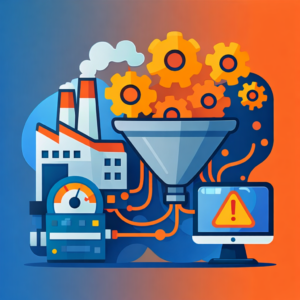
 Unlike many other industries where technology primarily supports office productivity or customer engagement, manufacturing systems are often directly tied to physical operations on the production floor. When data systems lag, machines idle, or workflows become fragmented, it doesn’t just create frustration, it creates bottlenecks that can slow or disrupt production entirely.
That idea surfaced repeatedly in our internal manufacturing market research. Across conversations with professionals in the space, one pattern became clear: manufacturers are under increasing pressure to keep production moving while managing more data, more systems, and more operational complexity than ever before.
While every organization had its own priorities, many of the same underlying challenges appeared again and again. As manufacturing environments become more connected, bottlenecks are no longer caused only by equipment or labor constraints. In many cases, they are tied to visibility, system responsiveness, and the flow of information that keeps production on track.
Bottlenecks Don’t Always Start on the Floor
In manufacturing, a bottleneck forms when one part of the process cannot keep pace with the rest of the operation. Traditionally, that might mean an overloaded machine, a staffing gap, poor plant layout, or a delay in materials. Those issues still matter, but many manufacturers are now dealing with a different kind of constraint as well: digital slowdowns that affect physical output.
Production today depends on a constant exchange of information. Machine data, sensor readings, inventory systems, scheduling tools, quality checkpoints, and digital work instructions all play a role in keeping operations moving. When one of those systems slows down or fails to provide timely insight, the impact can spread quickly across production.
That is what makes manufacturing different from industries like retail, where technology issues may affect reporting, forecasting, or customer experience, or construction, where challenges often center around coordination and project execution. In manufacturing, system performance is often tied much more directly to throughput, uptime, and production flow.
Limited Visibility Makes Small Problems Bigger
Another pattern that stood out in our research was the challenge of identifying issues early enough to prevent disruption. Many manufacturing teams are still working from delayed reporting, manual logs, or fragmented systems that make it difficult to see where a slowdown actually begins.
That lack of real-time visibility can turn a minor issue into a much larger one. A brief machine stoppage, a missed material handoff, an outdated instruction, or a delay in surfacing production data may not seem significant in isolation. But when teams cannot see and respond to those issues quickly, small inefficiencies have a way of compounding across the line.
In environments where output depends on tightly connected processes, even short disruptions can reduce capacity, create backlogs, or leave downstream teams waiting for work to catch up. By the time the problem becomes obvious in a report or end-of-shift review, the damage has often already been done.
Digital Monitoring Is Becoming Essential
As a result, many manufacturers are placing greater value on tools and systems that improve real-time visibility into production. Rather than relying only on periodic reviews, they want to understand what is happening in the moment: where flow is breaking down, which station is lagging, whether downtime is increasing, and how operational issues are affecting output.
This is where digital production tracking, live analytics, and connected systems are becoming more important. These technologies help manufacturers detect bottlenecks faster, understand root causes more clearly, and respond before a localized slowdown turns into a broader operational issue.
Traditional improvement frameworks like Lean and the Theory of Constraints still matter, but they are increasingly being supported by digital systems that provide more immediate feedback. The goal is not simply to collect more data. It is to make that data usable in ways that improve flow, reduce downtime, and support better day-to-day decision-making.
Manufacturing Is Managing Flow, Not Just Equipment
What stood out most in our internal research is that manufacturers are not only focused on machines themselves. They are focused on the full system around those machines: the data, workflows, staffing, materials, and operational visibility required to keep production moving efficiently.
That broader view is important because bottlenecks rarely stay isolated for long. When one part of the system slows down, the effects move quickly across the rest of the operation. And in a manufacturing environment, those slowdowns are felt immediately in output, efficiency, and cost.
For manufacturers trying to improve performance, the challenge is no longer just identifying which machine or process is under strain. It is understanding how digital systems, production visibility, and real-time responsiveness all contribute to the flow of operations.
Because in modern manufacturing, when systems slow down, production slows down with them.
