
Marketers talk a lot about “decision makers,” but in real buying cycles, that label is rarely as straightforward as it sounds. In our internal market research, one pattern came through clearly: different seniority levels play very different roles in the purchase process.
That matters because many demand generation campaigns still focus too narrowly on one title tier. In reality, technology purchases often involve a chain of influence, validation, and approval. The person researching options is not always the person signing off. The executive in the room is not always the one driving the shortlist. And the role most likely to make the final call may not be the one many marketers expect.
Important context: this is a technology-oriented dataset. So this is not meant to claim that IT owns every business purchase. It does suggest something more useful: when the purchase involves technology, IT is very often part of the buying group, and in many cases they are central to the process.
Decision-making patterns change dramatically by seniority
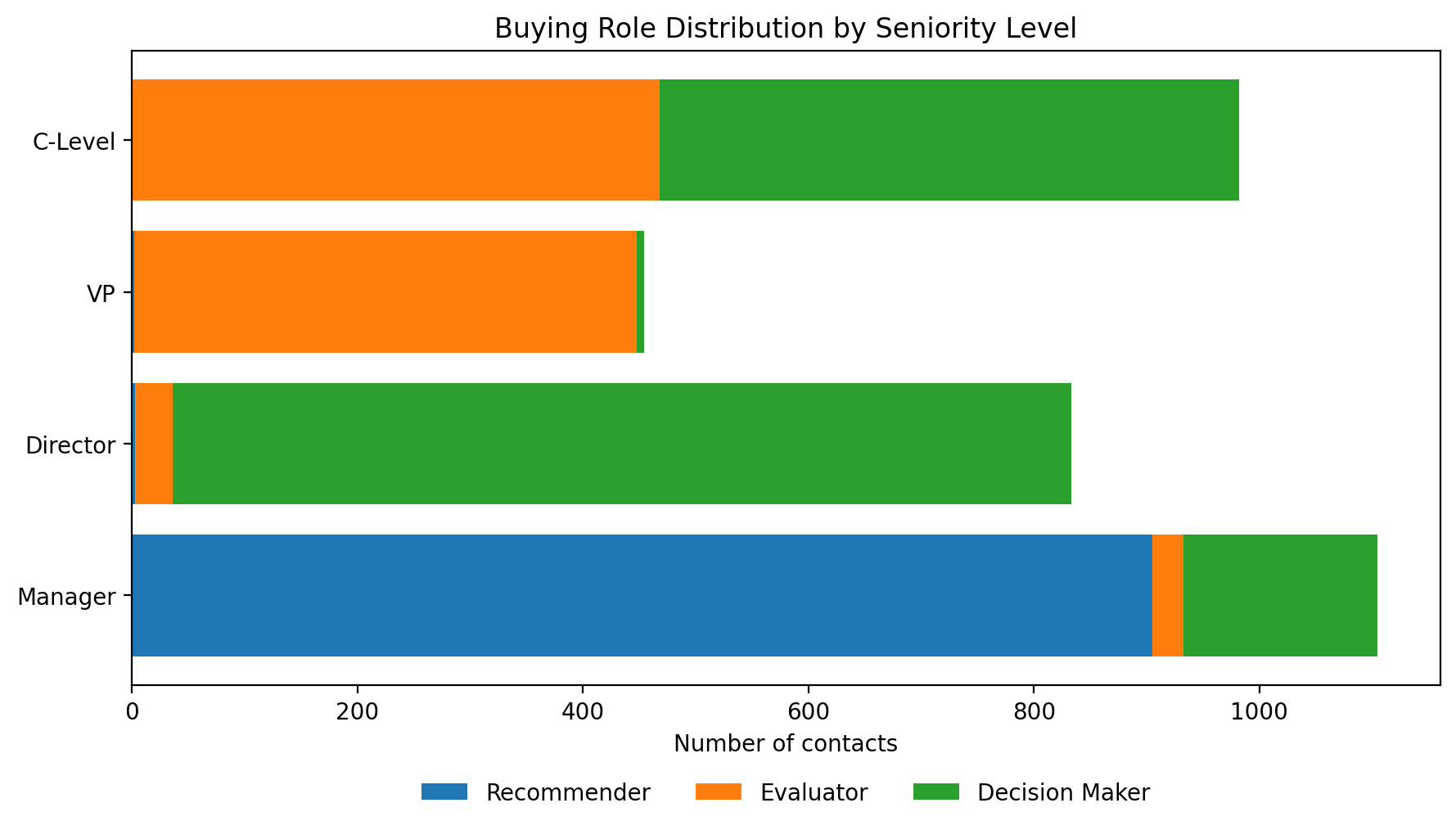
The clearest pattern in the data is how strongly purchasing role shifts by title level.
- Managers were overwhelmingly recommenders. Roughly 81.9% of manager-level contacts were tagged as recommenders, with just 15.6% classified as decision makers.
- Directors were the opposite. About 95.7% of director-level individuals were decision makers.
- VPs were mostly evaluators. Nearly 98.2% of VP-level contacts were classified that way, suggesting a review and validation role more than a final purchasing role.
- C-level contacts were split much more evenly, with 52.3% tagged as decision makers and 47.7% as evaluators.
This is one of the most useful takeaways in the entire dataset. The word “decision maker” is not evenly distributed across the org chart. In technology buying cycles, title level gives marketers a meaningful clue about how someone is likely to participate.
Managers influence, directors decide
If there is one simplified takeaway from the data, it is this: managers tend to help shape the purchase, while directors are far more likely to own the final decision.
That distinction has real campaign implications. Managers are often close to the day-to-day pain points. They are more likely to evaluate usability, workflow fit, implementation friction, and whether a new tool will actually solve the problem it promises to solve. That makes them valuable champions, but not necessarily the last word.
Directors, on the other hand, show up in this dataset as the most decision-oriented level by far. That suggests director-level contacts, especially in IT and operations, may often be the practical owners of the final choice in technology purchases. They are senior enough to control budget or vendor direction, but still close enough to the operational need to drive action.
Specific roles behave very differently
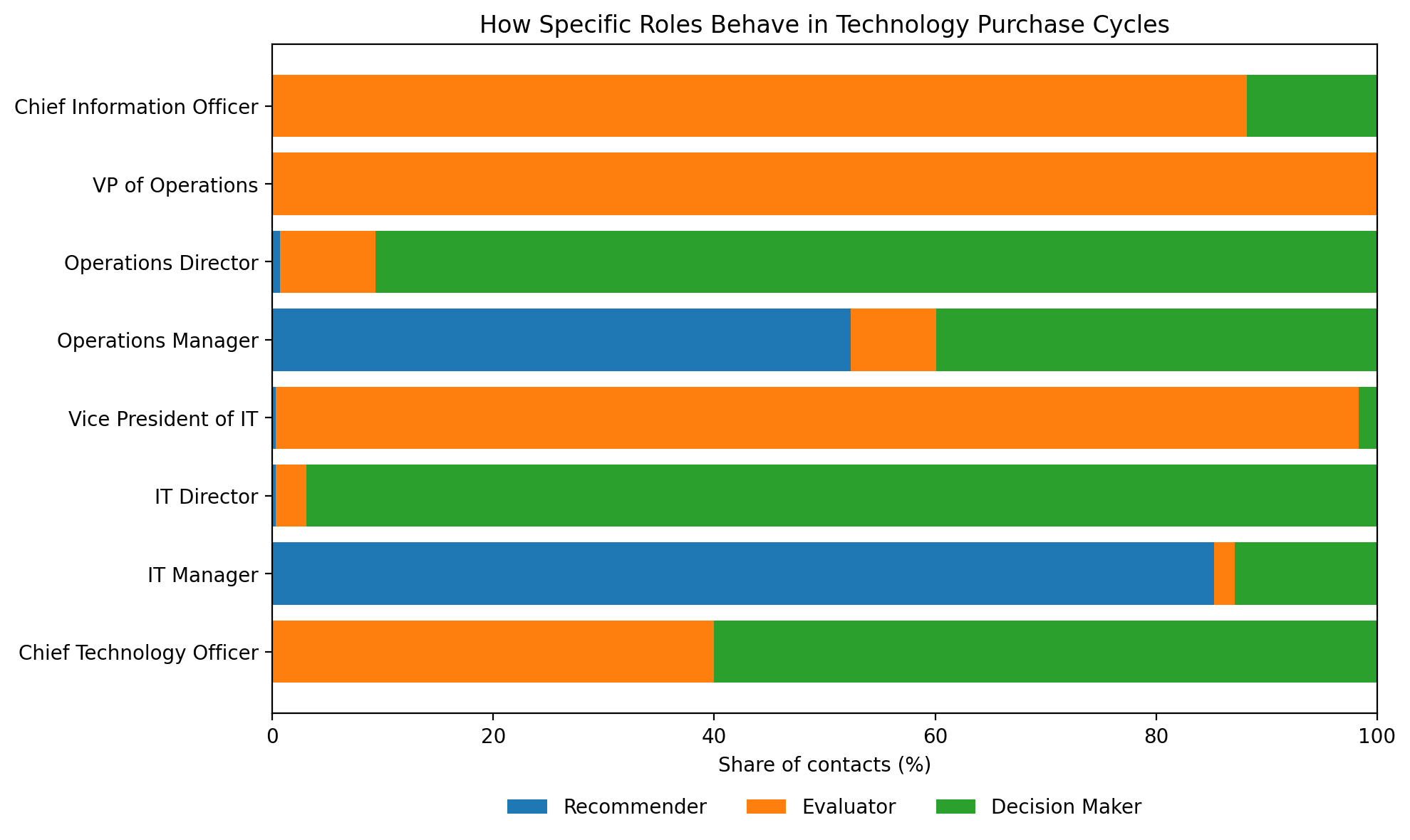
Looking at title families makes the pattern even clearer.
- IT Managers were primarily recommenders.
- IT Directors were overwhelmingly decision makers.
- Vice Presidents of IT were almost entirely evaluators.
- Chief Technology Officers split between evaluation and final decision.
- Chief Information Officers leaned heavily toward evaluation rather than direct purchase ownership.
This is a useful reminder that “senior” does not always mean “the buyer.” Some executive roles appear to validate direction, assess fit, or pressure-test the recommendation rather than formally own the purchase.
Smaller companies show more blended responsibility
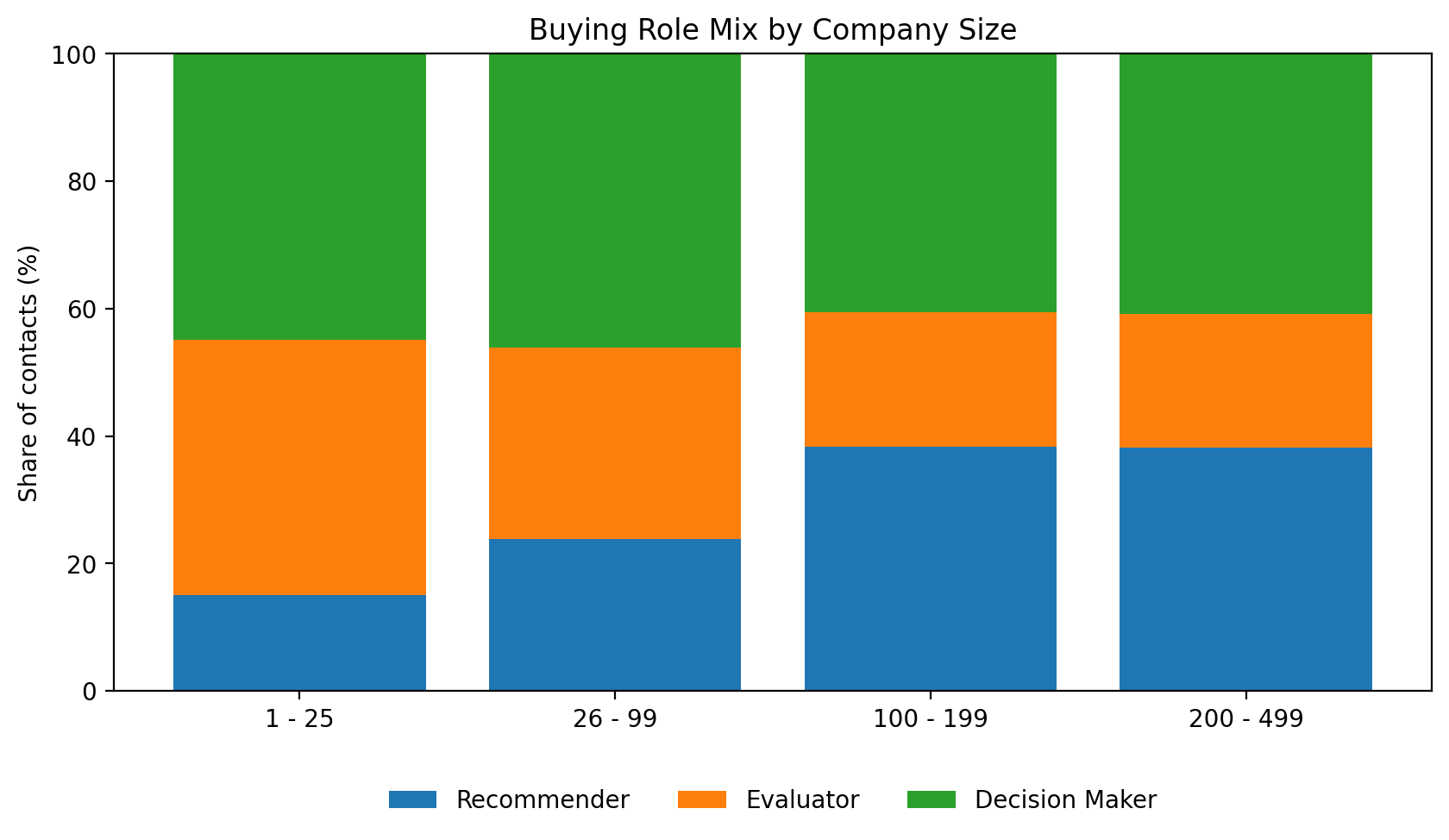
Company size also matters. In smaller organizations, role boundaries are often less specialized. That means one person may evaluate, recommend, and decide, especially when the IT function is lean.
In this dataset, smaller companies still showed meaningful evaluator and decision-maker representation, but recommenders became more prominent as company size increased. That aligns with how buying committees grow: as organizations add layers, more stakeholders participate before a final call is made.
What this means for B2B marketers
The practical lesson is not to target only one title level. It is to build messaging around how each level participates in the buying process.
- Manager-level messaging should help contacts validate the problem, compare options, and build an internal case.
- Director-level messaging should focus on business impact, implementation confidence, and why now.
- VP and C-level messaging should support validation, risk reduction, scalability, and strategic fit.
In other words, if your campaign only speaks to the “decision maker,” you may be missing the people who shape the shortlist long before a decision is made.
Final takeaway
One of the biggest mistakes in B2B marketing is treating buying authority like a fixed attribute. This dataset suggests something more nuanced and more useful: in technology purchases, buying role is often tied to where someone sits in the organization.
Managers are more likely to recommend. Directors are more likely to decide. VPs often evaluate. C-level contacts may weigh in heavily, but are not always the formal owner of the purchase.
For marketers, that means stronger campaigns do not just identify the right account. They identify the right mix of stakeholders and speak to each one differently.
