The Poverty of Stimulus

Contrary to popular belief, few laws are immutable in economics. While physics presents us with maybe 4 laws that explain something like 90% of the observed universe, economics has 90 laws that explain perhaps 3% of observed behavior. The distinction i…

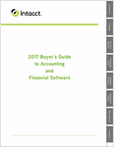
2017 Buyer’s Guide to Accounting and Financial Software

Financial leaders today balance the need to manage an increasing level of business complexity with the need for speed. You’re expected to keep your eye on multiple entities with multiple regulatory frameworks and multiple currencies. Think that’s complicated? Now add frequent change to the equation. A monthly financial check-in isn’t good enough for today’s CFO. You need the agility to make decisions at a moment’s notice—and those decisions must be based on the real-time financial truth.

Here’s the question. In today’s complicated business climate, is your accounting software helping you grow and compete—or holding you back? This guide will help you understand whether it’s time to make a move.

Request Free!

Best Practices for Choosing the Right Accounting Software: Achieving Best-in-Class Financial Management

It starts innocently enough. You need a report your current accounting system can’t deliver, so you create a spreadsheet or hire a vendor to customize the code. A few months down the line, your company tries to capitalize on an opportunity by entering a new market or rolls out a new type of offering. Before long, you find that you are hiring consultants to build reports, add custom fields, and integrate new modules – and your staff is spending hours creating and updating spreadsheets that are out of date moments after they’re created.

This happens over a long period so most organizations do not even realize how much time and money they are spending on extra modules, expert customization, and “spreadware.” And once support and maintenance are factored in, they are accumulating excess time and costs that would have been better spent adding strategic value to the business.

If this scenario sounds familiar, then your accounting software is holding you back and you should check out this guide.

Request Free!

The 5 Questions To Ask Your Controller

As the office of the controller becomes ever more strategic—creating higher levels of financial visibility to help drive growth and profitability—the financial organization’s relationship to the controller role must evolve as well. Specifically: Today’s CFO needs to work closely with the controller to ensure that, one, the organization gets the full benefit of the controller’s talents and knowledge and, two, the controller’s office is operating at the highest levels of efficiency and accuracy.

Follow the link below to read about the five questions to ask your controller to initiate a conversation around best practices.

Request Free!