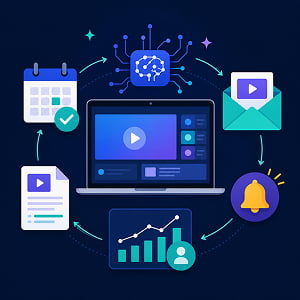
Webinars and virtual events are among the highest-effort, highest-reward channels in marketing. A single event requires topic research, speaker coordination, landing pages, email sequences, social promotion, reminder campaigns, live production, and post-event follow-up. Using AI to plan and promote webinars means applying artificial intelligence to each of those stages (i.e. analyzing audience data to pick topics that will draw registrations, generating and personalizing promotional content at scale, optimizing send times and reminder sequences to improve attendance, and turning a single live event into weeks of repurposed content). The goal isn’t to hand your event program over to a machine, it’s to remove the repetitive production work so that your team can focus on the parts that actually require human judgment, like the ideas, the speeches, and the audience relationships.
In this article we’ll discuss where AI fits into each phase of the webinar lifecycle, from planning and topic selection through promotion, attendance optimization, and post-event follow-up. We’ll look at what the latest benchmark data says about webinar performance, which tasks AI handles well (and which it doesn’t), and how to build a repeatable AI-assisted workflow without letting your events start to feel generic. We’ll also cover the guardrails that keep your AI-assisted event marketing on-brand and honest.
TL;DR Snapshot
Webinars remain one of the most reliable pipeline generators in B2B and B2C marketing alike, but they’re also one of the most labor-intensive. This article walks through a practical, stage-by-stage framework for using AI across the full webinar lifecycle, and multiplying the value of every event through AI-powered repurposing. Along the way, it grounds each recommendation in current benchmark data so that you can measure your own program against real-world numbers.
Key takeaways include…
- AI delivers the most value in webinar marketing when it’s applied across the whole lifecycle (planning, promotion, attendance, and follow-up), not just used to write a few invitation emails.
- Roughly half of registrants never show up to the average webinar, and AI-assisted segmentation, personalization, and reminder timing are some of the most effective levers for closing that gap.
- Every AI output still needs human review. Your speakers, point of view, and brand voice are what make an event worth attending, AI just gets the production work out of the way.
Who should read this: Marketers, demand gen and event managers, founders, solopreneurs, and AI enthusiasts who run (or want to run) webinars and virtual events.
Why Webinars Are a Perfect Fit for AI Assistance
Webinars aren’t going anywhere. According to Wave Connect’s webinar statistics roundup, 87% of businesses now use them as part of their core marketing strategy. The problem has never been about whether webinars work, but rather about how much work they require. Livestorm’s Webinar Marketing Report found that 42% of marketers name time and resource constraints as their single biggest webinar challenge.
That’s exactly the kind of problem AI is good at solving. A webinar program is a long chain of repeatable production tasks (titles, outlines, landing page copy, email sequences, social posts, follow-ups, recaps) wrapped around a small core of genuinely creative work. Event teams have noticed. A Bizzabo survey cited in Lensmor’s guide to AI event planning tools found that 95% of event teams expect to increase their AI usage in 2026, and the same guide notes that roughly half of meeting planners worldwide had already incorporated AI into their workflows in 2025.
The benchmark data suggests the investment pays off. Takeaways from On24’s Digital Engagement Benchmarks Report found that businesses using AI for promotion, content creation, and nurture flows achieved better engagement and participation, alongside record platform-wide numbers: an average registrant-to-attendee conversion rate of 60%, and average engagement time of 49 minutes per attendee.
Planning: Let AI Do the Research, You Make the Call
The most expensive webinar mistake is picking a topic nobody is realistically interested in. AI can dramatically de-risk that decision…
Mine your existing data for topics: Feed an AI assistant your support tickets, sales call notes, blog search queries, and past webinar Q&A transcripts, then ask it to surface the questions your audience keeps asking that your content hasn’t already addressed. Recurring unanswered questions are webinar topics with built-in demand.
Generate and stress-test titles and outlines: Once you have a topic, AI is excellent at producing variations. Platforms are increasingly building this in natively. Livestorm’s AI webinar features, for example, include a title generator that suggests titles and outlines based on a topic description, tone of voice, and audience knowledge level. Whether you use a built-in feature or a general-purpose assistant, generate ten title options, then test the strongest two or three with a small paid or organic audience before committing.
Build the run of show: AI can draft a full event agenda with timing blocks, transition notes, poll placements, and Q&A windows from a simple outline. This is pure production work, and it’s a great first task to delegate.
Pick the date and time with data, not habit: Timing genuinely moves the needle. Teleprompter’s webinar statistics roundup cites an analysis finding that Wednesday webinars achieve about 48% attendance, higher than any other day of the week. Ask AI to analyze your own registration and attendance history by day and time before you default to whatever slot you used last quarter.
Promotion: Personalization at Scale, Not Spray and Pray
Most webinar promotion fails because it treats the entire email list as one audience. AI’s biggest promotional advantage is making genuine segmentation practical for small teams.
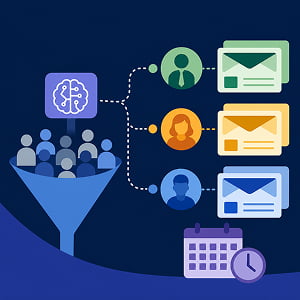
Segment first, then generate: Instead of one invitation blast, have AI score your list for relevance to this specific topic and group contacts by role, industry, or past engagement. Then generate a distinct invitation angle for each segment. A VP of Sales and a marketing coordinator should not receive the same pitch for the same event. This matters more than it might seem, ON24’s benchmark analysis found that personalization boosts performance from registration rates through to conversion outcomes, and Goldcast’s B2B Webinar Benchmark Report attributed rising attendance in part to companies getting better at using audience data to send more targeted invitations.
Draft the full campaign in one sitting: Give your AI assistant the topic, speakers, audience segments, and event details, then ask for the complete promotional kit: landing page copy, a three-to-five email invitation sequence, social posts for each channel, a speaker promotion kit they can share with their own networks, and paid ad variations. You’ll edit all of it of course, but you’ll edit in hours instead of drafting for days.
Keep promoting until the event starts: Teleprompter’s statistics roundup notes that nearly 59% of webinar sign-ups occur within the week before the event, and 29% of people register on the day of the webinar itself. Late promotion isn’t desperate, it’s where a huge share of your registrations actually come from. AI-scheduled last-week and day-of pushes are low-effort and high-return.
Attendance: Using AI to Fight the No-Show Problem
Registration is only half the battle. Livestorm’s Webinar Benchmark Report, based on 33,786 webinar sessions, found an average show-up rate of just 47.7%, meaning the typical webinar loses more than half its registrants before the event begins. Goldcast’s B2B benchmark data is even more sobering for B2B specifically, showing a 33% average attendance rate (though that’s up from 29% in their prior report at least).
AI helps close this gap in three ways…
- Smarter reminder sequences: Move beyond the generic “starting in one hour” email. Use AI to generate reminder content that resells the event (e.g. a teaser insight from the speaker, one specific question the session will answer, or a preview slide). Vary the message across the sequence so registrants aren’t deleting the same email three times.
- Behavior-based timing and channel selection: AI can analyze when each registrant actually opens email and schedule reminders accordingly, and it can flag high-value registrants who warrant an extra touch, like a personal note from the host or a calendar hold.
- A first-class on-demand plan: Many registrants sign up intending to watch later, so treat no-shows as an on-demand audience rather than a loss. Have AI generate a distinct post-event sequence for non-attendees with a recording link, a chaptered summary, and timestamps for the sections most relevant to their segment.
After the Event: One Webinar, a Month of Content
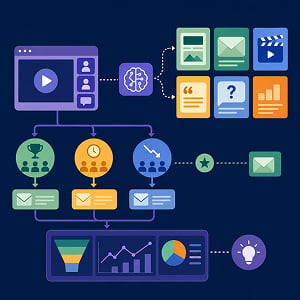
The webinar recording is one of the most underused assets in marketing, and repurposing it is arguably AI’s strongest single use case in the event lifecycle. From one transcript, AI can produce a blog post recap, an email nurture sequence, short social clips with captions, quote graphics, a follow-up FAQ based on audience questions, and sales enablement notes summarizing what prospects asked about.
Follow-up also deserves segmentation. Attendees who stayed for the full session and asked questions should get a different email than someone who dropped off after ten minutes. AI can read your platform’s engagement data, group attendees by behavior, and draft an appropriate follow-up for each group, including flagging the hottest prospects for a direct sales touch instead of another automated email.
Finally, close the loop on measurement. Ask AI to compare this event’s funnel (i.e. registrations, show-up rate, engagement time, post-event conversions, etc.) against your own history and the public benchmarks cited above, and to suggest one variable to change next time. This practice turns every webinar into an experiment that makes the next one better.
Guardrails: What Not to Hand Over
You’ll want to implement a few important boundaries to keep your AI-assisted event marketing from backfiring. Review every output before it ships, because AI drafts confidently and is sometimes confidently wrong about your product, your speakers, or your data. Keep a human voice in the actual event. Audiences show up for people and a point of view, not for content they could have generated themselves with ChatGPT. Feed AI your brand voice guidelines and past top-performing copy so the output starts closer to your standard. And be transparent where it matters. If AI plays a visible role in the attendee experience, such as an AI-generated summary or AI-powered Q&A, label it as such.
Frequently Asked Questions
Show-up rate (also called attendance rate) is the percentage of people who registered for a webinar and actually attended it live. It’s calculated by dividing attendees by registrants and multiplying by 100. Benchmarks vary by source and audience. Livestorm’s benchmark data puts the average at 47.7%, while Goldcast’s B2B-focused report found a 33% average.
Livestorm is a browser-based webinar and video engagement platform. It publishes an annual webinar benchmark report based on sessions run on its platform, and offers built-in AI features such as title and outline generation.
ON24 is an enterprise webinar and digital engagement platform used heavily in B2B marketing. It publishes annual benchmark reports analyzing webinar performance data from events run on its platform.
Goldcast is a B2B events and webinar platform known for AI-powered content repurposing features. It publishes an annual B2B webinar benchmark report based on events hosted on its platform.
Wave Connect is a digital business card and lead capture platform used by professionals and teams to share contact information via QR codes and NFC cards. Its blog publishes a quarterly webinar statistics report.
Lensmor is a B2B event intelligence tool focused on trade shows. It helps event teams identify and score exhibitors and attendees against their ideal customer profile for pre-show targeting. They published a guide on using AI event planning tools, which includes AI adoption statistics among event teams.
Teleprompter is a teleprompting app for presenters and video creators. Its blog publishes webinar statistics roundups, which include data on registration timing and best-performing webinar days.
Repurposing means converting a finished webinar into other content formats, such as blog posts, short social video clips, email sequences, quote graphics, etc. It extends the value of a single live event across weeks of marketing and reaches people who never attended.
No. Purpose-built platforms bundle these features in conveniently, but you can run most of this workflow with a general-purpose AI assistant plus the tools you already have (e.g. your email platform, your CRM, and your existing webinar software). Start with one stage of the lifecycle, prove the time savings, and expand from there.
Other AI Training Modules You May Be Interested In
How to Avoid AI Content Homogenization
The Right Way to Run an AI Tool Pilot Before Committing Budget
The Right Way to Think About Brand Presence in AI Training Data
Using AI to Build Predictive Lifetime Value Models That Shape Acquisition Strategy
