
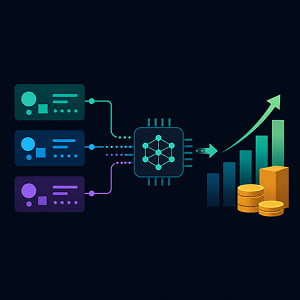
Predictive customer lifetime value (CLV) is a data-driven approach that uses artificial intelligence and machine learning to estimate the total revenue a customer will generate over the course of their relationship with your business. Unlike traditional CLV formulas that rely on historical averages and static calculations, predictive CLV models analyze thousands of behavioral signals, including purchase frequency, engagement patterns, browsing behavior, and support interactions, to forecast each customer’s future value in real time. According to a Future Market Insights report published in April 2026, the global CLV and churn prediction AI market was valued at $1.62 billion in 2025 and is projected to reach $10.74 billion by 2036, growing at a 19% compound annual growth rate. That kind of growth tells you one thing clearly, businesses are betting heavily on this technology, and for good reason.
In this article, we’ll discuss why predictive CLV matters more now than ever, how AI-powered models outperform the old-school formulas most marketers still rely on, and the specific ways you can use these predictions to make smarter acquisition decisions. We’ll also cover the practical tools that make predictive CLV accessible to marketing teams without requiring a dedicated data science department, and we’ll walk through real-world examples of companies that have used this approach to dramatically reduce acquisition costs while growing customer value. Whether you’re trying to justify your ad spend, figure out which channels attract your most valuable customers, or simply stop wasting budget on prospects who’ll never stick around, predictive CLV gives you a framework for making those calls with confidence.
TL;DR Snapshot
Predictive customer lifetime value modeling uses AI to forecast how much revenue each customer will generate over time, then feeds those predictions directly into your acquisition strategy. Instead of treating every lead or prospect the same, you can allocate budget toward the channels, campaigns, and audiences that consistently attract high-value customers, while pulling back spend on sources that deliver low-value, high-churn buyers. The result is a more efficient growth engine where acquisition costs go down and long-term revenue goes up.
Key takeaways include…
- AI-powered CLV models outperform traditional historical calculations by 25-40% in prediction accuracy according to e-commerce CLV research compiled by Envive, which means you’re making decisions based on much sharper data.
- Your CLV predictions can directly inform how much you’re willing to spend to acquire a customer on each channel, helping you maintain a healthy CLV-to-CAC ratio of 3:1 or better.
- You don’t need a data science team to get started. Platforms like Klaviyo, Optimove, and Salesforce Einstein now offer built-in predictive CLV features that work out of the box for marketing teams.
Who should read this: Marketers, e-commerce operators, growth strategists, and business owners who want to spend smarter on acquisition.
Why Traditional CLV Falls Short, and What AI Does Differently
Most marketers who calculate CLV at all are using some version of the classic formula: average purchase value multiplied by purchase frequency, multiplied by average customer lifespan. It’s simple, but that’s exactly the problem. This formula treats every customer in a segment the same way, ignores behavioral nuance, and can only look backward. It tells you what happened, not what’s about to happen.
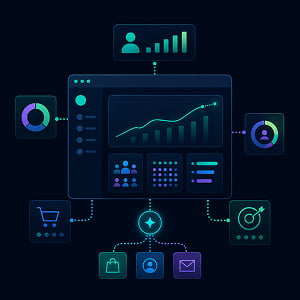
AI-powered predictive CLV models work fundamentally differently. Machine learning algorithms like random forests, gradient boosting, and neural networks analyze patterns across a massive range of customer data points, including purchase history, browsing behavior, email engagement, support ticket frequency, product category preferences, and even seasonal buying patterns. As AI predictive analytics guide from Digital Applied notes, companies using AI-powered CLV models see a 20-35% increase in customer lifetime value because they can allocate retention spending proportionally to each customer’s predicted value, rather than using simple recency-frequency-monetary (RFM) buckets that treat customers in broad, undifferentiated groups.
The key advantage is adaptability. Traditional formulas are snapshots. AI models are living systems that retrain on your latest data regularly, so your predictions stay current as customer behavior evolves. If a product launch, price change, or market shift alters how your customers act, the model adjusts accordingly. Your old spreadsheet formula doesn’t.
There’s also the matter of churn prediction, which is really CLV’s other half. An IEEE research study found that AI-based predictive CLV systems can improve client segmentation accuracy to 92% and raise revenue projections by 35%. When you know which customers are trending toward disengagement months before they actually leave, you can intervene early and protect their lifetime value, something no backward-looking formula can do.
Using CLV Predictions to Make Smarter Acquisition Decisions
Here’s where predictive CLV gets really practical for marketers, it changes how you think about acquisition spending at a fundamental level.
The standard approach to customer acquisition is to look at your cost per acquisition (CPA) across channels and try to drive it down. But CPA alone doesn’t tell you whether you’re acquiring good customers or bad ones. A Facebook campaign might deliver $15 CPAs while Google Search delivers $45 CPAs. But if the Facebook customers churn after one purchase and the Google customers stick around for two years, the “expensive” channel is actually the better investment.
Predictive CLV lets you see this clearly. When you know the predicted lifetime value of customers acquired from each channel, campaign, or audience segment, you can calculate your CLV-to-CAC ratio per channel and allocate budget appropriately. According to Harvard Business Review, acquiring a new customer costs anywhere from 5 to 25 times more than retaining an existing one. That makes it critical to ensure you’re acquiring customers who will actually stay. A CLV-to-CAC ratio guide from Admetrics notes that a healthy ratio typically falls between 3:1 and 5:1, meaning you should aim to generate three to five times more revenue from a customer than what it cost to acquire them. If a channel is delivering a 1.5:1 ratio, you know to either fix your targeting on that channel or reallocate the budget elsewhere.
Turkish retail company Boyner provides a compelling real-world example. According to a case study analyzed by Growth-onomics, Boyner used predictive analytics to identify patterns among their highest-value customers and then applied those insights to prioritize new prospects that matched similar profiles. The results were striking: a 240% increase in new customers, 310% growth in CLV, and a 20% reduction in acquisition costs. They achieved this by aligning marketing budgets with high-value customer profiles across marketing, sales, and customer success teams, ensuring that every department worked toward the same goal.
The lesson here is straightforward, predictive CLV turns acquisition from a volume game into a value game. You stop asking “how many customers can we get?” and start asking “how many of the right customers can we get?”
The Tools That Make Predictive CLV Accessible
One of the biggest misconceptions about predictive CLV modeling is that you need a team of data scientists and custom machine learning infrastructure to make it work. That may have been true five years ago, but the landscape has shifted dramatically. According to a MoEngage comparison of AI segmentation tools, several major marketing platforms now include predictive CLV capabilities built right into the product.
Klaviyo, for instance, automatically builds a CLV model using your company’s data and retrains it at least once a week. It provides predicted CLV, churn risk scores, expected next order dates, and spending tier classifications that you can use directly in segmentation and automated flows, with no configuration or data science work required. For e-commerce brands on Shopify or BigCommerce, the data syncs automatically. A Rackwave comparison of Klaviyo and Salesforce Marketing Cloud confirmed that in 2026, Klaviyo’s predictive analytics are directly tied to e-commerce revenue outcomes and are immediately usable in segmentation and flow logic.
Salesforce Einstein covers purchase likelihood and engagement scoring with deep CRM context, making it a strong choice for B2B companies and larger organizations with complex sales cycles. Optimove is particularly well-suited for subscription businesses and direct-to-consumer brands, offering CLV forecasting combined with cross-channel campaign orchestration specifically designed for retention-first strategies. Google Analytics 4 also contributes a useful predictive layer with purchase probability and churn probability metrics tied to audience building, though it’s often best used alongside a more robust platform for full CLV forecasting.
The practical takeaway is that you likely already have access to a platform that can deliver predictive CLV insights. The bottleneck isn’t the technology anymore, it’s whether your team is actually using these predictions to inform how and where you spend your acquisition budget.
Building Feedback Loops That Keep Getting Smarter
Deploying a predictive CLV model isn’t a one-and-done project, the companies that get the most out of this approach are the ones that build ongoing feedback loops between their predictions and their results.
Start by setting clear thresholds for action based on your CLV predictions. A practical framework from Growth-onomics suggests creating tiered action plans: customers with a CLV above $10,000 and retention rates of 80% or more could be enrolled in VIP loyalty programs, those with a CLV above $5,000 but moderate retention rates might receive targeted retention offers, and high-churn-risk customers could be prioritized for win-back campaigns. The exact thresholds will depend on your business, but the principle is the same. Different predicted values should trigger different responses.
Then, compare your predictions against actual outcomes on a regular basis. If your model predicts that customers from email marketing will have 40% higher CLV than those from paid social, track whether that holds true over the next 6 to 12 months. These comparisons don’t just validate the model, they actively improve it. As a predictive modeling guide from Influencers Time recommends, you should update your CLV scores at the cadence of the decisions they inform. If your marketing team optimizes campaigns weekly, your CLV updates should also refresh weekly.
The feedback loop also helps you catch problems early. If your model’s predictions start diverging from reality, it’s usually a signal that something has changed in your market, your product, or your customer base, and that’s valuable information in its own right. Maybe a competitor launched a similar product and your retention assumptions no longer hold. Maybe a pricing change altered purchase frequency. The model won’t just tell you what’s happening, it’ll flag that something has shifted so you can investigate and respond.
Over time, this creates a compounding advantage. Each cycle of prediction, measurement, and refinement makes your model more accurate and your acquisition strategy more efficient. Companies that operate this way don’t just react to their data, they anticipate where their best customers will come from next and invest accordingly.
Frequently Asked Questions
Customer lifetime value is a metric that estimates the total revenue a business can expect from a single customer over the entire duration of their relationship. It helps businesses understand how much a customer is worth beyond their first purchase, factoring in repeat purchases, average order value, and how long they typically remain a customer. CLV is a foundational metric for making informed decisions about how much to invest in acquiring and retaining customers.
Customer acquisition cost is the total amount a business spends on marketing and sales efforts to acquire one new customer over a given period. It’s calculated by dividing your total marketing and sales expenses (including ad spend, salaries, software, agency fees, and creative production costs) by the number of new customers acquired during that same period. For example, if you spent $50,000 on marketing in a quarter and acquired 1,000 new customers, your CAC would be $50. Tracking CAC by channel helps you understand which acquisition sources are most cost-efficient, and comparing it against CLV tells you whether your growth strategy is sustainable.
The CLV-to-CAC ratio compares the lifetime value of a customer to the cost of acquiring that customer. It’s calculated by dividing CLV by CAC. A ratio of 3:1 is generally considered healthy, meaning you earn $3 in lifetime value for every $1 spent on acquisition. A ratio below 3:1 may indicate that you’re spending too much to acquire customers relative to what they’re worth, while a ratio above 5:1 could mean you’re under-investing in growth.
Predictive analytics is a branch of data analysis that uses statistical techniques and machine learning algorithms to forecast future outcomes based on historical data. In the context of marketing, predictive analytics can estimate which customers are likely to purchase again, which are at risk of churning, and how much revenue a customer will generate over time. It moves beyond describing what happened in the past to projecting what’s likely to happen next.
Random forests and gradient boosting are both machine learning algorithms commonly used in predictive CLV models. Random forests work by building many decision trees on random subsets of your data and averaging their predictions to improve accuracy. Gradient boosting builds decision trees sequentially, with each new tree correcting the errors of the previous ones. Both are well-suited to handling the kind of complex, multi-variable customer data that CLV prediction requires.
Klaviyo is an e-commerce marketing automation platform that provides email and SMS marketing tools with built-in predictive analytics. It’s especially popular among Shopify and BigCommerce merchants. Klaviyo’s predictive features include predicted CLV, churn risk scoring, expected next order dates, and spending tier classifications, all of which can be used to build automated marketing flows and audience segments without needing a data science team.
Salesforce Einstein is the AI layer built into the Salesforce CRM platform. It provides predictive capabilities including purchase likelihood scoring, engagement analysis, and CLV estimation, all using data already stored within Salesforce. It’s particularly useful for B2B companies and enterprise organizations that need deep CRM context integrated into their predictive models.
Optimove is a customer-led marketing platform that specializes in CLV forecasting and cross-channel campaign orchestration. It’s designed for retention-first strategies and is frequently used by subscription businesses and direct-to-consumer brands. Optimove uses predictive models to help marketers identify at-risk customers, segment audiences by predicted value, and automate personalized retention campaigns across multiple channels.
Google Analytics 4 (GA4) is Google’s current web and app analytics platform, which replaced Universal Analytics in 2023. Beyond standard traffic and conversion reporting, GA4 includes a predictive layer that calculates metrics like purchase probability and churn probability. These predictions can be used to build audiences for Google Ads campaigns, helping marketers target users based on their predicted behavior. While GA4’s predictive features are useful for audience building and attribution, most businesses pair it with a more robust CDP or marketing platform for full-scale CLV forecasting.
Other AI Training Modules You May Be Interested In
The Right Way to Use AI for Internal Marketing
The Right Way to Use AI for Seasonal and Moment Marketing
Using AI to Optimize for Voice Search and Conversational Commerce
Using AI to Identify and Evaluate Co-Marketing and Partnership Opportunities
