A win-back campaign is a targeted marketing effort designed to re-engage customers who’ve stopped buying, cancelled a subscription, or gone silent. Unlike broad retention strategies that try to keep everyone engaged, win-back campaigns zero in on people who’ve already churned or are well on their way out. Re-engagement campaigns are closely related, but they focus more specifically on subscribers or users who haven’t interacted with your brand’s communications recently, even if they haven’t fully churned yet. Both campaign types share a common goal: reignite a dormant relationship with someone who already knows your brand, your product, and your value proposition. When powered by AI, these campaigns move from blunt, one-size-fits-all “we miss you” emails to highly personalized, precisely timed outreach that addresses the specific reasons each customer disengaged in the first place.
In this article, we’ll discuss how AI transforms win-back and re-engagement campaigns from guesswork into a data-driven discipline. We’ll cover how predictive models identify which lapsed customers are actually worth pursuing, how AI personalizes messaging and timing at the individual level, and how to build a multi-channel win-back system that runs largely on autopilot. We’ll also walk through real-world examples, highlight the tools that make this possible, and address the common mistakes that cause most win-back efforts to fall flat.
TL;DR Snapshot
Win-back and re-engagement campaigns target customers who’ve gone quiet or churned entirely, and AI makes these campaigns dramatically more effective by predicting who’s likely to come back, personalizing the outreach they receive, and optimizing the timing and channel of every message. Rather than blasting your entire lapsed list with a generic discount code, AI lets you treat each dormant customer as an individual, with a tailored reason to return.
Key takeaways include…
- AI-powered churn prediction models can identify at-risk customers before they fully disengage, giving you a window to intervene with personalized outreach rather than reacting after they’re already gone.
- Personalization driven by AI goes far beyond inserting a first name. It includes dynamically selecting the right product recommendations, the right incentive, the right channel, and the right send time for each individual customer.
- A well-structured AI win-back system doesn’t just recover lost revenue. It also cleans your list, protects your sender reputation, and generates insights about why customers leave in the first place, feeding improvements back into your broader marketing strategy.
Who should read this: Email marketers, CRM managers, lifecycle marketers, retention specialists, and e-commerce operators looking to recover revenue from lapsed customers.
Why Win-Back Campaigns Deserve More Attention (and More AI)
Most marketing teams pour the bulk of their energy and budget into acquisition. It makes sense on the surface, new customers feel like growth. But the economics tell a different story. According to an analysis by Churnkey, acquiring a new customer costs anywhere from 5 to 25 times more than retaining an existing one, depending on your industry and business model. A report from Artisan Strategies found that customer acquisition costs have surged by 222% over the past several years, yet 44% of businesses still prioritize acquisition over retention. Meanwhile, the probability of selling to an existing customer sits between 60-70%, compared to just 5-20% for a new prospect.
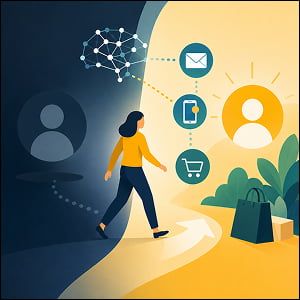
This is where win-back campaigns come in. Your lapsed customers already know who you are. They’ve already navigated your on boarding, experienced your product, and made at least one purchase. The friction involved in getting them to come back is dramatically lower than the friction of converting a stranger. The problem is that traditional win-back campaigns are crude. They typically involve segmenting everyone who hasn’t purchased in 90 days, sending a generic email with a discount code, and suppressing whoever doesn’t respond. That approach ignores the massive differences between individual customers (e.g. why they left, what they valued, when they’re most likely to open an email, and whether or not a discount is even the right incentive to convince them to return).
AI changes this equation. Machine learning models can analyze behavioral signals, purchase history, engagement patterns, and dozens of other variables to predict which lapsed customers are most likely to respond, what kind of message will resonate, and when to send it. Instead of treating your churned list as a monolith, AI lets you treat each person as an individual, which is exactly what win-back campaigns need to actually work.
Building the AI-Powered Win-Back Engine
A successful AI-driven win-back campaign isn’t a single email, it’s a system with several interconnected components, each enhanced by machine learning and automation. Here’s what that system should entail…
Step 1: Predict Who’s Worth Pursuing
Not every lapsed customer is equally likely to come back, and not every lapsed customer is equally valuable if they do. The first job of AI in a win-back campaign is to score your dormant customers on two dimensions: their likelihood of reactivation and their predicted lifetime value if reactivated.
Churn prediction models, typically built with supervised machine learning, analyze historical data to identify patterns that precede disengagement. These models look at signals like declining purchase frequency, reduced email engagement, fewer site visits, support ticket history, and changes in browsing behavior. The output is a score for each customer that estimates how likely they are to churn (or, for those who’ve already churned, how likely they are to come back with the right nudge).
Pecan AI, for example, builds predictive models that rank lapsed customers by their probability of returning. Instead of guessing or sending to everyone, your team gets a prioritized list: here are the 500 customers with the highest win-back probability, and here’s what’s most likely to bring them back. This kind of prioritization means you’re spending effort and budget where it’ll actually move the needle, rather than chasing customers who left for good.
Uplift modeling takes this a step further. Rather than just predicting who will come back, uplift models predict who will come back because of your outreach, as opposed to customers who would have returned on their own regardless. This distinction matters because it helps you avoid wasting resources on people who don’t need a nudge and avoid over-discounting customers who were coming back anyway.
Step 2: Personalize the Message, the Offer, and the Channel
Once you know who to target, AI tackles the question of what to say and how to say it. This is where the gap between AI-driven campaigns and traditional campaigns becomes most obvious.
Traditional win-back emails tend to follow a template: a “we miss you” subject line, a generic reminder of the brand, and a blanket discount. AI-powered campaigns, by contrast, can dynamically assemble every element of the message based on what the model knows about each individual customer.
Consider subject lines. AI can generate and test dozens of variations, learning which styles perform best for different customer segments. According to Blueshift’s survey of over 290 U.S marketing leaders, 92% of marketers have successfully re-engaged lapsed customers using targeted cross-channel campaigns, and 89% report that AI-powered content and product recommendations lead to more repeat purchases. The key isn’t just personalization for its own sake. It’s that AI can match the right type of personalization to each individual customer.
Product recommendations are another area where AI shines. Instead of showing a lapsed customer whatever’s on sale this week, recommendation engines analyze their purchase history, browsing behavior, and the behavior of similar customers to surface the products most likely to pull them back. Incentive selection is equally important. AI can determine whether a specific customer is more likely to respond to a percentage discount, free shipping, early access to a new product, or no incentive at all. This prevents the common trap of training customers to disengage deliberately just to receive a discount, something that Mailflow Authority identifies as one of the biggest mistakes in re-engagement campaigns.
Channel optimization is the final piece. Some customers are email-first. Others respond better to SMS, push notifications, or re-targeting ads on social media. AI models can analyze each customer’s historical engagement patterns across channels and route the win-back message to whichever channel has the highest probability of generating a response.
Step 3: Optimize Timing at the Individual Level
When you send a win-back message matters just as much as what it contains. Traditional campaigns pick a single “best” send time, like Tuesday at 10am, and blast the entire segment at once. AI takes a fundamentally different approach.
Send-time optimization analyzes each customer’s historical engagement patterns to predict when they’re most likely to open, read, and act on a message. One customer might consistently engage during their morning commute. Another checks email during lunch. A third only opens marketing messages on weekends. Tools like Seventh Sense and the send-time optimization features built into platforms like Bloomreach and Braze can deliver each customer’s win-back message at their individually optimal time.
This matters even more for win-back campaigns than for regular marketing sends, because you’re fighting for attention from people who are already disengaged. As Mailflow Authority points out, hitting their inbox when they’re most likely to check email meaningfully increases your chances of breaking through.
The timing question extends beyond individual send times to campaign cadence. How many touchpoints should a win-back sequence include? How far apart should they be spaced? AI can optimize this as well, testing different cadences across customer segments and learning which sequence length and spacing produces the best results without crossing the line into annoyance.
Real-World Win-Back Campaigns Powered by AI
Theory is useful, but results are more convincing. Several brands have already demonstrated what’s possible when AI drives win-back and re-engagement efforts.
Bloomreach partnered with Voyo Croatia, a European video-on-demand service, to build an AI-powered win-back campaign targeting customers who cancelled their subscriptions. Rather than sending a generic “come back” message, their system triggered a personalized cancellation flow. Upon cancellation, each customer received content recommendations drawn from their favorite genres. If they didn’t reactivate, a follow-up featured the top 10 most-watched titles in their preferred category. This personalized approach achieved a 38% open rate and a 2.53% click-through rate, contributing to a 500% return on investment within the first six months.
Hightouch highlights how Blue Apron uses AI-driven seasonal relevance in its win-back campaigns, with messages like “Join us again for sweater weather eats” that connect a customer’s past preferences to timely, contextual hooks. These sorts of campaigns give the customer a specific, timely reason to return by showing how the menu has evolved since their last order.
Netflix, while famously private about its internal data, is widely recognized for running robust win-back programs that prioritize content relevance over discounts. As Hightouch notes, Netflix’s win-back emails are timed for peak engagement hours and focus on showcasing fresh, relevant content rather than relying on price incentives. This approach underscores an important principle, the best win-back campaigns lead with value, not desperation.
Protecting Your Sender Reputation While Winning Customers Back
One aspect of win-back campaigns that doesn’t get enough attention is deliverability risk. By definition, you’re emailing people who have demonstrated that they aren’t particularly interested in hearing from you right now. If you do this carelessly, you can damage your sender reputation, which hurts deliverability for your entire email program, not just your win-back campaigns.
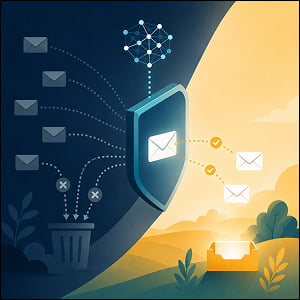
AI helps manage this risk in several ways. First, predictive models can identify which lapsed customers are most likely to engage, letting you avoid sending to people who are almost certainly never coming back. Mailflow Authority recommends a hard rule, never attempt to re-engage subscribers who’ve been inactive for more than 180 days, because the risk of spam traps and complaints outweighs the benefit of any potential recovery. They also recommend keeping complaint rates below 0.15% for re-engagement campaigns, tightening targeting criteria if the first batch exceeds that threshold.
Second, AI-powered suppression logic ensures that once a customer interacts with a win-back message (or redeems an offer), they’re immediately removed from the win-back sequence and transitioned back into regular communications. This prevents message fatigue and the very awkward experience of receiving a win-back email after they’ve already returned.
Third, and perhaps counterintuitively, a good win-back campaign should suppress most of the people it targets. The goal isn’t just to recover customers. It’s also to clean your list by identifying and removing contacts who are truly gone.
Getting Started Without Overcomplicating It
If you’re new to AI-powered win-back campaigns, you don’t need to build a custom machine learning pipeline from scratch, many modern marketing platforms have AI-driven win-back capabilities built in.
Platforms like Bloomreach, Blueshift, and Braze offer built-in AI features for predictive segmentation, send-time optimization, and dynamic personalization. Klaviyo, popular among e-commerce brands, provides AI-driven segments and predictive analytics that can identify lapsed customers with high reactivation potential. For more advanced predictive modeling, tools like Pecan AI specialize in building custom win-back models using your existing customer data.
You can also use a general-purpose AI assistant like Claude or ChatGPT to help at several stages of the process. Use it to analyze your churn data and identify patterns. Use it to draft and iterate on win-back email copy. Use it to brainstorm incentive structures or to build segmentation logic. You don’t need a dedicated data science team to get started, you just need clean customer data, a clear definition of what “lapsed” means for your business, and a willingness to test and iterate.
Start with one high-impact flow. For most businesses, that’s a simple three-to-four email win-back sequence triggered when a customer crosses your inactivity threshold. Use AI to personalize the product recommendations, optimize the send time, and test different subject lines. Measure the results, then expand from there.
The most important thing is to resist the temptation to over-discount. Lead with value. Remind customers what they loved about your product. Show them what’s new or what’s changed. Use AI to surface the specific products or content most relevant to each individual, and save the discount for the final touchpoint (if you use one at all).
Frequently Asked Questions
A win-back campaign is a targeted marketing effort designed to re-engage customers who’ve stopped purchasing, cancelled a subscription, or otherwise gone inactive. It typically involves a sequence of personalized messages, often via email but sometimes across multiple channels, intended to remind lapsed customers of a brand’s value and motivate them to return.
A re-engagement campaign is a targeted marketing effort focused on subscribers or users who’ve stopped interacting with a brand’s communications, even if they haven’t fully churned as customers. The goal is to recapture their attention and pull them back into an active relationship with the brand. These campaigns typically use personalized messaging, updated content, and sometimes incentives to spark renewed interest.
Churn prediction uses machine learning models to identify customers who are likely to stop doing business with a company. These models analyze behavioral signals like declining purchase frequency, reduced email engagement, and fewer site visits to assign each customer a risk score. In the context of win-back campaigns, churn prediction helps marketers identify at-risk customers early enough to intervene, and it helps prioritize which lapsed customers are most likely to respond to outreach.
Sender reputation is a score that email service providers (like Gmail, Yahoo, and Outlook) assign to your sending domain and IP address based on factors like complaint rates, bounce rates, and engagement metrics. A poor sender reputation can cause your emails to land in spam folders or be blocked entirely. Win-back campaigns carry inherent deliverability risk because you’re emailing people who’ve shown declining engagement, which is why careful targeting and suppression are essential.
Send-time optimization is an AI-driven technique that analyzes each individual subscriber’s historical engagement patterns to determine when they’re most likely to open and interact with a message. Instead of picking a single “best” send time for an entire list, the system delivers each person’s message at their individually optimal time.
Uplift modeling is a predictive analytics technique that estimates the incremental impact of a specific action (like sending a win-back email) on an individual customer’s behavior. Unlike standard predictive models that simply forecast whether a customer will convert, uplift models predict whether they’ll convert because of your intervention, helping you distinguish between customers who need a nudge and those who would have returned on their own.
Other AI Training Modules You May Be Interested In
How to Measure the ROI of Your AI Marketing Tools
The Right Way to Use AI for Brand Positioning and Messaging Architecture
The Right Way to Prepare Your Brand for AI Shopping Agents
Using AI to Create Data Visualizations and Infographics for Content Marketing
