

AI shopping agents are autonomous AI assistants that research, compare, and even purchase products on behalf of a customer. Instead of a person opening ten browser tabs to find the best carry-on bag under $200, they simply tell an assistant like ChatGPT, Claude, or Gemini what they want, and the agent queries product catalogs, weighs the options, and in a growing number of cases completes the checkout itself. This shift is often called agentic commerce, and it means your next site “visitor” might not be a human at all. It could very well be a piece of software shopping with someone else’s money, someone else’s preferences, and zero regard for your compelling hero section.
In this article, we’ll discuss why AI shopping agents have moved from sci-fi curiosity to urgent priority, what the data says about how fast this is happening, and the concrete steps brands should take right now to set themselves up for ongoing success. We’ll cover how to make your product data machine-readable, what the new agentic commerce protocols mean for your checkout process, how to choose a strategic posture toward third-party agents, and how to protect your customer relationships when a bot sits between you and the buyer.
TL;DR Snapshot
AI shopping agents are rapidly becoming a meaningful sales channel. Adobe Analytics found that AI-driven traffic to US retail sites grew 393% year over year in the first quarter of 2026, and that traffic now converts better than traditional channels. Two open standards, OpenAI and Stripe’s Agentic Commerce Protocol (ACP), and Google and Shopify’s Universal Commerce Protocol (UCP), are establishing the plumbing that lets agents transact directly with merchants. Brands that clean up their product data, adopt these protocols, and rethink loyalty for an agent-mediated world will likely thrive. Brands that don’t will be practically invisible to the software doing the shopping.
Key takeaways include…
- AI shopping traffic isn’t just growing, it’s outperforming. By March 2026, AI-referred visitors converted 42% better than traditional channels, a complete reversal from a year earlier.
- Structured, complete, machine-readable product data is the single most important preparation step. Agents parse data, not pages, and they skip products they can’t confidently evaluate.
- You need a deliberate agent strategy. Whether you embrace third-party agents, build your own, or restrict access, the worst position is making that choice by accident.
Who should read this: E-commerce managers, brand marketers, digital strategists, founders, and AI-curious retailers of any size.
Why AI Shopping Agents Are Suddenly Everyone’s Problem
For most of 2024 and 2025, AI shopping felt like a novelty. That’s no longer the case. According to Adobe Analytics, which analyzed more than one trillion visits to US retail sites, traffic from AI sources grew 393% year over year in the first quarter of 2026, following a 693% year-over-year surge during the 2025 holiday season. In Adobe’s companion survey of more than 5,000 US consumers, 39% said they’d already used AI for online shopping, and 85% of those said it improved their experience.

The unexpected quality of that traffic is the real story though. In March 2025, AI-referred visitors converted 38% worse than traditional channels like paid search and email. By March 2026, Adobe found they converted 42% better, spent 48% more time on product pages, and viewed more pages per visit. Vivek Pandya, director of Adobe Digital Insights, put it plainly in the report: “AI is quickly becoming the primary interface between consumers and their favorite brands.”
Consulting firms see the same trajectory. Deloitte reports that 63% of global retailers agree companies without AI agent capabilities will fall behind within two years, and 58% believe AI agents will handle most customer interactions within five years. Bain & Company describes the moment as a narrow window, comparing it to the early days of e-commerce when retailers had to rethink operations, marketing, technology, and pricing to stay relevant.
The uncomfortable part is that most brands simply aren’t ready for this change. Adobe’s same report found that roughly a quarter of retailers’ homepage and category content can’t be properly read by large language models, and product pages fare even worse, with about 34% not optimized for machine readability. In other words, a meaningful chunk of the retail web is functionally invisible to its fastest-growing source of high-intent traffic.
Step One: Make Your Product Data Machine-Readable
Human shoppers forgive a lot. They’ll squint at a low-quality photo, infer dimensions from context, and scroll past a vague description if the vibes are right. Agents won’t. As CIO.com put it, agents don’t search the way people do, they parse data instead of pages. When an agent can’t confidently extract a product’s price, dimensions, materials, shipping time, or return policy, it moves on to a competitor whose data is cleaner.
That makes product data quality your foundation. Practically, that means..
- Complete, standardized product attributes: Bloomreach recommends that every product carry standardized identifiers (like GS1 GTINs), schema.org markup, detailed specifications, and a clear taxonomy. If a human would need to email support to learn whether the jacket is waterproof or water-resistant, an agent will never know at all.
- Schema.org structured data on every product page: Product, Offer, AggregateRating, and FAQ markup gives agents an unambiguous, machine-readable layer underneath your human-facing design. This is the same markup that powers rich results in search, so the work pays off twice.
- Healthy, frequently updated product feeds: Agentic platforms ingest catalogs through feeds, not screenshots. Stale pricing or phantom inventory doesn’t just hurt the sale, it teaches the agent that your data can’t be trusted.
- Plain-language policies: Shipping, returns, and warranty terms buried in a PDF or rendered only through JavaScript may as well not exist. State them in clean, crawlable text.
A useful mental model is to treat AI agents as a new audience segment with perfect reading comprehension and zero tolerance for ambiguity. You’re no longer just designing pages for people, you’re publishing a dataset that software will judge you on.
Step Two: Get Checkout-Ready with ACP and UCP
Discovery is only half the story, the bigger shift is that agents can now complete purchases, and two open protocols are emerging as the rails.
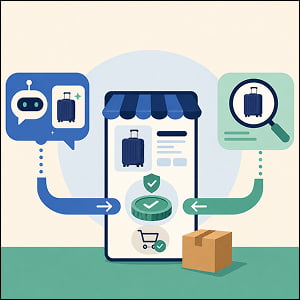
The first is the Agentic Commerce Protocol (ACP), an open standard co-developed by Stripe and OpenAI, and launched in September 2025 to power purchases inside ChatGPT. Under ACP, the AI assistant sends order details to the merchant’s backend, and the merchant accepts or declines the order, processes payment through their existing provider, and handles fulfillment and support exactly as they do today. Payment security relies on Stripe’s Shared Payment Tokens, which are scoped to a single transaction and time-limited, so the agent never handles raw card credentials.
The second is the Universal Commerce Protocol (UCP), co-developed by Google and Shopify, and announced in January 2026. UCP is broader in scope, covering the full journey from discovery through post-purchase, and it’s endorsed by more than 20 organizations including Walmart, Target, Best Buy, Visa, and Mastercard. It powers commerce inside Google’s AI Mode and the Gemini app, and implementation requires an active Google Merchant Center account with healthy product feeds plus a published capability profile declaring what your store supports.
Which should you adopt? Most analysts land on “eventually, both,” because the two protocols capture different moments of intent. ACP-style integrations capture conversational discovery, where a shopper starts with a broad question inside a chat assistant. UCP captures high-intent searches where someone’s already researching a specific product. If you’re on a major platform like Shopify, much of this work arrives as platform features. If you run custom infrastructure, budget for a real development project that includes feed endpoints, checkout APIs, and delegated payment token support.
Step Three: Pick Your Posture Toward Third-Party Agents
Not every brand should fling its doors open to every agent, and this is where strategy matters more than tooling. Bain & Company outlines a spectrum of postures retailers are adopting. At one end, brands fully embrace third-party agents, allowing them to crawl their sites, list their products, and close transactions. This makes sense for brands that lack the awareness to drive traffic at scale on their own. At the other end, retailers with strong brand gravity build their own agentic experiences, aiming to make their proprietary assistant the front door for their category.
There’s also active resistance in some spaces, and it’s getting litigious. A recent IndexBox summary noted that a federal judge issued a preliminary injunction blocking Perplexity’s browser from making purchases on Amazon, a preview of the walled-garden fights ahead as platforms decide whose agents get to shop where.
Whatever posture you choose, make it a decision rather than a default. A practical starting framework is to…
- Measure agent traffic separately: You can’t manage what you’ve lumped in with “direct.” Segment AI referrals and agent-driven transactions in your analytics now, even while volumes are small.
- Decide where agents add value and where they erode it: Commodity replenishment purchases are ideal for agents. High-consideration, emotionally driven purchases deserve experiences that pull humans back into the loop.
- Run a small pilot: Enable one protocol or one agentic surface, watch conversion, average order value, and return rates, and expand based on evidence rather than hype.
Step Four: Protect the Customer Relationship When the Customer Is a Bot
The most underrated risk in agentic commerce isn’t lost sales, it’s lost relationships. When an agent completes a purchase inside a chat interface, the shopper may never visit your site, see your brand storytelling, or join your email list. Bain & Company warns that agents may bypass storefronts entirely, and marketplaces and brands alike will need trust signals like reviews, ratings, and guarantees to stay in consideration.

That said, you’re probably going to want to invest in some post-purchase touchpoints. Packaging, onboarding emails, warranty registration, and loyalty enrollment become your primary brand moments when the pre-purchase journey happens inside someone else’s interface.
It’s also important to preserve your first party data, and Launchcodex’s UCP guide recommends setting up server-side conversion tracking and post-purchase email opt-ins, because session-based analytics and re-targeting pixels won’t capture buyers who never load your pages.
When it comes to your loyalty program info, make sure it’s agent legible. If an agent comparing two retailers can see that one offers the shopper free shipping through a rewards tier, that data becomes a ranking factor. Loyalty benefits locked inside an app the agent can’t read might as well not exist.
But even with all of that in mind, at the end of the day, the most important thing is still being a brand that human customers ask for by name. Agents honor explicit preferences, so being mentioned in a prompt or search query beats any optimization you’ll ever do. The brand-building work that earns those mentions matters considerably more in an agentic world, not less.
The Bottom Line: What Brands Should Do Next
Preparing for AI shopping agents will require more than just a one-and-done initiative, there are a sequence of important projects you’ll need to undertake. Start with reviewing your product data, because nothing else works without it. Layer in protocol readiness so agents can actually transact with you. Choose a deliberate posture toward third-party agents, and rebuild your loyalty and measurement systems for a world where a growing share of your buyers never see your website. The brands that treated early SEO seriously owned a decade of search, and the same window is open right now for agentic commerce. The data suggests it won’t stay open long.
Frequently Asked Questions
Agentic commerce is a model of online shopping where autonomous AI agents act on behalf of consumers to research, compare, and complete purchases, often with minimal human involvement. Instead of a person browsing a website, the AI assistant interprets the shopper’s intent, evaluates options across merchant catalogs, and can even finish a transaction itself.
ACP is an open standard co-developed by Stripe and OpenAI, launched in September 2025, that defines how AI agents and merchants communicate to complete a purchase. It powers checkout inside ChatGPT. Merchants receive the order through the protocol, then accept or decline it, process payment with their existing provider, and handle fulfillment as they normally would.
UCP is an open standard co-developed by Google and Shopify, announced in January 2026, that covers the full commerce journey from product discovery through post-purchase. It powers shopping inside Google’s AI Mode and the Gemini app and is endorsed by more than 20 organizations, including Walmart, Target, Best Buy, Visa, and Mastercard.
A chatbot answers questions and points you in the right direction, like a helpful store clerk. An AI shopping agent takes actions. It searches catalogs, compares structured product attributes across merchants, applies the shopper’s stated preferences and constraints, and can complete checkout processes autonomously. The difference is between getting advice and delegating the task.
Not under the major protocols. ACP uses Stripe’s Shared Payment Tokens, which are scoped to a single transaction and expire after a short window, so the agent passes a secure token to the merchant rather than raw card credentials. The merchant then charges it through their normal payment provider. Under UCP, agents and merchants exchange cryptographically signed, single-use tokens or usage-scoped hashes rather than transmitting raw credit card data. The protocol uses a “push” model where agents issue a “Cart Mandate” and a “Payment Mandate” in order to complete the transaction.
Other AI Training Modules You May Be Interested In
Using AI to Create Data Visualizations and Infographics for Content Marketing
Using AI to Produce and Repurpose Podcasts
Using AI to Build and Maintain a Dynamic Knowledge Base for Your Marketing Team
