

Physical AI is the branch of artificial intelligence that lets machines perceive, reason about, and act within the real world, and it just got a major boost. On July 16, 2026, Nvidia announced a sweeping set of partnerships with Japanese robotics and industrial leaders, including Fanuc and Yaskawa Electric, to accelerate the development of AI-powered robots. Announced by CEO Jensen Huang at an event in Tokyo, the deals position Japan, home to some of the world’s largest industrial robot makers, as a central hub in Nvidia’s push to move AI out of the data center and onto the factory floor.
In this article we’ll discuss what Nvidia announced in Tokyo, why the company is pairing up with Japan’s robotics giants, the technology stack behind these partnerships, and what a government-backed chip purchase reveals about Japan’s AI infrastructure ambitions. We’ll also look at the bigger picture of why Japan sees physical AI as an answer to its shrinking workforce, and what this means for the global AI investment cycle.
TL;DR Snapshot
Nvidia is partnering with a number of Japanese industrial firms to embed its AI platforms into next-generation robots. At the same time, a government-backed Japanese company committed to purchasing thousands of Nvidia’s chips. Together, the announcements mark one of Nvidia’s most aggressive expansions into robotics to date and underline Japan’s strategic importance in the AI supply chain.
Key takeaways include…
- Nvidia is teaming up with Fanuc, Yaskawa Electric, and dozens of other Japanese firms to bring AI into industrial robots, factories, and warehouses.
- Government-backed Noetra will buy 27,500 Nvidia Rubin chips, which will be used to build out physical AI infrastructure starting in April 2027.
- The partnerships lean on Nvidia’s physical AI stack, including their Cosmos, Isaac, Metropolis, and Jetson solutions, which help machines to understand and act in the real world.
Who should read this: Tech investors, robotics engineers, manufacturing leaders, and AI enthusiasts.
What Nvidia Announced in Tokyo
Speaking at a media event in Tokyo on Thursday, Jensen Huang unveiled partnerships with Japanese companies including Fanuc and Yaskawa Electric, two of the biggest names in industrial robotics. According to Reuters, Huang told the audience that with AI, robots will become “smart, easily adaptable and accessible.”

The message here was clear, Nvidia doesn’t just want to power chatbots and data centers. It wants its chips and software inside the machines that build cars, move packages, and assist in hospitals. Huang also argued that Japan is currently missing out on one key emerging technology, physical AI, and framed the partnerships as a way to close that gap.
The announcement didn’t come out of nowhere though. A Crypto Briefing report notes that Nvidia struck an AI infrastructure agreement with Fujitsu in October 2025, and announced an initial partnership with Fanuc to embed physical AI into industrial robots in December 2025. This week’s news significantly widens that circle, with the same report naming Kawasaki Heavy Industries, Canon, OMRON, Hitachi, and pharmaceutical firms Astellas and Daiichi Sankyo among the companies adopting Nvidia’s platforms.
Noetra’s 27,500-Chip Bet on Physical AI
Alongside the robotics partnerships, a separate announcement highlighted just how serious Japan is about AI infrastructure. Reuters reported that Noetra, a government-backed company whose investors include Sony, will purchase 27,500 Nvidia Rubin chips as it develops physical AI. Noetra plans to begin infrastructure construction in April 2027, and to start operations in June 2028.
That’s a substantial commitment to Nvidia’s newest chip architecture, and it signals that Japan intends to build homegrown computing capacity for training and running the AI models that will power its robots, rather than relying entirely on overseas infrastructure. The combination of public backing and private investors like Sony also shows how tightly Japan’s government and industry are coordinating on AI strategy.
The Technology Stack Powering the Partnerships
Under the hood, these collaborations revolve around Nvidia’s suite of physical AI platforms. According to Evertiq’s coverage of the announcement, Huang described the effort as pairing Japan’s heritage in manufacturing, precision engineering, and robotics with Nvidia Cosmos, Isaac, Metropolis, and Jetson to build the next generation of intelligent machines.
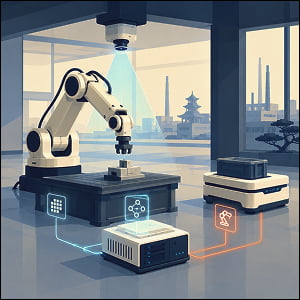
One highlight is Nvidia Cosmos 3 Edge, which Evertiq describes as a 4-billion-parameter model built on Nvidia Nemotron that helps robots and vision AI agents understand their surroundings, reason in real time, and generate robot actions on edge computers. Notably, developers can reportedly adapt the model for specific robots, vehicles, sensors, and environments in about a day, which could dramatically shorten the time it takes to deploy AI in specialized industrial settings.
The list of Japanese participants goes well beyond Fanuc and Yaskawa however. Evertiq names a multitude of companies including Hitachi, Honda R&D, Kawasaki Heavy Industries, Kubota, Mitsubishi, Mujin, NEC, and Preferred Networks, just to highlight a few of those building with Nvidia’s various platforms.
Why Japan, and Why Now?
Japan is a natural home for this push. It’s one of the world’s leading producers of industrial robots, and it retains strong positions in semiconductor materials and equipment even though its overall chipmaking market share has declined since the 1980s. Huang’s Tokyo visit included meetings with executives from chipmaker Kioxia and equipment maker Tokyo Electron, underscoring how deeply Japan is woven into the AI supply chain.
There’s also a demographic driver at play. Crypto Briefing frames the partnerships as part of Japan’s race to automate its way out of a labor shortage caused by an aging population, with AI-powered robots targeted at shipping, manufacturing, and even caregiving through long-term government initiatives.
Finally, the timing lands in the middle of a booming AI investment cycle. Reuters notes that chip equipment maker ASML raised its sales forecast this week while TSMC, the world’s leading contract chipmaker, posted record earnings and raised its capital spending forecast. For Nvidia, expanding into robotics opens a new frontier of demand just as investors are asking where AI growth comes from next.
Frequently Asked Questions
Nvidia is an American technology company best known for designing the graphics processing units (GPUs) that power most of today’s AI systems. Originally famous for gaming graphics cards, it’s now the dominant supplier of chips and software platforms for training and running AI models, and it’s expanding into robotics through platforms like Cosmos, Isaac, Metropolis, and Jetson.
Fanuc is one of Japan’s largest industrial robotics and factory automation companies. It’s known worldwide for its yellow robotic arms used in car manufacturing and other heavy industries, and it first partnered with Nvidia on physical AI in December 2025 before this week’s expanded collaboration.
Yaskawa Electric is a Japanese manufacturer of industrial robots, motion control systems, and servo motors. It’s one of the world’s top robot makers and, alongside Fanuc, is a headline partner in Nvidia’s new push to bring AI into industrial machines.
Noetra is a government-backed Japanese company whose investors include Sony. It announced plans to buy 27,500 Nvidia Rubin chips to develop physical AI, with infrastructure construction beginning in April 2027, and operations expected to start in June 2028.
Physical AI refers to artificial intelligence that operates in the real world rather than purely in software. It enables robots, vehicles, and other machines to perceive their surroundings, reason about what they see, and take physical actions, which is exactly what Nvidia’s Cosmos and Isaac platforms are designed to support.
Rubin is Nvidia’s next-generation AI chip architecture, the successor to its earlier GPU platforms used for training and running AI models. Noetra’s purchase of 27,500 Rubin chips is one of the notable early commitments to the architecture in Japan.
Cosmos 3 Edge is a 4-billion-parameter AI model built on Nvidia Nemotron. It runs on Nvidia edge computers and helps robots and vision AI systems understand their environment, reason in real time, and generate actions, and developers can adapt it to specific robots and settings in about a day.
Other Enterprise AI Articles You May Be Interested In
Microsoft Becomes First Hyperscaler to Adopt 3M EBO Technology
What Is Grok 4.5? Everything to Know About xAI’s Latest AI Model
Meta Enters the AI Image Race: Everything You Need to Know About Muse Image
GPT-5.6 Is Finally Public: Why the Government Delayed OpenAI’s Most Powerful AI Models
Nvidia Stock Is Cheaper Than the S&P 500 for the First Time Since 2019
