

A valuation reset occurs when the market fundamentally reprices a stock, stripping away the premium investors were once willing to pay and bringing its multiples back in line with historical norms or the broader market. For Nvidia, that reset has arrived. After losing roughly $1 trillion in market capitalization in under two months, the chipmaker’s stock is now trading at levels not seen since before the generative AI boom kicked off in late 2022. It’s a dramatic fall for a company that, not long ago, was the hottest ticker on Wall Street.
In this article, we’ll discuss what’s behind Nvidia’s trillion-dollar slide, why investors are rotating out of the stock despite its still-dominant position in AI hardware, and what this shift signals about the next phase of the artificial intelligence trade. We’ll also explore the rise of competing semiconductor stocks, the growing importance of memory chips, and whether Nvidia’s current valuation makes it a bargain or a trap.
TL;DR Snapshot
Nvidia’s stock has fallen 16% since hitting an all-time high on May 14, 2026, erasing roughly $1 trillion in market value. At 18 times forward earnings, the chipmaker is now cheaper than both the S&P 500 and the Nasdaq 100, even as analysts continue to raise earnings estimates. The selloff doesn’t reflect a crumbling business, but instead reflects a market that’s rotating the AI trade away from a single dominant player and toward a broader set of semiconductor companies, particularly in the memory chip space.
Key takeaways include…
- Investors are shifting capital from Nvidia into competing chipmakers like Micron, Intel, and AMD. The Philadelphia Stock Exchange Semiconductor Index has surged 74% in 2026, while Nvidia is up just 5.6% according to Bloomberg.
- Nvidia’s fundamentals remain strong, but their premium is gone. They still control roughly 97% of the server GPU market, and analysts project $228 billion in profits on $393 billion in revenue for fiscal year 2027 per Bloomberg data. But its forward P/E has compressed to 18x, below the S&P 500’s 20x.
- New competitive threats are emerging. From Micron’s memory chip dominance to DeepSeek’s in-house AI chip project, the landscape around Nvidia is shifting in ways that could pressure its long-term pricing power.
Who should read this: Investors, tech professionals, market analysts, and AI enthusiasts following the semiconductor industry.
The Numbers Behind the Slide
The raw numbers paint a stark picture of just how quickly sentiment has shifted for Nvidia. Since peaking on May 14, 2026, their shares have tumbled 16%, bringing their market capitalization down to around $4.8 trillion. At 18 times projected earnings over the next 12 months, the stock hasn’t been this inexpensive in years according to Bloomberg data.
To put that in perspective, Nvidia is now cheaper on a forward P/E basis than the S&P 500, which trades above 20 times forward earnings, and significantly below the Nasdaq 100, which commands nearly 23 times. As Quartz noted, Nvidia is now less expensive than roughly half of all S&P 500 components, including companies like Hershey and Dominion Energy.
The disconnect between price and fundamentals is notable. Wall Street analysts have actually been raising their earnings estimates for Nvidia, not cutting them. The company generated $215.9 billion in total revenue during fiscal year 2026, up 65% year over year, with its data center business accounting for $193.7 billion of that figure, as The Motley Fool reported. First-quarter fiscal 2027 results accelerated further, with total revenue of $81.6 billion (up 85% year over year) and data center revenue of $75.2 billion (up 92%).
Of the 82 analysts tracked by Bloomberg who cover Nvidia, only three have hold ratings and just one recommends selling. Their average price target of $302 implies a gain of more than 50% over the next 12 months, per Bloomberg. The market, however, isn’t waiting for those targets. It’s repricing what it’s willing to pay for even extraordinary growth.
The Great AI Rotation
The key driver behind Nvidia’s slide isn’t deteriorating demand for its chips, it’s the fact that investors are spreading their bets across a much wider set of AI-related semiconductor companies.
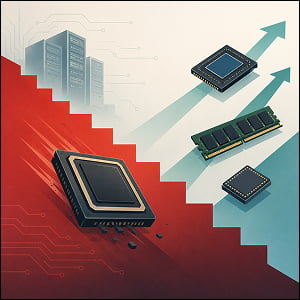
The Philadelphia Stock Exchange Semiconductor Index has jumped 74% in 2026, putting it on pace for its best year since 2003, per Bloomberg. Leading that charge is Micron Technology, which has surged 229% in 2026 alone after already climbing 239% in 2025. As a CNBC report detailed, Wall Street’s AI chip enthusiasm has moved decisively toward Intel, AMD, and Micron, with all three more than doubling in value in 2026. Intel leads the pack, up well over 200% for the year.
Memory chips have become central to the AI infrastructure story. As AI models grow larger and inference workloads scale, the demand for high-bandwidth memory (HBM) has exploded. According to a World Semiconductor Trade Statistics forecast, the global semiconductor market is on track to nearly double in 2026, reaching $1.51 trillion, driven overwhelmingly by a surge in memory chip demand.
Meanwhile, Nvidia’s correlation to the broader chip index sank to the lowest level since 2014 last month as noted by Bloomberg. In 2024, Nvidia was the second-best performer in the 30-stock semiconductor benchmark. Now, it’s the third-worst.
New Challengers on the Horizon
Beyond the rotation into memory stocks, Nvidia faces a longer-term competitive landscape that’s becoming more crowded.
Perhaps the most headline-grabbing development this week is the news that China’s DeepSeek is developing its own AI chip. Reuters reported that the Chinese AI startup has spent the past year quietly building a custom inference chip, recruiting semiconductor engineers through private channels and working with chip designers, foundries, and memory suppliers. The chip is designed for inference rather than training, targeting the stage of AI computing where trained models generate responses for users. The news sent Nvidia shares down approximately 1.6% in premarket trading on Monday.
DeepSeek isn’t alone though. As TechStartups noted, there’s an ongoing trend of AI developers designing their own chips. OpenAI recently unveiled Jalapeno, its first custom inference chip developed with Broadcom, and Anthropic has also explored building proprietary AI processors. In China, Alibaba and Baidu are both investing heavily in their own AI processors, and Huawei has captured roughly 50% of China’s domestic AI chip market, per Semafor.
As reported by Big News Network, Analyst Richard Windsor of Radio Free Mobile offered a measured take, noting that DeepSeek’s chip may not pose a near-term threat to Nvidia, partly because the startup may struggle to attract customers outside of China. However, the broader pattern is clear, the era of near-total dependence on a single GPU supplier is winding down. As more companies build custom silicon tailored to their own models and workloads, Nvidia’s ability to command premium pricing could gradually erode, even as overall demand for AI compute continues to grow.
The implications aren’t limited to China. U.S. based hyperscalers like Google, Amazon, and Microsoft have all invested in custom AI chips for their cloud platforms, and the trend toward vertical integration in AI hardware is accelerating. Nvidia’s CUDA software ecosystem remains a powerful moat, but the market is signaling that it’s no longer willing to pay an open-ended premium for dominance alone.
Bargain or Warning Sign?

So is Nvidia’s current valuation a screaming buy or a canary in the coal mine? The bull case is straightforward. Nvidia’s fundamentals have never been stronger. The company is projected to deliver $228 billion in profits on $393 billion in revenue for fiscal 2027, representing growth of 90% and 82% respectively per Bloomberg data. Wall Street’s consensus price target of roughly $300 implies more than 50% upside from current levels. Demand still exceeds supply, and Nvidia holds an estimated 97% share of the server GPU market according to Quartz. As The Motley Fool highlighted, Wall Street expects Nvidia’s GAAP earnings to soar by 91% to $9.36 per share during fiscal 2027, which could have significant implications for the stock price.
The bear case is more nuanced. As NAI 500 observed, the market is no longer asking whether Nvidia can grow, it’s asking whether that growth translates into durable, high-return cash flows, or whether it’s more cyclical than structural. Capital intensity is rising, competition is broadening, and geopolitical risks (particularly U.S. export controls limiting access to the Chinese market) continue to weigh on the outlook.
There’s also the question of whether the AI infrastructure boom itself will follow the same cycle as previous technology buildouts. Harvard Business School professor Willy Shih told Fortune that the AI memory boom looks like every other memory cycle he’s observed since the 1980s, just bigger. If history is any guide, supply will eventually catch up with demand, and the companies riding the wave today may face margin pressure tomorrow.
For now, Nvidia sits in an unusual position: a company with best-in-class growth trading at a discount to the broader market. Whether that discount is an opportunity or a signal of a deeper shift depends on how much you believe the AI trade is changing, and whether Nvidia can adapt to a world where it’s no longer the only game in town.
Frequently Asked Questions
Nvidia is an American semiconductor company headquartered in Santa Clara, California. It designs and manufactures graphics processing units (GPUs) that have become the primary hardware for training and running artificial intelligence models. Its data center business is the company’s largest revenue driver, and its CUDA software platform is widely used across the AI development ecosystem.
A forward price-to-earnings (P/E) ratio measures a company’s current stock price relative to its projected earnings per share over the next 12 months. It’s a commonly used metric for evaluating whether a stock is expensive or cheap relative to its expected profitability. A lower forward P/E generally suggests the stock is less expensive on an earnings basis.
High-bandwidth memory is a type of advanced memory chip designed for high-performance computing and AI applications. HBM chips stack multiple layers of memory on top of each other, enabling faster data transfer rates and lower power consumption compared to traditional memory. They’re a critical component in AI accelerator systems.
DeepSeek is a Chinese artificial intelligence startup that gained international attention in early 2025 after releasing highly efficient AI models that rivaled Western counterparts at a fraction of the training cost. The company is reportedly developing its own AI inference chip to reduce reliance on Nvidia and Huawei hardware.
AI inference is the process of using a trained AI model to generate outputs, such as answering questions, writing text, or producing images. Unlike training, which requires massive computational power to teach a model, inference happens every time a user interacts with an AI system. It’s one of the fastest-growing areas of AI computing demand.
U.S. export controls are government regulations that restrict the sale of advanced semiconductor technology to certain countries, most notably China. These controls have limited Chinese companies’ access to Nvidia’s most powerful AI chips, prompting Chinese firms like Huawei, DeepSeek, and Alibaba to develop domestic alternatives.
Other Enterprise AI Articles You May Be Interested In
Microsoft Frontier Company: Why Big Tech Is Spending Billions on AI Deployment
How Meta’s New Cloud Business Could Disrupt the AI Market
Anthropic Relaunches Fable 5 and Mythos 5 After Government Ban
GPT 5.6 Sol, Terra, and Luna: A Complete Guide to OpenAI’s New Model Family
Micron’s AI-Driven Boom: How HBM4 Chips Are Fueling a 700% Stock Rally
