

AI-powered marketing reporting is the practice of using artificial intelligence tools to automatically collect data from multiple marketing platforms, synthesize that data into meaningful insights, and deliver polished, readable reports to stakeholders without hours of manual work. Instead of logging into six different dashboards every Friday afternoon, copying numbers into a slide deck, and writing narrative summaries by hand, marketers can now use AI to handle the heavy lifting of data aggregation, trend identification, and even plain-language commentary on campaign performance. It’s a shift from “marketer as report assembler” to “marketer as strategic decision-maker.”
In this article, we’ll discuss why manual reporting is one of the biggest hidden time drains in the industry, how AI tools can automate the process from data collection all the way through stakeholder-ready narratives, and what to watch out for so you don’t trade accuracy for speed. We’ll walk through the specific tools and techniques that make this possible, explore how to tailor AI-generated reports for different audiences within your organization, and share the guardrails you need to put in place to make sure your automated reports are trustworthy enough to act on.
TL;DR Snapshot
Marketing teams spend a staggering amount of time pulling data from platforms, cleaning it, formatting it into reports, and presenting it to leadership. AI tools can now automate the majority of that workflow, from extracting cross-channel data and identifying performance trends to generating written summaries tailored for different stakeholders. The result isn’t just faster reporting, it’s a fundamental shift in how marketers spend their time, freeing them to focus on strategy, creativity, and the kind of critical thinking that actually moves the needle.
Key takeaways include…
- Marketing teams spend an average of 14.5 hours per week just managing and collecting data, and 63% of marketers’ data-related time could be partially or fully automated.
- AI reporting tools can pull data from hundreds of marketing platforms, normalize inconsistent metrics, and generate stakeholder-ready reports in minutes rather than hours, but they require human oversight to catch errors.
- The biggest gains come not from replacing human judgment, but from eliminating the repetitive data wrangling that prevents marketers from exercising that judgment in the first place.
Who should read this: Marketing managers, agency owners, marketing ops professionals, and data-driven entrepreneurs looking to reclaim their reporting hours.
The Hidden Time Drain: Why Manual Reporting Is Killing Your Marketing Team’s Productivity
If you manage marketing campaigns across multiple channels, you already know the routine. Monday morning starts with logging into Google Analytics, then Google Ads, then Meta Ads Manager, then your email platform, then your CRM. You pull exports, drop them into spreadsheets, and start trying to reconcile numbers that never quite agree with each other. A global survey from Treasure Data found that marketing teams spend an average of 14.5 hours per week just managing and collecting customer data, with 18% spending more than 20 hours per week on these tasks. That’s up to half the workweek consumed before any analysis even begins.
The problem isn’t just the time spent though, it’s what that time prevents. A HubSpot survey found that the average marketer spends roughly 16 hours per week on routine tasks. When a third of your working hours go to repetitive chores, that’s time you’re not spending on campaign strategy, creative development, or the higher-order thinking that actually drives results.
The data quality issue makes things worse. Each marketing platform measures conversions on its own terms, using different attribution windows, different identity rules, and different event definitions. A single purchase might count as a “click” in Google Ads, a “view-through conversion” in Meta, and a “session” in GA4. Reconciling these discrepancies by hand is what eats most of a marketing team’s week, and it’s why a Funnel and MarketingProfs study of 713 marketers found that the top data-related frustration was data quality (cited by 50% of respondents), followed by data silos and availability (43%).
Here’s the part that really stings, the same study found that 63% of marketers’ data-related time could be partially or fully automated. That’s hundreds of hours per year, per marketer, being spent on tasks a machine can handle.
How AI Transforms the Reporting Workflow

AI-powered reporting isn’t one tool or one technique, it’s a layered approach that addresses each stage of the reporting workflow, from pulling raw data to delivering a polished narrative that a C-suite executive can actually act on.
The data aggregation layer is where dedicated marketing data platforms come in. Tools like Improvado, Funnel.io, and Supermetrics connect to hundreds of advertising, analytics, CRM, and email platforms to automatically extract and normalize data. Improvado, for example, offers over 500 pre-built connectors and includes AI agents that can be configured to send automated period-over-period reports directly to your inbox, highlighting performance trends and surfacing deviations without manual effort. Funnel.io takes a data-warehouse-first approach, storing all marketing data in a managed warehouse before it reaches your dashboards, so reports load faster and data stays consistent. Supermetrics takes a lighter-weight approach, pulling data directly into Google Sheets, Excel, or Looker Studio for teams that prefer working in familiar environments.
The insight generation layer is where generative AI tools like ChatGPT, Claude, and Gemini enter the picture. Once your data is aggregated, you can feed it into these tools to generate written analysis. A Dataslayer guide on AI marketing reporting notes that the best practice is to use AI for the first 80% of analysis (data compilation, calculations, trend identification) and then apply human expertise for the final 20% of interpretation and recommendations. This approach lets you generate a first draft of your weekly performance summary in minutes rather than hours while still maintaining the strategic nuance that only a human marketer can provide.
The delivery layer is about getting the right report to the right person at the right time. Modern reporting platforms support automated scheduling, so stakeholders receive dashboards and summaries when they need them rather than only at month-end. As Robotic Marketer notes, executive dashboards can surface strategic KPIs like revenue influence or MQL velocity, while campaign managers drill into granular detail, and the ability to personalize reporting output improves relevance for each stakeholder group.
The practical efficiency gains are significant. A ZoomInfo survey on the state of AI in sales and marketing found that AI users report increases in productivity of up to 47%, cutting low-value manual tasks by an average of 12 hours per week. And ALM Corp reports that marketing teams implementing AI automation can bring campaigns to market up to 75% faster and reallocate up to 30% of their working time from repetitive execution to strategy and creative work.
Tailoring Reports for Different Stakeholders
One of the most powerful applications of AI in reporting isn’t just making reports faster to produce, it’s making them more relevant to the person reading them. A single data set can and should generate very different reports depending on the audience.
Your CMO doesn’t want to see the same report as your paid media specialist. The CMO needs a high-level narrative about how marketing is contributing to pipeline and revenue, which channels are outperforming, and where budget should shift next quarter. The paid media specialist needs granular campaign-level data about cost per click, conversion rates by ad set, and creative fatigue indicators. Your agency clients need polished, branded deliverables that build confidence and justify spend. AI lets you generate all three from the same underlying data set, automatically.
Generative AI tools are especially useful here because they can adapt tone and depth. When you prompt an AI with your raw performance data and ask for an executive summary, it can produce a concise, narrative-driven overview that leads with business outcomes. Feed it the same data and ask for a tactical analysis, and it can generate a detailed breakdown with specific recommendations for optimization. This isn’t theoretical. As Robotic Marketer describes, rather than overwhelming teams with numbers, AI-driven marketing reporting delivers specific, prioritized recommendations tailored for each campaign and business objective.
To make this work in practice, start by mapping your stakeholders and defining what each one needs to see. Create prompt templates for each audience type. For example, you might have an “Executive Summary” prompt that instructs the AI to lead with revenue impact and limit the report to one page, a “Channel Performance” prompt that asks for platform-by-platform comparisons with week-over-week trends, and a “Client Report” prompt that emphasizes ROI, includes visual-ready data points, and uses a professional tone. Save these as reusable templates and you’ll have a system that generates multiple tailored reports from a single data pull.
The Guardrails: Avoiding the Accuracy Trap
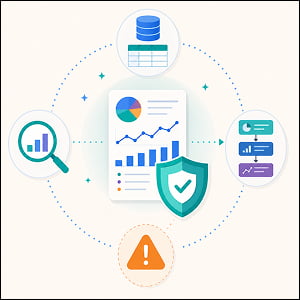
The efficiency promise of AI reporting is real, but so are the risks. The single biggest danger is treating AI-generated reports as gospel without human verification.
NP Digital’s Report on AI hallucinations, which was based on a survey of 565 U.S.-based digital marketers and accuracy testing of 600 prompts across six major language models, found some sobering numbers. Nearly half of marketers (47.1%) encounter AI inaccuracies multiple times per week. More than 70% spend one to five hours weekly fact-checking AI output. And more than a third (36.5%) admitted that hallucinated or incorrect AI-generated content has been published publicly.
When mistakes do go live, the most common issues are brand-unsafe content (53.9%), completely false information (43.5%), and formatting errors (42.5%). This is especially critical in reporting because a single wrong number in a stakeholder report can erode trust far more than an error in a blog post. If your AI-generated report tells the CEO that conversions are up 30% when they’re actually up 3%, you’ve got a credibility problem that no tool can fix. And as Glean reports, research from enterprise AI deployments shows that after experiencing just three significant errors, employee trust in AI systems drops by 67%, with usage declining proportionally.
Here’s how to build guardrails that make AI reporting trustworthy…
- Always feed AI your actual data rather than asking it to look up or estimate metrics. When you provide an AI tool with a CSV export or structured data set, it’s summarizing and interpreting known numbers. When you just ask it to tell you how your campaigns performed without providing the explicit data, it’s guessing, and that’s where hallucinations happen.
- Implement a “spot-check” workflow. Be sure to review all of the key metrics against your source dashboards before any report goes to stakeholders. You’ll especially want to be cognizant of metrics that drive decisions (e.g. revenue, conversion rates, and cost per acquisition).
- Use AI tools that show their work. Some newer AI reporting platforms show exactly which data sources and calculations went into each insight, making it easier to verify accuracy. Look for tools that provide transparency into their methodology rather than just delivering a finished narrative.
- Keep a human in the loop for the “so what” layer. AI is excellent at telling you what happened. It’s improving at telling you why. But it’s still unreliable at telling you what to do about it. The strategic recommendations in your stakeholder reports should always come from a marketer who understands the business context, competitive landscape, and organizational priorities that no AI model can fully grasp.
As NP Digital put it, speed without accuracy creates real risk. The right approach is to let AI handle the 80% of reporting that’s data aggregation and formatting, and let your team own the 20% that’s judgment and strategy.
Getting Started: A Practical Roadmap
You don’t need to overhaul your entire reporting stack overnight, here’s a phased approach to introducing AI into your reporting workflow…
Phase one – Automate data collection: Start by connecting your marketing platforms to a data aggregation tool. If you’re a small team or solopreneur working with a handful of platforms, Supermetrics pulling data into Google Sheets may be all you need. If you’re managing larger budgets across many channels, evaluate tools like Funnel.io or Improvado that offer more robust data normalization and governance features. The goal in this phase is simply to stop manually logging into platforms and copying numbers.
Phase two – Template your reports with AI: Once your data is flowing into a central location, start using a generative AI tool to draft your report narratives. Export your aggregated data as a CSV or paste it into the AI tool, along with a prompt template that specifies the audience, format, and key metrics to highlight. Refine your prompts over several reporting cycles until the AI consistently produces a useful first draft. At this stage, you’re still reviewing and editing everything before it goes out.
Phase three – Automate delivery: Once you trust your data pipeline and your AI-generated drafts, set up automated scheduling. Many reporting platforms let you send dashboards and summaries to stakeholders on a recurring schedule. Configure different views for different audiences. Start with internal stakeholders before automating client-facing reports, since internal teams are more forgiving of the occasional formatting issue while you dial things in.
Phase four – Build feedback loops: Track which reports get opened, which metrics get questioned, and which recommendations get acted on. Use this feedback to continuously refine your templates, prompts, and data sources. The best reporting systems aren’t static, they evolve as your business and your stakeholders’ needs change.
The ultimate goal isn’t to remove humans from reporting, it’s to remove the parts of reporting that don’t require human intelligence, so your team can spend their time on the parts that do.
Frequently Asked Questions
Data normalization in marketing reporting refers to the process of standardizing data from different platforms so it can be compared and analyzed consistently. For example, Google Ads and Meta Ads might define “conversions” differently or use different attribution windows. Normalization resolves these discrepancies so that your cross-channel reports are comparing apples to apples rather than apples to oranges.
A data warehouse is a centralized storage system designed to hold large volumes of structured data from multiple sources. In the context of marketing reporting, a data warehouse (like Google BigQuery, Amazon Redshift, or Snowflake) serves as the single location where all your marketing data lives after being extracted from individual platforms. Having all your data in one place makes it possible to run complex queries, build comprehensive dashboards, and generate reports that span your entire marketing operation.
ETL stands for Extract, Transform, Load, and it refers to the process of pulling data from source systems (extract), converting it into a usable format (transform), and storing it in a destination like a data warehouse (load). ELT is a variation where the data is loaded into the destination first and then transformed. Many marketing data platforms like Improvado and Funnel.io handle ETL or ELT automatically, saving marketing teams from having to build and maintain these data pipelines manually.
An AI hallucination occurs when a generative AI model produces information that sounds plausible and confident but is factually incorrect, fabricated, or unsupported by the input data. In marketing reporting, this might look like an AI tool inventing a statistic, falsely attributing a trend to the wrong channel, or generating a recommendation based on data that doesn’t exist. Hallucinations are a well-documented limitation of current large language models, which is why human review of AI-generated reports remains essential.
Improvado is an enterprise-level marketing analytics and data integration platform that connects to over 500 marketing data sources, including ad platforms, CRMs, email tools, and analytics platforms. It automatically extracts, normalizes, and harmonizes marketing data into a single source of truth, and includes AI-powered features like natural language querying and automated report generation. It’s designed primarily for mid-market and enterprise marketing teams that need to consolidate data across many channels and brands.
Funnel.io is a marketing data platform that automates the collection and preparation of marketing data from over 500 sources. It uses a data-warehouse-first architecture, meaning all data flows through Funnel’s managed warehouse before reaching visualization tools like Looker Studio or your own data warehouse. It’s known for its data normalization capabilities and is popular with both agencies and in-house marketing teams.
Supermetrics is a data integration tool that pulls marketing data from platforms like Google Ads, Meta, LinkedIn, and Google Analytics into destinations marketers already use, including Google Sheets, Excel, Looker Studio, and data warehouses like BigQuery. It’s a lighter-weight, more accessible option compared to enterprise platforms, and is popular with small to mid-sized teams and agencies that want straightforward data extraction without complex setup.
Other AI Training Modules You May Be Interested In
Using AI for Sales Enablement: Battlecards, Onboarding, and Messaging Consistency at Scale
Using AI to Build and Manage Thriving Brand Communities
Using AI to Design Smarter Customer Loyalty and Retention Programs
