AI-powered loyalty and retention program design is the practice of using artificial intelligence, machine learning, and predictive analytics to build customer loyalty programs that go beyond generic points and discounts. Instead of treating every customer the same, AI analyzes individual purchase histories, engagement patterns, and behavioral signals to personalize rewards, predict which perks will drive repeat purchases, and time re-engagement offers so they arrive at exactly the right moment. It’s the difference between blasting a “We miss you!” email to your entire list and proactively offering a specific, high-value customer their favorite product at a discount before they’ve even thought about leaving.
In this article, we’ll discuss why traditional loyalty programs are losing their grip on modern consumers, how AI is transforming the way brands design and manage retention strategies, and what specific AI-driven tactics are producing real results for companies like Starbucks and Sephora. We’ll walk through the core AI capabilities that power next-generation loyalty programs, explore case studies and data that show what’s actually working, and lay out a practical framework for marketers who want to start building smarter retention systems without needing a data science team.
TL;DR Snapshot
AI is reshaping loyalty programs from static, one-size-fits-all point systems into dynamic, personalized retention engines that adapt to each customer in real time. By analyzing behavioral data, purchase patterns, and engagement signals, AI helps brands predict churn before it happens, deliver rewards that resonate with individual customers, and continuously optimize the loyalty experience to maximize customer lifetime value.
Key takeaways include…
- Traditional points-based loyalty programs are losing effectiveness as consumer expectations shift toward personalization. 58% of brands listed personalization as their top loyalty program investment, a dramatic increase from 28% in 2021.
- AI-powered predictive analytics can detect early warning signs of customer disengagement and trigger personalized retention offers before customers churn. Companies implementing AI-powered retention strategies have reported up to a 30% decrease in churn rates and a 50% increase in CLV.
- The financial case for a good retention program is overwhelming, acquiring a new customer costs 5 to 25 times more than retaining an existing one, and a 5% increase in customer retention can boost profits by 25% to 95%.
Who should read this: Marketers, eCommerce managers, CRM strategists, retention specialists, and entrepreneurs looking to reduce churn and grow customer lifetime value.
Why Traditional Loyalty Programs Are Losing Their Edge
For decades, loyalty programs operated on a simple formula: customers earn points for purchases, and eventually they redeem those points for rewards. It worked when consumers had fewer choices, but today’s landscape tells a different story.
According to Bubblehouse’s State of Loyalty report, customer acquisition costs have surged 222% over the past five years, the average eCommerce store loses 70-77% of its customers every year, and true brand loyalty fell to just 29% in 2025. Perhaps most revealing is the perception gap, as nine out of ten executives believe their customers are loyal, but only four in ten consumers agree.
The problem isn’t that loyalty programs don’t work. The Antavo Global Customer Loyalty Report found that 83% of loyalty program owners who measure ROI reported a positive return, with programs generating an average of 5.2 times more revenue than they cost to run. The problem is that generic, points-only programs are leaving massive value on the table. When every brand offers a near-identical earn-and-burn system, customers have no compelling reason to stay loyal to any single one.
This is exactly where AI changes the equation. Instead of rewarding all customers identically, AI allows brands to understand each customer as an individual and tailor the loyalty experience accordingly. The Open Loyalty Program Trends report frames this shift clearly. Loyalty programs are evolving from transactional, points-based systems into AI-driven programs focused on hyper-personalization, immediate gratification, and experiential rewards. And approximately 70% of brand preference decisions are rooted in emotional factors, not transactional ones.
The brands that are winning at retention aren’t the ones offering the most points, they’re the ones using AI to make every customer feel like the program was built specifically for them.
The AI Capabilities Powering Next-Generation Loyalty
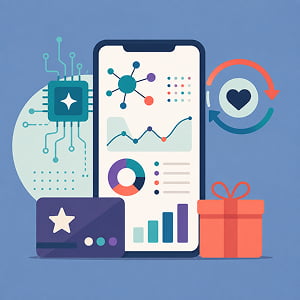
There are four core AI capabilities that are transforming how loyalty and retention programs operate. Understanding each one will help you identify where AI can have the biggest impact on your own retention strategy.
Predictive churn modeling is arguably the highest-impact application of AI in loyalty. Traditional retention programs are reactive: a customer stops buying, and weeks or months later the brand sends a generic “come back” email. AI flips this by detecting early warning signs of disengagement, such as reduced purchase frequency, declining email open rates, or shorter browsing sessions, and triggering personalized interventions before the customer actually leaves. As TRIFFT’s loyalty trends analysis explains, propensity modeling acts as predictive “radar” for customer behavior. It can identify, for example, when a customer is 85% likely to stop using a service in the next 30 days. Instead of waiting for churn to happen, brands can trigger a “Next Best Action,” such as offering early access or an exclusive experience, to re-engage the customer before disengagement occurs.
Personalized reward optimization uses AI to determine which specific rewards will resonate most with each individual customer. Rather than offering every customer the same 10% discount, AI analyzes purchasing patterns, product preferences, browsing behavior, and even contextual signals like time of day or season to recommend the reward most likely to drive a repeat purchase. Consumers who receive personalized experiences spend 37% more with brands that personalize, according to Netguru’s analysis of AI loyalty programs. Sephora’s Beauty Insider program is a prime example. The company uses data analytics to deliver highly personalized product recommendations, and its loyalty program members drive 80% of total sales, according to Annex Cloud’s analysis. With over 25 million members globally, the program works because it personalizes everything from birthday gifts to product samples based on each member’s beauty profile and purchase history.
Real-time decisioning and Next Best Action (NBA) engines take personalization a step further by determining not just what to offer a customer, but when and how to offer it. These AI systems evaluate a customer’s current context, including their recent behavior, their position in the customer lifecycle, and external factors, and select the single best action to take at that exact moment. As TRIFFT describes it, this might mean sending a specific coffee discount at exactly a user’s usual 8:15 AM commute time. It’s personalization based on habits, timing, and intent, not guesswork. Starbucks has built one of the most sophisticated examples of this capability through its proprietary AI framework called Deep Brew. According to CyberElite’s analysis, Deep Brew analyzes billions of data points, including purchase history, location, time of day, and contextual factors like weather, to make personalized recommendations. The result is that they reported a 23% increase in customer engagement and a 14% lift in average order value through AI-driven notifications. Their rewards program now has over 34 million active members in the U.S. alone, as noted by Hobo Video.
AI-powered segmentation and lifecycle marketing enables brands to move beyond broad demographic segments and into micro-segments or even segments of one. According to Tada’s loyalty trends analysis, brands that leverage AI-driven personalization effectively can predict what each customer values most (timing, reward type, channel), serve relevant offers while reducing spam, and increase lifetime value and retention because customers feel understood. The Propello loyalty trends report found that 62% of businesses now invest in AI and machine learning capabilities to improve the customer experience in their loyalty programs, using deep learning algorithms to evaluate individual customer personas based on their habits and preferences.
How to Build an AI-Driven Retention Strategy (Without a Data Science Team)
You don’t need a Starbucks-sized budget or a team of machine learning engineers to start using AI in your loyalty and retention programs. Here’s a practical framework for getting started…
- Start with your data foundation: AI is only as good as the data it learns from. Before investing in any AI-powered loyalty platform, audit your existing customer data. Do you have a unified view of each customer across purchase history, email engagement, website behavior, and support interactions? If your data is scattered across disconnected systems, your first step should be consolidating it. The Baesman loyalty analysis makes an important point, brands that struggled with data hygiene, identity resolution, and operational ownership saw very limited impact from AI.
- Choose tools that match your maturity level: You don’t have to build a custom AI engine from scratch, several loyalty platforms now offer built-in AI capabilities that are accessible to marketing teams without technical expertise. Options like Open Loyalty, Antavo, Bubblehouse, and Yotpo offer varying degrees of AI-powered personalization, from basic predictive segmentation to real-time offer optimization. The key is to choose a platform that integrates with your existing tech stack (CRM, email platform, eCommerce system) and offers the AI capabilities you’ll actually use. According to Antavo’s report, 28.8% of companies identified “ease of managing the loyalty program” as the most valuable aspect of third-party loyalty technology, so don’t overcomplicate things.
- Implement predictive churn alerts first: If you only do one AI-powered thing with your loyalty program, make it churn prediction. Identify the behavioral signals that historically precede customer drop-off in your business (reduced purchase frequency, lower email engagement, declining average order value) and set up automated interventions. These don’t have to be complex, even a simple system that flags customers whose purchase frequency has dropped by 30% or more and triggers a personalized offer can significantly reduce churn. Research from Firework highlights that 25% of customers will leave a brand due to a lack of engagement or personalized offers, which means that acting before disengagement deepens is one of the highest-value things you can do.
- Personalize rewards based on behavior, not just spend: Move beyond simple “spend X, earn Y” structures. Use AI to identify what each customer actually values. Some customers respond best to exclusive early access. Others prefer experiential rewards like virtual events or personalized content. Still others just want a straightforward discount. The Access Development loyalty statistics roundup, citing an EY study, found that 51% of consumers aged 25-44 say having rewards curated to their preferences is important, and 52% say the top benefit of sharing data is increased product personalization. AI can help you match the right reward type to the right customer at the right time.
- Measure what matters: As loyalty budgets face increasing scrutiny, the Open Loyalty report notes that metrics like customer lifetime value, retention rate, and cost efficiency are increasingly prioritized over short-term revenue lifts or campaign-level wins. According to data compiled by Access Development, the top loyalty marketing goals for businesses are improving overall CLV (60%), increasing purchase frequency (38%), and lowering customer churn (38%). Set these as your north-star metrics, and use AI to continuously test and optimize against them. The compounding effects of small retention improvements are enormous. A Marketing LTB analysis notes that even a 2% increase in retention can have the same financial impact as cutting costs by 10%.
- Build toward emotional loyalty, not just transactional loyalty: The ultimate goal of AI-driven retention isn’t just to prevent customers from leaving, it’s to make them genuinely want to stay. The Open Loyalty report emphasizes that emotional loyalty represents the strongest form of customer relationship, with approximately 70% of brand preference decisions based on emotional factors. AI enables this by powering the kind of personalized, timely, “they really know me” experiences that build emotional connections at scale. When a loyalty program consistently delivers rewards that feel personally relevant and arrive at moments that feel thoughtful rather than random, that’s when transactional loyalty transforms into something much more durable.
Frequently Asked Questions
Churn refers to the rate at which customers stop doing business with a company over a given period. In subscription businesses, it’s the percentage of subscribers who cancel. In retail and eCommerce, it typically refers to customers who haven’t made a purchase within a defined timeframe. Reducing churn is a primary goal of AI-powered retention programs because even small decreases in churn can have outsized effects on profitability.
Customer lifetime value is the total revenue a business can expect from a single customer account throughout their entire relationship. It’s one of the most important metrics in retention marketing because it captures the long-term financial impact of keeping a customer engaged rather than just measuring individual transactions. AI helps improve CLV by predicting which customers have the highest potential value and tailoring retention strategies to maximize their long-term spend and engagement.
Predictive analytics is the use of data, statistical algorithms, and machine learning techniques to identify the likelihood of future outcomes based on historical data. In the context of loyalty programs, predictive analytics can forecast which customers are at risk of churning, which rewards are most likely to drive a repeat purchase, and when the optimal time is to deliver a specific offer.
A Next Best Action engine is an AI system that evaluates a customer’s current context, including their recent behavior, preferences, lifecycle stage, and external factors, and determines the single most effective action to take at that specific moment. This could be sending a particular offer, recommending a product, triggering a re-engagement campaign, or simply choosing not to contact the customer at all. NBA engines move loyalty programs from rule-based automation (“if X, then Y”) to intelligent, real-time decision-making.
Propensity modeling is a predictive analytics technique that assigns a probability score to each customer based on how likely they are to take a specific action, such as making a purchase, churning, or responding to an offer. In loyalty programs, propensity models help brands prioritize which customers to target with retention efforts and which types of interventions are most likely to succeed for each individual.
Emotional loyalty refers to the deep, affective connection a customer feels toward a brand that goes beyond transactional incentives like points or discounts. Emotionally loyal customers choose a brand because they feel understood, valued, and aligned with its values, not just because they’re getting a good deal. Emotional loyalty is considered more durable and valuable than transactional loyalty because emotionally connected customers are less likely to switch to a competitor offering a better price.
Other AI Training Modules You May Be Interested In
The Right Way to Use AI for Landing Page Optimization
Using AI for PR Outreach and Earned Media Strategy
The Right Way to Build an AI Governance Policy for Your Marketing Team
The Right Way to Use AI for Topic Clustering and Search Authority
Using AI to Build Quizzes, Calculators, and Interactive Lead-Gen Tools That Actually Convert
