
An internal AI governance policy for marketing is a documented set of rules, guidelines, and processes that define how your marketing team is allowed to use artificial intelligence tools in their day-to-day work. It covers which tools are approved, what data can and can’t be fed into them, who needs to sign off on AI-assisted outputs, and how your team stays compliant with evolving regulations like the EU AI Act and GDPR. Think of it as a playbook that sits between “use whatever you want” and “AI is banned,” giving your marketers the freedom to innovate while protecting your brand, your customers, and your bottom line.
In this article, we’ll discuss why every marketing team needs a formal AI governance policy, even if you’re a small shop with just a handful of people. We’ll walk through how to build one from scratch, including how to audit your team’s current AI usage, how to classify tools and data into risk tiers, and how to create an approval process that doesn’t slow your team to a crawl. We’ll also cover the regulatory landscape you need to be aware of, the growing problem of shadow AI in marketing departments, and practical frameworks you can steal and adapt for your own organization.
TL;DR Snapshot
AI governance for marketing isn’t about restricting your team’s creativity, i’s about channeling it safely. A well-built policy tells every person on your team exactly what’s fair game and what’s off-limits, so they can move fast without accidentally leaking customer data or publishing content that puts your brand on the wrong side of a compliance audit.
Key takeaways include…
- Shadow AI is rampant in marketing departments, and the cost of ignoring it can reach into the hundreds of thousands of dollars per breach. A governance policy is the single most effective way to get ahead of it.
- Your policy needs to be specific enough to guide real decisions (which tools, which data, which workflows) but flexible enough that your team doesn’t just ignore it and use whatever they want anyway.
- Regulatory enforcement is accelerating globally, and marketing teams that use AI to profile, segment, or target consumers are increasingly in scope for laws like the EU AI Act, which began enforcing rules on high-risk AI systems in August 2026.
Who should read this: Marketing leaders, operations managers, brand strategists, compliance professionals, and anyone responsible for how AI gets used inside a marketing organization.
Why Your Marketing Team Needs an AI Governance Policy Right Now
If you think your team doesn’t need a formal policy because “everyone’s being responsible,” the data suggests otherwise. As reported by Cybersecurity Drive, a report from UpGuard found that more than 80% of workers use unapproved AI tools in their jobs, and marketing and sales teams reported using shadow AI at a higher rate than operations and finance departments. Even more striking, the report found a positive correlation between employees who said they understood AI security requirements and those who regularly used unapproved tools. In other words, the people who think they know enough to manage the risk are often the ones taking the biggest chances.

The financial consequences are real. According to Proofpoint, organizations with a greater prevalence of shadow AI breaches face costs averaging $670,000 more than those with lower levels or no shadow AI, a figure originally sourced from IBM’s research on data breach costs. And those costs don’t account for the reputational damage that comes from a leaked customer list, an embarrassing AI hallucination published under your brand name, or a compliance violation triggered by feeding personal data into an un-vetted tool.
Meanwhile, AI adoption in the workplace is accelerating rapidly. Gallup’s workforce research found that 45% of U.S. employees reported using AI at work at least a few times a year by Q3 2025, up from 40% just one quarter earlier. By Q1 2026, that number crossed 50% for the first time. Yet only 37% of employees said their organization had implemented AI to improve productivity, and nearly one-quarter didn’t even know whether their company had an AI strategy at all. That gap between usage and organizational awareness is exactly where risk lives.
For marketing teams specifically, the risk surface is unusually large. Your team handles customer data, brand voice, public-facing content, paid media budgets, and audience segmentation. Every one of those areas is a potential landmine if someone on your team plugs sensitive data into the wrong tool. A governance policy doesn’t eliminate risk entirely, but it dramatically reduces the odds of a costly mistake by making expectations explicit.
How to Build Your Policy: A Practical Framework
Building a governance policy doesn’t have to be a six-month project. The goal is to create something your team will actually follow, not a 40-page legal document that collects dust in a shared drive. Here’s a framework you can use…
Step 1: Audit Your Team’s Current AI Usage
Start by surveying every person on your marketing team. Ask what AI tools they use, how often they use them, what data they put into them, and whether they’re using personal accounts or company-approved ones. You’ll almost certainly be surprised by the results. Deloitte’s State of AI in the Enterprise report found that worker access to AI rose by 50% in 2025 alone, yet only one in five companies had a mature governance model to oversee how that AI was actually being used.
Don’t approach this audit as a punishment exercise. The goal is visibility, not blame. Frame it as an opportunity to understand what’s working and to make sure the tools people love are available in a safe, approved way.
Step 2: Classify Your Data Into Risk Tiers
Not all data carries the same risk. Your policy should define clear categories so that team members know, without having to ask, what they can and can’t share with AI tools. A three-tier system works well for most marketing teams:
Tier 1 (Public/Low Risk): Published marketing materials, public-facing blog posts, general industry research, publicly available competitor information. This data is fair game for any reputable AI tool.
Tier 2 (Internal/Medium Risk): Internal strategy documents, campaign performance data without personally identifiable information, draft creative briefs, brand guidelines. This data should only be used with company-approved enterprise AI tools that have been vetted by your IT or security team.
Tier 3 (Sensitive/High Risk): Customer personal data, email lists, CRM exports, financial records, proprietary audience segments, unreleased product information. This data requires explicit approval before it touches any AI tool, and it should only go into designated platforms with data handling agreements in place.
The key is making this classification actionable. Don’t just list it in a document, train your team on it. Post it somewhere visible and give people concrete examples. “Don’t paste our customer email list into the free version of ChatGPT” is infinitely more useful than “exercise caution with sensitive data.”
Step 3: Create an Approved Tools List
Maintain a curated list of AI tools that your security and legal teams have vetted and approved. For each tool, specify what it can be used for, which data tier it’s approved to handle, and whether it requires a company account or can be used with personal credentials.
Your list should also include a “how to request a new tool” process. If a team member discovers an AI tool that could genuinely help the team, there should be a clear, fast path to getting it evaluated. If the approval process takes three months and twelve forms, your team will just use the tool without asking. The approval workflow should be lightweight. A short intake form, a quick security review, and a response within a week or two is reasonable for most organizations.
Step 4: Define Roles and Accountability
Your policy needs to clearly state who is responsible for what. At minimum, you should define who owns the policy and reviews it on a regular cadence (quarterly is ideal), who approves new tools and use cases, who is the first point of contact when someone has a question about whether a specific use of AI is appropriate, and what happens when someone violates the policy.
On that last point, be reasonable. The goal is to encourage transparency, not to scare people into hiding their AI usage. Make it clear that asking for guidance will never be penalized, but knowingly violating the policy after being trained on it will have consequences consistent with your existing employee conduct policies.
Step 5: Build in Human Review Requirements
One of the most important provisions in any marketing AI governance policy is a clear standard for human review. AI-generated content used in customer-facing communications, paid ads, press releases, or official documents should always be reviewed by a human before it goes live. AI outputs should be treated as first drafts, never as finished products.
This isn’t just about catching hallucinations and factual errors (though that matters a lot). It’s about maintaining your brand voice, ensuring compliance with advertising regulations, and making sure that what you publish reflects your values. Your policy should specify which types of content require review, who is authorized to approve AI-assisted outputs, and what the review process looks like in practice.
The Regulatory Landscape You Can’t Ignore
Even if your company operates entirely in the United States, the regulatory environment around AI is shifting quickly, and marketing teams are increasingly in scope.
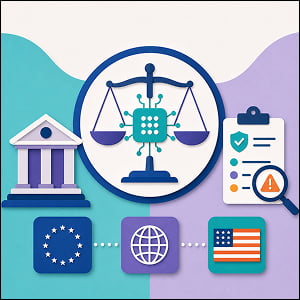
The EU AI Act, the world’s first comprehensive legal framework for artificial intelligence, has been rolling out in phases since August 2024. As of August 2025, rules for general-purpose AI models (the category that includes tools like ChatGPT and Claude) are already in effect. The transparency rules, which require disclosure when consumers are interacting with AI systems like chatbots, become enforceable in August 2026.
For marketing teams, the Act draws a critical distinction between providers (who build AI tools) and deployers (who use them professionally). Most marketing teams fall into the deployer category, and being a deployer doesn’t exempt you from compliance. As the Act makes clear, using a compliant AI tool doesn’t automatically mean your specific use of it is compliant. If your team uses AI systems to evaluate or score individuals, build detailed behavioral profiles, or make automated decisions that significantly affect consumers, you may be operating in high-risk territory under the Act’s framework.
In the United States, there’s no single federal AI law yet, but states are moving fast. As Dataversity reported, states from California to Colorado and Texas have accelerated AI legislation throughout 2025, and U.S. state attorneys general are increasingly using consumer protection and discrimination statutes to pursue AI-related claims. Additionally, the AI Act’s prohibition on subliminal manipulation and exploitative targeting practices should be on every marketer’s radar. As Conformitas notes, this includes dark patterns that use manipulative design elements to trick users into purchases they wouldn’t otherwise make.
The bottom line is that having an internal governance policy isn’t just a best practice, it’s increasingly a regulatory expectation. The IAPP’s AI Governance Profession Report found that 77% of surveyed organizations are currently working on AI governance, with that number jumping to nearly 90% among organizations already using AI. If your marketing team doesn’t have a policy yet, you’re falling behind the curve.
Keeping Your Policy Alive
The biggest mistake organizations make with AI governance isn’t failing to create a policy, it’s creating one and then never touching it again. AI tools, capabilities, and regulations are evolving at a pace that makes a static, “set it and forget it” policy worthless within months.
Your policy should be reviewed quarterly at minimum. Each review should assess whether new tools need to be added to (or removed from) the approved list, whether any regulatory changes affect how your team uses AI, whether any incidents or near-misses have revealed gaps in the policy, and whether the policy is actually being followed or if shadow AI usage has crept back in.
Training is equally important. Don’t just email the policy and assume everyone read it. Walk your team through what it means for their specific workflows. Give them real examples. Show them what a safe prompt looks like versus an unsafe one. Make it easy for people to ask questions and report concerns without fear of punishment.
Finally, treat your governance policy as a living document. As Rubrik’s guide to AI governance puts it, responsible AI governance works best when it’s treated as an operational discipline. The organizations that get this right are the ones that build governance into their culture.
Frequently Asked Questions
Shadow AI refers to the use of artificial intelligence tools within an organization without the knowledge or approval of IT, security, or leadership. In marketing, this often looks like team members using personal ChatGPT accounts to draft copy, plugging customer data into un-vetted analytics tools, or installing AI browser extensions without telling anyone. It’s a growing concern because it creates security, compliance, and brand reputation risks that the organization can’t see or manage.
The EU AI Act (Regulation (EU) 2024/1689) is the European Union’s comprehensive legal framework for regulating artificial intelligence. It uses a risk-based approach, categorizing AI systems into tiers ranging from minimal risk to unacceptable risk, and imposes obligations on both providers (who build AI systems) and deployers (who use them professionally). It entered into force in August 2024, with provisions being phased in through 2027. It applies to any organization that places AI systems on the EU market or uses AI systems within the EU, regardless of where the organization is headquartered.
Under the EU AI Act, a deployer is any organization that uses an AI system in a professional capacity. For marketing teams, this means that if you’re using third-party AI tools for campaigns, content creation, audience segmentation, or customer engagement, you have compliance obligations as a deployer. You can’t simply rely on your vendor’s compliance, you’re independently responsible for ensuring your specific use case doesn’t violate the regulation.
The International Association of Privacy Professionals (IAPP) is the world’s largest global information privacy community. It conducts research, provides education and certification, and publishes reports on privacy, data protection, and AI governance. Their AI Governance Profession Report is one of the most widely cited sources on how organizations are building and staffing AI governance programs.
A data classification tier system is a framework that categorizes your organization’s data into levels based on sensitivity and risk. In the context of AI governance, it helps team members quickly determine which data can be used with which AI tools. A typical three-tier system separates public data (low risk), internal data (medium risk), and sensitive data (high risk), with different rules and approved tools for each tier.
The General Data Protection Regulation (GDPR) is the European Union’s data protection law, which has been in effect since May 2018. It governs how organizations collect, store, process, and share personal data of EU residents. The EU AI Act doesn’t replace GDPR. It sits on top of it, meaning that if your AI use involves personal data about EU individuals, both frameworks apply simultaneously.
Other AI Training Modules You May Be Interested In
The Right Way to Use AI for Topic Clustering and Search Authority
Using AI to Build Quizzes, Calculators, and Interactive Lead-Gen Tools That Actually Convert
Using AI for Video Scripting and Storyboarding in Marketing
Using AI to Improve Accessibility in Marketing Content
Using AI to Design Better Surveys and Unlock Qualitative Research at Scale
