
At Google I/O 2026, Google introduced what it’s calling the biggest upgrade to Search in over 25 years, transforming the familiar search box into an intelligent, AI-powered tool that can handle conversational queries, dispatch background agents, and even build mini apps on demand. Powered by the new Gemini 3.5 Flash model, the redesigned experience blends traditional web search with agentic AI that can monitor information, book appointments, generate custom interfaces, and tap into your personal context across Google apps.
In this article we’ll discuss exactly what Google unveiled at its 2026 developer conference, why the company says it’s re-imagining Search from the ground up, and how new features like Search agents, generative UI, and expanded Personal Intelligence are set to change how you find information online. We’ll also break down which features are rolling out immediately, which are coming down the road, which are reserved for paid subscribers only, and what these changes mean for the future of how people interact with the web.
TL;DR Snapshot
Google used its I/O 2026 keynote to announce a sweeping overhaul of Search, anchored by a redesigned AI-powered Search box, a new generation of background “Search agents” that work for you 24/7, and generative UI features that let Search build custom dashboards and mini apps tailored to specific tasks. According to Google’s official I/O 2026 Search blog, the upgrade is fueled by the newly released Gemini 3.5 Flash model and is now the default for AI Mode globally.
Key takeaways include…
- Google launched the biggest update to its Search box in over 25 years, with AI-powered suggestions, multi-modal inputs, and dynamic expansion.
- New Search agents can monitor the web on your behalf, book appointments, and even call local businesses for you.
- Generative UI capabilities let Search build interactive visuals, custom dashboards, and mini apps on the fly using Google Antigravity.
Who should read this: Marketers, SEO professionals, entrepreneurs, product managers, and anyone curious about the future of AI-driven search.
The Biggest Search Box Upgrade in 25 Years
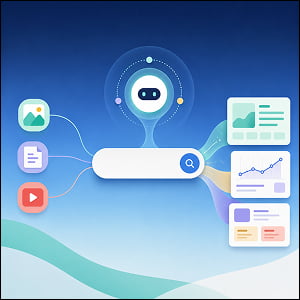
For most of its history the Google search bar has looked roughly the same, but the thin rectangle you’ve come to know and love is sadly being retired. According to Google’s announcement, they’re rolling out an intelligent AI-powered Search box that dynamically expands to fit longer, more conversational queries, and uses AI to anticipate what you’re trying to ask.
Instead of plain autocomplete, the new box offers AI-powered suggestions that help you formulate questions you might not yet know how to phrase. It also supports a much wider range of inputs. As Engadget reported, users can now drop in text, images, files, videos, and even Chrome tabs as the basis for a search.
Powering all of this is Gemini 3.5 Flash, which is now the default model in AI Mode for everyone globally. 9to5Google notes that 3.5 Flash is roughly four times faster than other frontier models in output tokens per second, while still surpassing Gemini 3.1 Pro on coding, agentic, and multi-modal benchmarks. That speed matters because the new Search experience leans heavily on real-time reasoning rather than simple keyword matching.
The traction behind these changes is significant. Google says AI Mode has surpassed one billion monthly users just one year after launch, with queries more than doubling every quarter according to CEO Sundar Pichai.
Search Agents: AI That Works for You in the Background
Perhaps the most ambitious announcement is the introduction of Search agents, AI helpers that you can create, customize, and manage directly inside Search. Google is starting with what it calls “information agents,” which run 24/7 and reason across the web to surface exactly what you need at exactly the right moment.
In practical terms, that means you can tell Search to monitor for an apartment that matches a long list of criteria, watch for a sneaker collaboration drop from a favorite athlete, or track price changes on a specific item. The agent scans blogs, news sites, social posts, and Google’s freshest real-time data on finance, shopping, and sports, then sends back a synthesized update. According to Google’s Search blog, information agents will launch first for their AI Pro and Ultra subscribers this summer.
Google is also expanding agentic booking inside Search to a much wider range of categories, including local experiences and services. You can describe oddly specific requests, like a private karaoke room for six on a Friday night that serves food late, and Search will pull together pricing, availability, and direct booking links. For categories like home repair, beauty, and pet care, Google notes that agents can even place phone calls to businesses on your behalf. These capabilities are slated to roll out to everyone in the U.S. within the next couple of months.
Generative UI, Mini Apps, and Personal Intelligence
Another major shift is what Google calls “agentic coding” inside Search. By integrating Antigravity, their agentic development platform, Search can now generate custom user interfaces on the fly. Ask about astrophysics or how a mechanical watch works, and Search can assemble interactive visuals, tables, graphs, or simulations in real time, rather than dropping you onto a list of blue links.
Google is taking this idea further with what it describes as mini apps. For ongoing tasks like planning a wedding, managing a home move, or building a fitness routine, Search can code custom dashboards or trackers that pull from real-time sources such as reviews, live maps, and weather data. According to Google’s I/O 2026 Search announcement, these custom experiences will roll out soon, starting again with AI Pro and Ultra subscribers.
Finally, Google is expanding what it calls Personal Intelligence in AI Mode to nearly 200 countries and territories across 98 languages, with no subscription required. Users can securely connect apps like Gmail and Google Photos, and eventually Google Calendar, so Search can blend your personal context with general web knowledge. Google emphasizes that connecting these apps is opt-in and that users remain in control of what gets linked and what doesn’t.
Together, these changes signal that Search is no longer just a place to find answers. It’s quickly becoming a platform where AI actively does work for you, whether that’s answering a complex question, monitoring the web in the background, or building a tool tailored to your specific problem.
Frequently Asked Questions
Google I/O is Google’s annual developer conference held in Mountain View, California, where the company reveals updates to its biggest products and platforms. The 2026 event leaned heavily on AI, with a major focus on Gemini and Search updates.
AI Mode is Google’s AI-powered search experience that allows users to ask longer, more conversational questions and get synthesized answers rather than just a list of links. As of 2026 AI Mode has surpassed one billion monthly users.
Gemini 3.5 Flash is Google’s newest Flash-series AI model, designed to combine frontier intelligence with the ability to perform agentic tasks. It’s reportedly about four times faster than other frontier models in output tokens per second and now powers AI Mode in Search by default.
Search agents are AI helpers you can create inside Google Search that run in the background to handle ongoing tasks like monitoring listings, tracking news, or booking appointments. The first type Google is rolling out is called an “information agent,” which continuously scans the web for updates related to your specific question.
Google Antigravity is Google’s agentic development platform, which the company is now integrating into Search to power features like generative UI and custom mini apps. It enables Search to code interactive visuals and dashboards in real time based on what you ask.
Personal Intelligence is a feature inside AI Mode that lets you securely connect Google apps like Gmail and Google Photos so Search can use your personal context when answering questions. Google says it’s expanding the feature to nearly 200 countries and territories across 98 languages, with no subscription required.
Other Enterprise AI Articles You May Be Interested In
How a Single Pull Request Led to the Largest npm Worm Attack of 2026: Exploring Mini Shai-Hulud
Criminal Hackers Used AI to Find a Zero-Day Exploit for the First Time, Google Confirms
SpaceX Colossus 1 Deal With Anthropic: Everything You Need to Know
Why Nvidia Is Betting Big on Fiber Optics with Corning to Power the Future of AI
How SubQ’s SSA Architecture Could Make Million-Token AI Affordable
