

The race to build AI infrastructure has entered a new chapter. On May 6, 2026, Nvidia and Corning announced a multiyear commercial and technology partnership centered on dramatically expanding U.S.-based manufacturing of advanced optical connectivity solutions. The deal includes a $500 million investment from Nvidia, three new manufacturing facilities, thousands of new jobs, and a tenfold increase in Corning’s optical connectivity manufacturing capacity. At the heart of it all is a bet that fiber optics will replace copper as the connective tissue of AI data centers, and that the companies building that future need to move fast.
In this article, we’ll discuss why this partnership matters, what co-packaged optics technology is and why it’s critical for next-generation AI, how this deal fits into a broader pattern of massive infrastructure investments by tech giants, and what it could mean for investors, job seekers, and the U.S. manufacturing sector going forward.
TL;DR Snapshot
Nvidia and Corning have struck a landmark multiyear deal that positions Corning as a central supplier of optical fiber and connectivity technology for Nvidia’s AI infrastructure. The partnership will see Corning build three new advanced manufacturing plants in North Carolina and Texas, boosting its U.S. optical connectivity capacity and fiber production capacity. Nvidia is backing the expansion through share warrants.
Key takeaways include…
- Nvidia is investing $500 million in Corning through warrants and could invest up to $2.7 billion total, signaling deep commitment to securing the optical fiber supply chain for AI.
- Corning will build three new U.S. manufacturing plants and create over 3,000 jobs while increasing their optical connectivity capacity tenfold to keep up with surging AI data center demand.
- The partnership likely lays the groundwork for replacing the thousands of copper cables inside Nvidia’s rack-scale AI systems with fiber optics through a technology called co-packaged optics (CPO).
Who should read this: AI industry professionals, tech investors, supply chain strategists, and anyone following U.S. manufacturing trends.
Why Fiber Optics Are Becoming the Backbone of AI
Modern AI workloads are extraordinarily data-hungry. Training and running large language models requires thousands of GPUs working in concert, and all of those processors need to communicate with each other at extreme speeds. Traditionally, the connections inside server racks and between nearby components have relied on copper cables. But copper has limitations: it loses signal quality over short distances, generates excess heat, wastes energy, and requires costly signal boosters.
Optical fiber solves many of these problems. As Corning has explained, fiber transmits data using light rather than electrical signals, which means less signal loss, lower energy consumption per bit, and dramatically higher bandwidth. Fiber optic cables are already used to move data between servers in today’s data centers. But the connections within racks and close to the chips themselves have remained copper’s territory, until now.
The shift is being driven by a technology called co-packaged optics (CPO). According to Semiconductor Engineering, CPO integrates optical connections much closer to the GPU or switch chip, reducing the need for long and inefficient electrical traces. Instead of converting light to electricity at the server’s face plate and sending it over copper, CPO keeps data in optical form until it’s right next to the processor. The result is faster data transfer, lower power consumption, and less wasted space inside each rack.
At Nvidia’s GTC conference in 2025, CEO Jensen Huang called co-packaged optics essential for their AI build-out according to CNBC’s reporting. That statement now looks like it was foreshadowing this deal.
The Deal: What Nvidia and Corning Are Actually Building
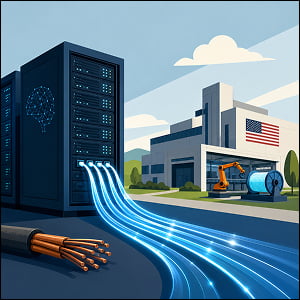
The joint press release from Nvidia and Corning outlines a partnership that’s both a technology collaboration and a major manufacturing expansion. Corning will build three new advanced manufacturing facilities in North Carolina and Texas, increase its U.S.-based optical connectivity manufacturing capacity by 10x, expand its U.S. fiber production capacity by more than 50%, and create more than 3,000 new jobs.
On the financial side, Bloomberg reported that Nvidia purchased $500 million worth of warrants for Corning shares. The structure includes a pre-funded warrant for up to 3 million shares at a nominal price, plus a traditional warrant to buy up to 15 million additional shares at $180 per share. According to CNBC, the deal gives Nvidia the right to invest up to $2.7 billion in Corning overall. The market reacted enthusiastically. Corning shares jumped 14% on the announcement, while Nvidia gained over 5% according to an Investing.com post via Yahoo Finance.
While the two companies didn’t provide specifics about what’s being developed inside the new facilities, the CNBC report suggests that Nvidia is likely preparing to replace copper with Corning’s optical glass fibers in its AI rack-scale systems like Vera Rubin. That would mean swapping out the roughly 5,000 copper cables inside each rack-scale system for fiber optic alternatives.
A Pattern of Massive Bets on Optical Infrastructure
This Nvidia deal isn’t happening in isolation, it’s part of a wave of enormous optical fiber investments driven by the AI boom. In January 2026, CNBC reported that Meta committed to paying Corning up to $6 billion through 2030 for fiber-optic cable for its AI data centers. That deal made Meta the anchor customer for a major expansion of Corning’s cable manufacturing facility in Hickory, North Carolina, which Business North Carolina reported will become the largest fiber-optic cable plant in the world.
And it doesn’t stop there. According to Corning’s Q1 2026 earnings filing, the company has finalized two additional hyperscaler deals similar in size and duration to the Meta agreement. Corning’s optical communications segment saw sales grow 36% year over year.
The pattern here is clear, the biggest tech companies in the world are locking in long-term supply agreements for optical connectivity, treating fiber as a strategic resource on par with training and inference chips. Corning’s stock reflects this reality, having risen more than 250% over the past year.
What This Means for U.S. Manufacturing and Jobs
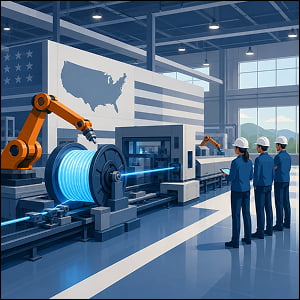
One of the most striking aspects of the partnership is its strong emphasis on domestic manufacturing. All three new facilities will be built in the United States, specifically in North Carolina and Texas. The deal will create more than 3,000 new jobs, adding to the roughly 1,000 jobs expected from the Meta-backed Hickory expansion.
Nvidia CEO Jensen Huang framed the partnership as part of a broader national priority, calling it, according to the Nvidia press release, a once-in-a-generation opportunity to reinvigorate American manufacturing and supply chains.
For Corning, a 175-year-old company that invented low-loss optical fiber back in 1970, it’s a dramatic acceleration. The company is perhaps best known to consumers as the maker of display glass for Apple’s iPhone, but optical communications is now its largest and fastest-growing business. They have now positioned themselves as a foundational supplier for the AI era’s physical infrastructure.
Corning CEO Wendell Weeks has emphasized that AI isn’t just a technology story but a manufacturing story. His company is making sure that the critical technologies powering AI are invented, engineered, and built in the United States.
Frequently Asked Questions
Nvidia is a semiconductor company headquartered in Santa Clara, California. It designs and manufactures graphics processing units (GPUs), which have become the primary chips used to train and run artificial intelligence models. Nvidia’s GPUs power data centers for major tech companies including Google, Meta, Microsoft, and Amazon.
Corning Incorporated is a 175-year-old materials science company based in Corning, New York. It specializes in glass, ceramics, and optical physics. Corning invented low-loss optical fiber in 1970 and is the world’s leading manufacturer of fiber-optic cable. It’s also widely known for making Gorilla Glass, used in smartphones like the iPhone.
Co-packaged optics is a technology that replaces traditional copper connections inside servers with high-speed fiber optical connections placed much closer to the processor chip. Instead of converting light to electricity at the edge of a server, CPO keeps data in optical form until it reaches the chip itself, which reduces energy use, lowers heat output, and dramatically increases data transfer speeds.
In this context, warrants are financial instruments that give Nvidia the right to purchase Corning shares at a specified price within a certain time frame. Nvidia paid $500 million for warrants that allow it to buy up to 18 million total Corning shares. Warrants are different from directly buying stock because they represent the option, not the obligation, to purchase shares later.
A hyperscaler is a company that operates massive-scale data center infrastructure, typically cloud computing and AI providers like Google, Amazon Web Services (AWS), Microsoft Azure, and Meta. These companies are the primary customers driving demand for advanced optical fiber and connectivity solutions.
Rack-scale AI refers to computing systems where an entire server rack is designed to function as a single, integrated unit for AI workloads. Nvidia’s rack-scale systems, such as its Vera Rubin platform, contain thousands of GPUs connected by dense cabling. The shift from copper to fiber optics inside these racks is a key motivation behind the Corning partnership.
Other Enterprise AI Articles You May Be Interested In
How SubQ’s SSA Architecture Could Make Million-Token AI Affordable
HUMAIN ONE: The First Enterprise Operating System for Autonomous AI Agents, Powered by AWS
AI-Powered Vehicle Design: Inside IBM and Dallara’s New Collaboration
