

Conversational analytics in marketing refers to AI-powered tools that let marketers ask questions about their campaign performance in plain, everyday language and receive strategic, actionable answers in return. Rather than requiring teams to build dashboards, export CSV files, or manually crunch numbers across multiple platforms, conversational analytics agents interpret natural-language queries and surface insights drawn from real-time customer and campaign data. It’s an approach that promises to collapse the distance between having data and actually knowing what to do with it.
In this article, we’ll discuss Intuit Mailchimp’s brand-new Analytics AI feature, announced on May 28, 2026, and what it means for e-commerce brands and small-to-midsize businesses trying to make smarter marketing decisions. We’ll explore how Analytics AI works, why it matters in a landscape where marketers are drowning in data, how expanded integrations with Claude, ChatGPT, Shopify, Wix, WooCommerce, and Canva fit into the bigger picture, and what Mailchimp’s roadmap toward fully agentic marketing could look like in the months ahead.
TL;DR Snapshot
Intuit Mailchimp has launched Analytics AI, a native conversational analytics agent that connects campaign performance, audience behavior, and revenue data so marketers can ask questions and get strategic recommendations without ever touching a spreadsheet. Alongside it, expanded integrations with popular third-party tools aim to unify e-commerce data across platforms and let marketers build campaigns directly from the conversational AI solutions they already use.
Key takeaways include…
- Analytics AI eliminates manual reporting by letting marketers ask plain-language questions and receive instant, actionable next steps tied directly to revenue impact.
- New integrations with Claude and ChatGPT allow marketers to draft, refine, and finalize complete Mailchimp campaigns without leaving their preferred AI tool.
- Mailchimp is positioning Analytics AI as the foundation for a fully agentic future where the platform autonomously plans, builds, and executes campaigns based on what’s working.
Who should read this: E-commerce marketers, small business owners, solopreneurs, and AI-curious entrepreneurs.
The Problem Analytics AI Is Solving: Too Much Data, Not Enough Direction
Marketers in 2026 aren’t lacking data, they’re lacking clarity. According to HubSpot’s 2026 Marketing Report, 33% of marketers said assessing campaign effectiveness was their single biggest challenge in 2025, making it the number-one issue in the survey. That finding is especially striking given that 65% of companies in the same report said they exceeded their goals. In other words, marketing teams are hitting targets but can’t always explain which activities actually drove the results.
For smaller teams, the problem is compounded. A report from PGM Solutions and Ascend2 found that 81% of marketers say data challenges are holding them back, with 57% pointing to a lack of accurate data for personalization and 47% struggling to combine data from different sources. That’s the gap Mailchimp is targeting. As Diana Williams, VP of Product at Intuit Mailchimp put it in the company’s press release, “E-commerce brands tell us they have too much data but are starving for actionable insights.”
Analytics AI is designed to bridge that gap by turning Mailchimp into something closer to a marketing data analyst than a reporting tool. Instead of logging in, navigating to a dashboard, filtering by date range, and exporting a report, marketers can simply ask a question like “Which campaign drove the most revenue last month?” or “What audience segment has the highest engagement?” and get a direct, strategic answer with recommended next steps.
How It Works: Conversational Intelligence Meets Ecommerce Data
Under the hood, Analytics AI pulls from a marketer’s connected e-commerce data (from platforms like Shopify, WooCommerce, and Wix) alongside their full Mailchimp campaign history. The agent analyzes patterns across campaign performance, audience behavior, and revenue outcomes to identify what’s working and what isn’t, then surfaces specific recommendations that tie marketing activity directly to revenue impact.

This isn’t just a chatbot slapped on top of a dashboard though. According to Mailchimp’s announcement, the tool is purpose-built for omnichannel campaign performance and audience analytics, meaning it’s designed to work across email, SMS, and other channels marketers manage in the platform. Early adopters are already reporting significant time savings. Paulina Petkoski, Founder and Director of Playground Detroit (a contemporary art gallery that participated in the private beta) exclaimed that “Instead of spending over an hour manually processing reports, we can instantly access what we need through an intuitive, interactive search.”
Alongside Analytics AI, Mailchimp is also rolling out an AI Segment Builder in beta. This feature lets marketers describe their ideal audience using plain language, and AI automatically constructs the segment using behavioral, demographic, and engagement data. Together, these tools represent a shift from Mailchimp as a “do-it-yourself” platform to something more like a “describe-what-you-want” platform.
Expanding the Ecosystem: Claude, ChatGPT, and One-Click Data Activation
Perhaps the most forward-thinking piece of this announcement is how Mailchimp is meeting marketers where they already work. Official Mailchimp integrations, available in both Anthropic’s Claude and OpenAI’s ChatGPT, allow users to draft and refine personalized omnichannel campaigns using conversational prompts that pull directly from their Mailchimp customer data and campaign history. Once a campaign is finalized, it’s available within Mailchimp for launch in a single action.
This is significant because it acknowledges a reality that many platform companies have been slow to accept: marketers are increasingly doing their thinking and ideation inside AI tools, not inside marketing platforms. By integrating with Claude and ChatGPT, Mailchimp is turning campaign creation into a conversational workflow rather than a multi-step technical process that requires hopping between apps.
On the data side, Mailchimp is expanding its one-click Site Tracking Pixel activation to WooCommerce and Wix, following its earlier launch on Shopify. This makes it easier for merchants to capture on-site actions (like product views and cart additions) and use them as real-time automation triggers. The company also announced a deeper Canva integration that lets marketers import HTML and share select Canva designs directly into Mailchimp as ready-to-send emails. For brands in regulated industries like alcohol, new age-gating on SMS signup forms opens up a compliant way to collect and message SMS contacts.
The Bigger Picture: Laying the Foundation for Agentic Marketing
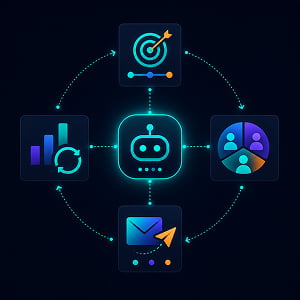
Mailchimp isn’t framing Analytics AI as a standalone feature, it’s positioning it as the first step toward what the company calls a “fully connected marketing AI experience.” In this vision, brands would describe what they want to accomplish, and AI would handle the rest from planning the strategy to building the audience, drafting the campaigns, and eventually even learning from the results.
This aligns with a broader industry trend. According to Six Degrees, measuring the impact of marketing activities is becoming increasingly difficult as platforms proliferate and buyer journeys fragment. Leadership teams are demanding clearer connections between campaign metrics and actual business outcomes. Tools like Analytics AI are a direct response to that pressure, promising to show not just what happened but why it happened and what to do next.
For Mailchimp specifically, the stakes are quite high. They serve over 13 million users worldwide and remains the largest email marketing platform by customer count according to their own reporting. But competition from tools like Brevo, ActiveCampaign, and others is intensifying. Investing in conversational AI and agentic capabilities is a clear play to differentiate on intelligence rather than just features, giving smaller businesses access to the kind of data-driven decision-making that used to require a dedicated analyst on staff.
Analytics AI is available now to all Mailchimp customers on paid plans globally. The AI Segment Builder is in beta with broader availability coming soon. The Claude and ChatGPT integrations are live for users in the US, Canada, UK, and Australia.
Frequently Asked Questions
Intuit Mailchimp is an email marketing and automation platform owned by Intuit Inc. It helps businesses design email campaigns, manage subscriber lists, automate marketing workflows, and analyze campaign performance. Intuit acquired Mailchimp in 2021, and it now sits alongside other Intuit products like TurboTax, QuickBooks, and Credit Karma.
Analytics AI is a new conversational analytics agent built natively into Mailchimp. It lets marketers ask questions about their campaign performance, audience behavior, and revenue data in plain language and receive strategic, actionable recommendations in return. It’s designed to replace manual dashboard analysis and reporting with a more intuitive, conversational experience.
A conversational analytics agent is an AI-powered tool that allows users to interact with their data through natural-language questions rather than traditional reporting interfaces. Instead of building charts or filtering tables, users can type or speak a question, and the agent interprets it, queries the underlying data, and returns a clear answer with context and next steps.
An AI Segment Builder is a tool that lets marketers describe their target audience in plain language, and AI automatically creates a filtered audience segment based on behavioral, demographic, and engagement data. This replaces the manual process of setting segment rules and filters one by one.
The Mailchimp Site Tracking Pixel is a small piece of code that merchants install on their e-commerce sites to capture visitor behavior, like product views and cart additions. This data feeds into Mailchimp’s automation and segmentation tools, enabling personalized campaigns triggered by real-time customer actions.
Agentic AI refers to AI systems that can autonomously plan, execute, and optimize tasks on behalf of a user with minimal human intervention. In a marketing context, this means AI that could independently build audience segments, draft campaigns, schedule sends, and adjust strategy based on performance data. Mailchimp has described Analytics AI as the foundation for this kind of fully agentic marketing experience.
Other Enterprise AI Articles You May Be Interested In
CNN Sues Perplexity AI Over Copyright Theft: What You Need to Know
Disarm AI: Inside Pope Leo’s Encyclical and Its Challenge to the Trump Administration’s AI Strategy
OpenAI Just Solved a Problem That Stumped Mathematicians for 80 Years
Google I/O 2026 Recap: New AI Search Box, Search Agents, and More
How a Single Pull Request Led to the Largest npm Worm Attack of 2026: Exploring Mini Shai-Hulud
