

Pope Leo XIV’s first encyclical, titled “Magnifica Humanitas” (“Magnificent Humanity”), is a sweeping 42,000-word teaching document that calls for the “disarming” of artificial intelligence. Released on May 25, 2026, the encyclical represents the Catholic Church’s most authoritative statement yet on the risks posed by AI, covering everything from autonomous weapons and job displacement to the concentration of technological power in the hands of a few corporations. It’s a document that positions the Vatican as a leading moral voice in one of the most consequential debates of our time.
In this article, we’ll discuss how Pope Leo’s landmark encyclical has exposed a deep ideological rift in how the world’s most powerful institutions think about AI. We’ll explore the Pope’s vision for a human-centered approach to AI governance, Anthropic’s surprising alignment with the Vatican’s concerns, and the Trump administration’s fundamentally different philosophy that prioritizes deregulation and military dominance. Together, these three perspectives form a triangle of tension that will shape how AI develops for years to come.
TL;DR Snapshot
Pope Leo XIV’s Magnifica Humanitas has thrust the question of AI governance onto the global stage, setting up a remarkable clash between religious authority, Silicon Valley ethics, and political power. The Pope is calling for robust legal frameworks and independent oversight. Anthropic, the maker of the Claude family of AI models, sent its co-founder to the Vatican to voice agreement. And the Trump administration, which has already blacklisted Anthropic from military contracts, is pushing in the opposite direction.
Key takeaways include…
- Pope Leo XIV’s encyclical calls AI a threat to human dignity and demands that governments, not tech companies, set the rules for how it’s developed and deployed.
- Anthropic co-founder Chris Olah spoke alongside the Pope at the Vatican, calling for “moral voices that the incentives cannot bend” and admitting that AI labs face pressures that “can sometimes conflict with doing the right thing.”
- The Trump administration has taken the opposite approach, labeling Anthropic a “supply chain risk” after the company took a hard-line stance against the use of its AI for autonomous weapons and mass surveillance.
Who should read this: Policymakers, tech professionals, ethicists, faith leaders, and anyone interested in the global debate over AI regulation.
To Disarm Does Not Mean Rejecting Technology
Pope Leo XIV’s recent encyclical didn’t mince words when it came to his thoughts on AI. As reported by CBS News, it acts as a stark warning against “a race for ever more powerful algorithms and larger datasets, driven by the desire to secure geopolitical or commercial dominance.” The Pope, who holds a degree in mathematics, used language that was unusually direct for a Vatican document.
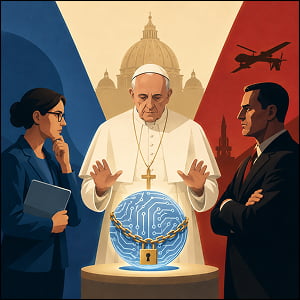
The core argument of the encyclical, entitled Magnifica Humanitas, is that AI is not morally neutral. Every algorithm reflects the choices, priorities, and biases of the people who built it. And when those algorithms are deployed at scale, they can hollow out the middle class, deepen inequality, and normalize AI-driven warfare. The Pope insisted that ownership of AI data must not be left solely in private hands and that policymakers need to protect workers’ rights and keep children safe.
The encyclical also takes direct aim at military applications of AI. According to the USCCB’s coverage, the Pope acknowledged the benefits of AI but was unequivocal in stating that more scrutiny is required. He noted that the word “disarm” was “deliberately chosen because this moment needs words capable of attracting attention, awakening consciences and indicating paths forward for humanity.”
Crucially, he framed this not as a rejection of technology but as a call for governance. As PBS News reported, the encyclical states that invoking ethics in the abstract isn’t enough, and that “robust legal frameworks, independent oversight, informed users, and a political system that does not abdicate its responsibility are required.”
An Unlikely Alliance: Anthropic at the Vatican
What made the encyclical’s release truly unusual was that the Pope chose not to present it alone. Christopher Olah, co-founder of Anthropic (the company that builds the powerful Claude family of AI models) sat alongside cardinals and theologians at the Vatican’s Synod Hall, and at one point was invited to share the stage.
As the National Catholic Reporter put it, the 33-year-old atheist tech leader and the Pope made “an unlikely duo in championing a partnership between the Catholic Church and the tech industry.” Olah’s full remarks, published on Anthropic’s website, were strikingly candid. He admitted that every frontier AI lab, including his own, “operates inside a set of incentives and constraints that can sometimes conflict with doing the right thing.” He called out “the pressure to stay commercially viable and to stay at the research frontier,” as well as “the older, plainer pressures of pride and ambition.”
Olah’s speech highlighted three areas that he said need urgent attention from voices outside the tech industry. The first is the duty to the global poor, warning that AI development is concentrated in a handful of wealthy nations and there’s no mechanism in place to ensure that any gains are shared worldwide. The second is the need for “moral imagination” about human flourishing in a world where AI is pervasive. And the third is a more philosophical concern: that researchers are finding mysterious internal structures inside AI models, including states that functionally mirror human emotions.
As Angelus News reported, there was a poignant moment where Pope Leo thanked Olah for being there, exclaiming “What a great sign of hope it is that with our differences we can listen to one another.”
This alliance isn’t just symbolic, Anthropic has been locked in a bitter legal and political dispute with the Trump administration over some of the issues the Pope’s encyclical raises. The company’s decision to send a co-founder to the Vatican, rather than a policy spokesperson, signaled the depth of its alignment with the Pope’s vision.
The Trump Administration’s Opposite Bet
While Pope Leo and Anthropic are calling for caution and oversight, the Trump administration has spent the past year moving aggressively in the other direction. According to a Brookings Institution analysis, the administration’s AI Action Plan (released in July 2025) focuses on “deregulation and infrastructure investment to achieve global AI dominance,” representing a notable shift from previous, more cautious AI policies.

Tensions between Anthropic and the government came to a head in early 2026 when the Pentagon demanded that Anthropic remove the safety guardrails preventing its Claude AI models from being used for autonomous weapons and mass domestic surveillance. Anthropic refused. According to NPR’s reporting, President Trump then ordered all federal agencies to stop using Anthropic’s technology, and Defense Secretary Pete Hegseth designated the company a “supply chain risk to national security,” effectively blacklisting it from working with the military or its contractors. It was the first time such a designation had been applied to a U.S. company.
As CNBC reported, the Pentagon’s Chief Technology Officer explained the reasoning in stark terms, exclaiming that the government can’t allow a company with “a different policy preference” to “pollute the supply chain so our warfighters are getting ineffective weapons.” OpenAI (Anthropic’s primary competitor) quickly signed a contract with the Defense Department to fill the gap.
A CNN report detailed how a federal judge in California later blocked Secretary Hegseth’s efforts, ruling that “nothing in the governing statute supports the Orwellian notion that an American company may be branded a potential adversary and saboteur of the U.S. for expressing disagreement with the government.” The legal battle, however, has continued through the appeals courts.
In any case, the broader context is very telling. According to Morrison Foerster’s legal analysis, the Trump administration’s National AI Policy Framework (released in March 2026) recommends federal preemption of state AI laws, and reflects “a policy preference for a sector-specific, federally led regulatory model.”
What Comes Next
The release of Magnifica Humanitas has crystallized a global debate into three distinct camps. One, led by the Vatican and echoed by voices across civil society, argues that AI’s development must be slowed down, governed by robust legal frameworks, and directed toward the common good of all people. Another, represented by Anthropic and a handful of other AI companies, agrees with many of those principles in theory but is trying to balance them against the realities of commercial competition. And a third, represented by the Trump administration and other world governments, views AI primarily through the lens of national security and economic dominance, treating regulation as an obstacle to be cleared.
The Pope’s encyclical has given moral weight to the argument for caution, and Anthropic’s presence at the Vatican has given it institutional credibility. As Chris Olah said in his Vatican address, “We need more of the world to do what His Holiness has done here. To take this seriously, to look closely, and to push events in a better direction.” Whether the world listens or not may depend on which of the aforementioned three visions ultimately wins out.
Frequently Asked Questions
Pope Leo XIV, born in Chicago, is the first American-born Pope. He was elected in May 2025 following the death of Pope Francis. He holds a degree in mathematics and has made artificial intelligence one of the central concerns of his papacy.
An encyclical is one of the highest forms of teaching issued by a Pope to the Roman Catholic Church. It’s a formal letter that outlines the Pope’s position on important theological, social, and/or moral issues. While encyclicals have traditionally been intended to address the Church’s 1.4 billion members, recent Popes have begun using them to speak to the wider world about important global challenges.
Magnifica Humanitas (Latin for Magnificent Humanity) is the title of Pope Leo XIV’s first encyclical. Released on May 25, 2026, it spans roughly 42,000 words and addresses the moral, social, and political challenges posed by artificial intelligence. It calls for the “disarming” of AI and advocates for robust regulation and oversight.
Anthropic is a U.S.-based AI company that develops the Claude family of AI models. Co-founded by former members of OpenAI (its primary competitor), the company has positioned itself as a leader in AI safety research and has drawn attention for its refusal to allow its technology to be used in autonomous weapons and mass surveillance systems.
Christopher Olah is a Canadian AI researcher and co-founder of Anthropic. He leads research focused on understanding the internal structures of AI models. Olah was invited by Pope Leo XIV to speak at the Vatican for the release of Magnifica Humanitas, where he called for “moral voices that the incentives cannot bend.”
The Trump administration’s approach to AI, outlined in its July 2025 America’s AI Action Plan and its March 2026 National AI Policy Framework, emphasizes deregulation, infrastructure investment, and U.S. global dominance in AI. It has rolled back safety requirements and pushed to preempt state-level AI regulations.
In the context of the Anthropic dispute, the “supply chain risk” label was applied by Defense Secretary Pete Hegseth in early 2026 after Anthropic refused to remove safety guardrails from its AI models for military use. The designation effectively bars the company and any contractors working with the Pentagon from using Anthropic’s technology.
Other Enterprise AI Articles You May Be Interested In
OpenAI Just Solved a Problem That Stumped Mathematicians for 80 Years
Google I/O 2026 Recap: New AI Search Box, Search Agents, and More
How a Single Pull Request Led to the Largest npm Worm Attack of 2026: Exploring Mini Shai-Hulud
Criminal Hackers Used AI to Find a Zero-Day Exploit for the First Time, Google Confirms
SpaceX Colossus 1 Deal With Anthropic: Everything You Need to Know
