

The Pentagon’s decision to expand its artificial intelligence partnership with Google represents one of the most significant intersections of military power and private-sector technology in recent memory. At its core, the deal allows the U.S. Department of Defense to use Google’s Gemini AI models on classified military networks for “any lawful government purpose,” a broad mandate that has reignited fierce debate about the role of Silicon Valley in modern warfare, government surveillance, and the ethical boundaries of AI.
In this article, we’ll discuss how this deal came together, why it matters in the broader context of the Pentagon’s AI strategy, and what the growing tension between tech companies, their employees, and the federal government could mean for the future of defense technology. We’ll also explore the fallout from the Anthropic dispute that set the stage for Google’s expanded role, and why hundreds of Google’s own workers tried to stop the deal from happening.
TL;DR Snapshot
The U.S. Department of Defense has signed an amended contract with Google, expanding access to the company’s Gemini AI for use on classified military networks. The deal, reportedly valued at up to $200 million, comes after the Pentagon cut ties with AI company Anthropic over disagreements about usage restrictions, and it positions Google alongside OpenAI and xAI as key AI providers for the American military.
Key takeaways include…
- Google’s Gemini AI can now be used on classified Pentagon networks for purposes including logistics, cybersecurity, mission planning, and weapons targeting.
- Over 600 Google employees signed an open letter to CEO Sundar Pichai urging him to reject the deal, arguing that classified workloads make it impossible to ensure the technology isn’t misused.
- The deal follows the Pentagon’s blacklisting of Anthropic after the AI company refused to grant unrestricted access to its models, a move that resulted in a supply chain risk designation and ongoing litigation.
Who should read this: Tech professionals, national security analysts, AI ethics advocates, defense industry stakeholders, and anyone following the intersection of artificial intelligence and government policy.
How the Deal Came Together: From Unclassified Access to Classified Networks
Google’s relationship with the Pentagon didn’t start this week, they had already signed a contract allowing their Gemini AI to be used on unclassified government systems, including through the Pentagon’s GenAI.mil platform. What changed on April 28, 2026 was the scope. According to eWeek, the new layer is an amendment to the existing $200 million contract, extending access to classified networks used for sensitive operations.
The contract permits the Pentagon to use Google’s AI for “any lawful government purpose.” While it includes language stating that the technology isn’t intended for autonomous weapons or domestic mass surveillance, the enforceability of those provisions remains an open question. Axios reported that, unlike OpenAI’s deal, Google’s agreement doesn’t give the company the right to control or veto how the government uses the technology. According to reporting cited by Axios, Google agreed to adjust its AI safety settings at the government’s request, while OpenAI reportedly retains “full discretion” over its safety mechanisms.
Pentagon AI chief Cameron Stanley confirmed the expansion in a CNBC interview, noting that the DoD is working with multiple AI vendors to modernize military capabilities. He emphasized that depending on a single provider isn’t a sustainable strategy, and pointed to concrete results already being delivered by AI adoption.
The Anthropic Dispute: The Catalyst Behind Google’s Expanded Role

To understand why Google’s deal matters, you have to understand what happened with Anthropic. In July 2025, Anthropic became the first frontier AI company to have its model approved for classified Pentagon networks, according to analysis from law firm Mayer Brown. That contract included an acceptable use policy with specific guardrails, including restrictions on using the technology for mass domestic surveillance or fully autonomous weapons.
The relationship fractured when the Pentagon pushed to renegotiate those terms, demanding that Anthropic allow its Claude models to be used “for all lawful purposes” without limitation. Anthropic’s CEO, Dario Amodei, refused. As Euronews reported, Amodei stated publicly that he could not agree to the Pentagon’s request for unrestricted access, citing concerns that certain AI applications could undermine democratic values rather than defend them.
The consequences came swiftly. On February 27, 2026 President Trump directed all federal agencies to stop using Anthropic’s technology, and Defense Secretary Pete Hegseth designated the company a “supply chain risk,” a label typically reserved for foreign adversaries. As CNBC reported, Anthropic filed lawsuits challenging the designation in two federal courts in March. The legal battles are ongoing, with split decisions leaving Anthropic excluded from Defense Department contracts but still able to serve other government agencies.
The Anthropic blacklisting created a vacuum, and Google, OpenAI, and Elon Musk’s xAI moved quickly to fill it. As TechCrunch noted, Google became the third major AI company to step into the gap left by Anthropic’s departure.
Employee Resistance: A Familiar Fight with Higher Stakes
Google’s agreement with the Pentagon didn’t go unchallenged internally. More than 600 employees, including over 20 directors, senior directors, and vice presidents, many from Google’s DeepMind AI research lab, sent an open letter to CEO Sundar Pichai demanding that he reject the deal, according to SiliconANGLE.
The letter argued that on air-gapped classified networks, Google would have no ability to monitor or limit how its AI tools are actually used. As the employees wrote, per CBS News reporting, they feel their proximity to the technology creates a responsibility to prevent its most unethical and dangerous applications.
This isn’t the first time Google employees have organized against military partnerships. In 2018, roughly 4,000 workers signed an internal petition, and at least 12 resigned, over Google’s involvement in Project Maven, a Pentagon program that used AI to analyze drone footage. The protests led Google to let the Maven contract expire and to introduce AI principles pledging not to pursue weapons or surveillance technology, as NBC News recounted.
But the landscape has shifted dramatically since 2018. As The Next Web detailed, Google has since won a share of the Pentagon’s $9 billion Joint Warfighting Cloud Capability contract, deployed Gemini to 3 million Pentagon personnel, and, according to reporting from Common Dreams, removed prior commitments about not using AI for weapons development from its AI principles. The 2018 victory was real, but Google has spent years rebuilding its defense credentials since then.
The deal was signed at 4 p.m. on Monday April 28, 2026, the same day the employee letter was delivered, according to Bloomberg.
The Bigger Picture: A New AI Arms Race Inside the Pentagon
Google’s deal doesn’t exist in isolation, it’s part of a broader Pentagon strategy to diversify its AI vendor base and integrate artificial intelligence into nearly every facet of military operations. Defense Secretary Pete Hegseth has been vocal about transforming the military into what he’s called an “AI-first warfighting force,” as NBC News reported.
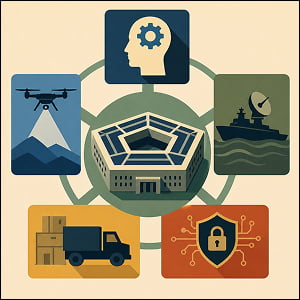
In addition to Google, the Pentagon now has agreements with OpenAI and xAI. Pentagon AI chief Cameron Stanley told CNBC that AI is already delivering results, saving thousands of man-hours weekly across various military operations. Use cases span logistics, cybersecurity, diplomatic translation, fleet maintenance, and defense of critical infrastructure.
But the rush to adopt AI has outpaced the policy frameworks meant to govern it. According to Axios, Congress has been slow to pass legislation establishing guardrails for military AI. Advocates like Hamza Chaudhry of the Future of Life Institute have been pushing for greater transparency and modernized testing processes before AI systems are deployed in the field. As Chaudhry noted to Axios, congressional attention hasn’t matched the rapid deepening of ties between powerful AI technology and the world’s most formidable and well-funded military.
The question going forward isn’t whether AI will become a core component of American defense strategy, it effectively already is. The real question is who gets to set the rules, and whether the contractual language governing these deals is strong enough to prevent the misuse that employees, advocacy groups, and at least one major AI company have warned about.
Frequently Asked Questions
Gemini is Google’s family of large language models and multimodal AI systems. It’s the company’s most advanced AI platform, capable of processing text, code, images, and other data types. Gemini powers many of Google’s consumer and enterprise products, and it’s now the primary AI model being used in the Pentagon’s classified and unclassified operations.
OpenAI is an AI company founded in 2015 that builds the GPT family of large language models and the widely used ChatGPT chatbot. Originally established as a nonprofit research lab, OpenAI has since transitioned toward a for-profit structure. The company was one of the first major AI labs to sign a deal with the Pentagon, revising its earlier “no military use” policy to allow national security applications of its technology. OpenAI’s contract with the DoD reportedly includes provisions against mass domestic surveillance and autonomous weapons, and the company says it retains full discretion over its safety mechanisms.
xAI is an artificial intelligence company founded by Elon Musk in 2023. The company develops the Grok family of AI models. xAI signed its own deal with the Pentagon following the Anthropic dispute, joining Google and OpenAI as the Defense Department’s primary AI vendors.
Anthropic is an AI company founded in 2021 by former OpenAI executives, including CEO Dario Amodei. The company builds the Claude family of AI models and became the first frontier AI company approved for classified Pentagon use in July 2025, but was later designated a supply chain risk after refusing to grant the military unrestricted access to its technology.
A supply chain risk designation is a formal determination by the Department of Defense that a company’s products or services pose a threat to national security. It’s a label historically reserved for entities from hostile foreign nations. When applied, it prohibits defense contractors from using the designated company’s technology in Pentagon-related work.
GenAI.mil is the Department of Defense’s centralized platform for deploying generative AI tools across military operations. It serves as the gateway through which service members and defense personnel access AI models from companies like Google and OpenAI for unclassified work.
Project Maven was a Pentagon program launched in 2017 that used artificial intelligence to analyze drone surveillance footage. Google’s involvement in the project sparked a major employee protest in 2018, with thousands of workers signing petitions against the work. Google ultimately let the Maven contract expire, and the project was taken over by Palantir.
The JWCC is a $9 billion multi-vendor cloud computing contract awarded by the Pentagon in December 2022. It replaced the controversial single-vendor JEDI contract and was split among Amazon, Google, Microsoft, and Oracle to provide cloud infrastructure services across all classification levels for the U.S. military.
This is the broad usage language the Pentagon favors, and it means the military can use the AI technology for any application that doesn’t violate existing law. Critics argue that this framing is too vague and could be interpreted to permit uses that many would consider ethically problematic, even if technically legal.
Other Enterprise AI Articles You May Be Interested In
Nvidia Nemotron 3 Nano Omni: A Unified Open Model for Vision, Audio, and Text
NetSuite SuiteConnect 2026: New AI Coding Agent Skills for SuiteCloud Developers
Meta’s $2B Manus AI Acquisition Blocked: What Founders, VCs, and Tech Leaders Need to Know
DeepSeek V4 Changes the AI Pricing Game: Full Breakdown and Analysis
GPT-Image-2 Is Here: What Marketers, Designers, and Developers Need to Know
