
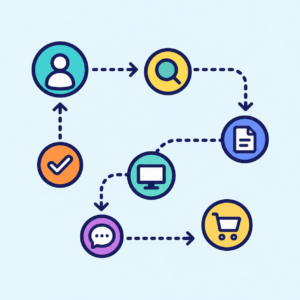
 Most B2B marketing frameworks are built around a simple idea: buyers move through a funnel in a predictable sequence. Awareness leads to consideration, consideration leads to decision, and decision leads to conversion. This model is easy to understand, easy to report on, and easy to build campaigns around.
The problem is that it does not reflect how buyers actually behave.
In reality, the B2B buyer journey is fragmented, inconsistent, and often unpredictable. Buyers move forward, backward, sideways, and sometimes not at all. They revisit the same content multiple times, engage across different channels, disappear for weeks, and then return with a completely different level of intent.
The Illusion of the Funnel
The traditional funnel suggests progression. It assumes that once a buyer moves from one stage to the next, they do not go back. But real buying behavior does not follow that pattern. Buyers frequently return to earlier stages, especially when new stakeholders are introduced, priorities shift, or additional information is needed.
This creates a disconnect between how performance is measured and how decisions are actually made. A buyer may look like they are in the awareness stage based on one interaction, while simultaneously evaluating vendors based on another. The journey is not a straight line. It is a series of overlapping behaviors.
Multiple Touchpoints, No Clear Order
Modern B2B buyers interact with content across multiple channels before making a decision. They might read a blog post, attend a webinar, see a social post, revisit the website, and download a guide, all in no consistent order. Each of these interactions contributes to their understanding, but none of them alone defines where they are in the journey.
This makes it difficult to assign meaning to any single action. A download does not necessarily mean consideration. A website visit does not necessarily mean interest. Context matters more than sequence, and without it, individual touchpoints can be misleading.
Different Stakeholders, Different Journeys
In B2B, buying decisions are rarely made by one person. Multiple stakeholders are involved, each with their own perspective, priorities, and level of engagement. One stakeholder may be deep in evaluation, while another is just becoming aware of the problem.
This adds another layer of complexity. The “buyer journey” is not one journey. It is a combination of several journeys happening at the same time. Marketing may engage one person early, while sales interacts with another later. Without visibility into the full buying group, it is easy to misinterpret where the account actually stands.
Engagement Does Not Equal Progression
One of the biggest misconceptions is that more engagement means a buyer is moving forward. In reality, engagement can represent many different things. It can signal curiosity, research, comparison, or even internal disagreement.
A buyer who engages repeatedly is not necessarily closer to a decision. They may still be trying to understand the problem, justify the investment, or align stakeholders internally. Without signs of narrowing focus or increased urgency, engagement alone is not a reliable indicator of progression.
Why Buyers Move Backward
Movement in the buyer journey is not always forward. Buyers often return to earlier stages for several reasons. New stakeholders may need to be educated. Budget concerns may require reevaluation. Competing priorities may delay the decision. External factors such as market conditions or internal changes can also reset progress.
This backward movement is normal, but it is rarely accounted for in reporting or forecasting. Instead, it is often interpreted as lost momentum, when in reality it is part of the process.
What This Means for Marketing
If the buyer journey is not linear, then marketing strategies built around linear progression are incomplete. Campaigns that assume a fixed sequence may miss opportunities to engage buyers who are moving in different directions.
Instead of focusing on pushing buyers from one stage to the next, marketing needs to focus on being present across multiple stages at once. This means creating content that supports different levels of awareness, different stakeholder needs, and different moments in the journey, all at the same time.
What This Means for Sales
For sales teams, a non-linear journey means that timing becomes more important than sequence. Buyers may enter conversations at different points, with different levels of knowledge and different expectations. A single interaction does not define readiness.
Sales teams need to adapt by focusing less on where a lead is “supposed” to be and more on what they are actually showing through their behavior. This requires flexibility, context, and a willingness to meet buyers where they are, rather than where the funnel suggests they should be.
Measuring What Actually Matters
Traditional metrics often struggle to capture non-linear behavior. Stage-based reporting, linear attribution models, and single-touch metrics all assume a predictable path. When that path does not exist, these measurements lose accuracy.
More useful indicators tend to focus on patterns rather than stages. Repeated engagement, cross-channel interaction, involvement from multiple stakeholders, and shifts in behavior over time provide a clearer picture of intent than isolated actions.
Final Thought
The B2B buyer journey is not broken. It is simply more complex than the models used to describe it. Buyers do not follow a script, and they do not move in straight lines.
The teams that perform best are not the ones trying to force buyers into a funnel. They are the ones that understand how buyers actually behave and build strategies that reflect that reality.
