

SuiteCloud Agent Skills are a new set of knowledge packages from Oracle NetSuite that give AI coding agents the context they need to build, review, and deploy NetSuite customizations with greater speed and accuracy. Announced at SuiteConnect San Francisco on April 28, 2026, these skills are designed to bridge the gap between general-purpose AI code assistants and the specific conventions, patterns, and best practices that define the SuiteCloud development platform. For businesses that rely on NetSuite as their core ERP system, this is a significant step toward faster, safer, and more consistent application development.
In this article, we’ll discuss what SuiteCloud Agent Skills are, why NetSuite’s adoption of the agentskills.io open standard matters, what specific skills are included in the initial release, and how this announcement fits into the larger trend of AI-assisted enterprise software development. We’ll also look at why this is relevant for NetSuite developers, solution partners, and business leaders evaluating the future of ERP customization.
TL;DR Snapshot
SuiteCloud Agent Skills are reusable, platform-agnostic knowledge packages that teach AI coding assistants how to write, review, and deploy NetSuite-compliant code. By leveraging the agentskills.io open standard, these skills work across more than 25 AI coding platforms, including tools like Claude Code, OpenAI Codex, and Cursor. The goal is to reduce the time and risk involved in building custom NetSuite applications and extensions.
Key takeaways include…
- NetSuite is the first ERP platform to adopt the agentskills.io open standard, enabling its development knowledge to be used across 25+ AI coding tools.
- The initial release includes six targeted skills covering UI components, permissions, SuiteScript references, documentation, security, and legacy code migration.
- Two skills are available globally now with the remaining skills coming to GitHub soon, though no specific release date has been given.
Who should read this: NetSuite developers, SuiteCloud partners, ERP administrators, IT leaders, and anyone interested in how AI is changing enterprise software development.
What Are SuiteCloud Agent Skills?
At their core, SuiteCloud Agent Skills are structured knowledge packages that provide AI coding agents with domain-specific expertise about NetSuite development. Think of them as on-boarding guides for AI assistants. Rather than relying on an AI tool’s general programming knowledge (which may be incomplete or outdated when it comes to NetSuite-specific APIs and conventions), these skills supply precise, validated information that the agent can reference while writing or reviewing code.
According to the official press release from Oracle NetSuite, the skills are built to be compatible with the agentskills.io specification, an open standard originally developed by Anthropic and now adopted by a wide range of AI development tools. As the NetSuite SuiteCloud SDK GitHub repository explains, each skill is self-contained and follows a consistent structure so that agents can discover, load, and use them reliably across different platforms.
Brian Chess, senior vice president of AI, Product, and Technology at Oracle NetSuite, framed the announcement in terms of business impact. He the ability for customers and partners to move away from lengthy, error-prone coding cycles and toward AI-assisted development that’s fast, secure, and consistent.
This isn’t just about making coding faster though, it’s also about making it more reliable. When an AI assistant has access to a validated catalog of 684 permission codes (as the Permissions References Skill provides), developers don’t have to worry about manual lookup errors or security misconfigurations that could create vulnerabilities down the road.
The Six Skills in the Initial Release
The launch includes six distinct skills, each targeting a different pain point in the SuiteCloud development lifecycle. Here’s what they cover…
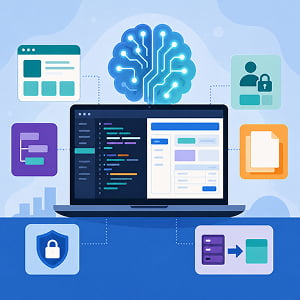
The User Interface Framework References Skill provides exact specifications for over 60 interface components in NetSuite’s UIF framework. It also includes insights drawn from real-world issues to help developers avoid common pitfalls. This is particularly valuable for teams building custom user interfaces that need to comply with NetSuite’s design standards. As the UIF SPA Reference Skill on GitHub describes, it covers API and type lookups for the @uif-js/core and @uif-js/component packages, including constructors, methods, props, enums, hooks, and component options.
The Permissions References Skill delivers a validated catalog of 684 precise permission codes. This helps ensure that custom roles and configurations follow least-privilege security practices, reducing the risk of over-permissioned users or misconfigured access controls.
The SuiteScript References Skill provides the correct field IDs, names, types, and required status for SuiteScript development. This eliminates the need for developers (or their AI assistants) to manually look up field definitions, saving time and reducing the chance of subtle data-handling errors.
The Documentation Practices Skill auto-generates README, ARCHITECTURE, and API files from code analysis. Consistent documentation is often the first thing that falls behind in fast-moving development projects, so having an AI assistant that can produce professional project docs automatically is a meaningful productivity boost.
The OWASP Security Reference Skill embeds NetSuite-specific security guidance based on the Open Worldwide Application Security Project (OWASP) standards. This means that security best practices are applied as code is being written, rather than being treated as an afterthought during code review.
The SuiteScript Conversion Skill helps developers migrate legacy v1.0 SuiteScript to v2.1. According to the press release, this skill maps every API, restructures entry points, and generates a validation report, potentially compressing what used to be a multi-day effort into just a few hours.
Of these six, the User Interface Framework References and Permissions References skills are available globally right now. The remaining skills will be released on GitHub in the near future.
Why the agentskills.io Open Standard Matters
One of the most notable aspects of this announcement is that NetSuite is the first ERP platform to adopt the agentskills.io open standard. This is significant because it means SuiteCloud Agent Skills aren’t locked into a single AI tool or vendor.
The Agent Skills open standard was originally developed by Anthropic for Claude Code, and has since been adopted by a broad ecosystem of AI coding tools, including OpenAI’s Codex, Cursor, GitHub Copilot, Google’s Gemini, and many others. The core idea is portability: a skill written once can be used across any compliant agent runtime without modification.
For NetSuite’s developer community, this matters in a practical way. A development team doesn’t have to commit to a single AI coding assistant to benefit from SuiteCloud Agent Skills. Whether a developer prefers Claude Code, Codex, Cursor, or another tool, the same skills work. As the GitHub repository notes, skills can be installed using a simple terminal command.
This approach aligns with a broader industry movement. According to a community-maintained directory of Agent Skills resources, the ecosystem now includes support from platforms like VS Code, GitHub Copilot, Mistral Vibe, Roo Code, and others, alongside official skill catalogs from Anthropic, OpenAI, Microsoft, and Google. By building on this open standard rather than creating a proprietary solution, NetSuite is positioning SuiteCloud Agent Skills to benefit from the growth of the entire AI coding agent ecosystem.
The Bigger Picture: AI and the Future of ERP Customization

This announcement doesn’t exist in a vacuum, it’s part of a broader transformation happening across the NetSuite platform. Earlier in 2026, NetSuite announced a wave of AI features at SuiteConnect events in New York and Chicago. According to BrokenRubik’s coverage of SuiteConnect, NetSuite founder Evan Goldberg described the updates as the biggest in the company’s history. Those announcements covered AI-powered financial close management, bank transaction matching, planning agents, and the SuiteCloud Developer Assistant, among other features.
SuiteCloud Agent Skills represent the developer-facing side of this AI transformation. While features like Ask Oracle and AI Canvas (part of the NetSuite Next initiative) are designed to help business users interact with their data using natural language, Agent Skills are aimed squarely at the people who build and extend the platform itself.
For NetSuite’s partner ecosystem, this could be especially transformative. Solution partners who build vertical and industry-specific applications on SuiteCloud stand to benefit from faster development cycles and more consistent output. When an AI coding agent understands the exact permission model, UI framework, and scripting conventions of NetSuite, it can produce code that’s closer to production-ready on the first pass, reducing the iteration cycles that typically slow down custom development.
It’s worth noting that AI-assisted ERP development is still an emerging practice. As BrokenRubik points out, claims about dramatically reduced implementation timelines should be evaluated carefully once they’re tested in real-world projects, not just in keynote demos. That said, the combination of validated knowledge packages, an open standard, and cross-platform compatibility makes SuiteCloud Agent Skills one of the more pragmatic approaches to AI-assisted ERP development we’ve seen so far.
Frequently Asked Questions
Oracle NetSuite is a cloud-based enterprise resource planning (ERP) platform that provides integrated business management capabilities, including financial management, supply chain operations, customer experience tools, and HR functions. It serves more than 43,000 customers across 220 countries and dependent territories, making it one of the most widely adopted cloud ERP solutions in the world.
SuiteCloud is NetSuite’s standards-based extensibility and customization platform. It provides the tools and frameworks that developers and partners use to build custom applications, integrations, and extensions on top of NetSuite. Key components of SuiteCloud include SuiteScript (NetSuite’s JavaScript-based scripting language), the SuiteCloud Development Framework (SDF), and the User Interface Framework (UIF) for building custom user interfaces.
SuiteScript is NetSuite’s JavaScript-based scripting language that developers use to customize and extend NetSuite’s functionality. It allows developers to create custom business logic, automate workflows, build integrations, and modify the behavior of standard NetSuite features. The current recommended version is SuiteScript 2.1, and one of the newly released Agent Skills specifically helps developers migrate from the older v1.0 to v2.1.
SuiteConnect is a series of free, one-day events hosted by Oracle NetSuite in cities around the world. These events feature keynote sessions, hands-on labs, live demos, and networking opportunities with NetSuite executives, customers, and partners. The SuiteCloud Agent Skills announcement was made at SuiteConnect San Francisco on April 28, 2026.
The agentskills.io specification is an open format for giving AI coding agents new capabilities through structured packages of instructions, scripts, and resources. Originally developed by Anthropic for Claude Code, it has been adopted as an industry-wide standard by platforms including OpenAI Codex, GitHub Copilot, Cursor, and many others. The standard is maintained as an open-source project and licensed under Apache 2.0 (code) and CC-BY-4.0 (documentation).
OWASP stands for the Open Worldwide Application Security Project. It’s a nonprofit organization that produces widely respected resources, tools, and best practices for improving software security. The OWASP Security Reference Skill included in the SuiteCloud Agent Skills release provides NetSuite-specific guidance based on OWASP standards, helping developers build more secure applications from the start.
Other Enterprise AI Articles You May Be Interested In
Meta’s $2B Manus AI Acquisition Blocked: What Founders, VCs, and Tech Leaders Need to Know
DeepSeek V4 Changes the AI Pricing Game: Full Breakdown and Analysis
GPT-Image-2 Is Here: What Marketers, Designers, and Developers Need to Know
SpaceX Eyes $60 Billion Cursor Acquisition to Challenge Anthropic and OpenAI in AI Coding
Google’s Eighth-Generation TPU: A New Era of Specialized AI Chips
