

Interactive content is any digital experience that requires active participation from the user rather than passive consumption. In marketing, this typically takes the form of quizzes, calculators, product configurators, assessments, and recommendation engines. Unlike a blog post or static landing page, interactive content asks questions, processes inputs, and delivers personalized results. It’s one of the most effective formats for capturing attention, qualifying leads, and moving prospects through the funnel. And with the rise of AI-powered creation tools, building these experiences no longer requires a developer or weeks of production time.
In this article, we’ll discuss how marketers can use AI to create interactive content that generates qualified leads, improves engagement metrics, and delivers genuine value to the people who interact with it. We’ll cover the types of interactive content that work best for different marketing goals, walk through the AI-powered tools that make creation fast and accessible, explore how to connect these tools to your existing marketing stack, and share best practices for getting the most out of every quiz, calculator, or configurator you build.
TL;DR Snapshot
Interactive content like quizzes, calculators, and product configurators consistently outperforms static content in engagement, time on page, and lead conversion. AI has made it dramatically easier and faster to build these experiences without knowing how to code. This article breaks down the strategy, tools, and best practices for using AI to create interactive lead-gen assets that actually work.
Key takeaways include…
- Interactive content generates significantly higher engagement than static formats, and AI tools now let marketers build quizzes, calculators, and configurators in minutes rather than weeks.
- The real power of interactive content isn’t just lead capture, it’s lead qualification. Every answer a user provides is zero-party data you can use to score, segment, and personalize follow-up.
- AI should accelerate the creation process, not replace your strategy. The best interactive experiences start with a clear goal and audience insight, then use AI to handle the build.
Who should read this: Content marketers, demand gen specialists, growth marketers, solopreneurs, and marketing agency teams.
Why Interactive Content Outperforms Everything Else in Your Funnel
Static content has a ceiling. Blog posts, whitepapers, and eBooks can educate and inform, but they’re fundamentally passive. The reader scrolls, maybe skims, and moves on. Interactive content flips that dynamic. It turns a visitor into a participant, and that shift in behavior changes everything about how they engage with your brand.
The data backs this up across the board. According to a DemandSage compilation of content marketing statistics, interactive content sees 52.6% more engagement than static content, and users spend an average of 13 minutes with interactive formats compared to just 8.5 minutes with static content. That’s a massive difference in attention, and attention is the scarcest resource in marketing today.
But engagement is only part of the story. According to an analysis from Amra and Elma, research by Kapost and CXL Institute covering over 14,000 landing pages confirmed that interactive content drives 2.4 times more conversions than static alternatives. Interactive product configurators alone delivered an average conversion rate of 18.3%, compared to the 7.6% industry benchmark for static product pages. Those aren’t incremental improvements, they’re category-changing numbers.
There’s also the social sharing angle. The same analysis cited BuzzSumo’s Social Sharing Index, and found that interactive content formats achieve a 73% higher share rate than static posts across major platforms. Branded quizzes and interactive polls averaged over three times the organic reach of standard image or text-based content. When your content invites participation, people don’t just engage with it, they share it. And organic reach is increasingly difficult to come by, which makes this an important factor for marketers working with limited paid budgets.
The bottom line is that interactive content holds attention longer, converts at a higher rate, and spreads further than the static assets most marketers still rely on. The challenge has always been that building these experiences was expensive, time-consuming, and often required development resources. That’s the gap AI now fills.
The Types of Interactive Content That Drive Real Marketing Results
Not all interactive content is created equal. The format you choose should depend on where your audience sits in the funnel and what kind of data you need to collect. Here’s how the major categories break down…
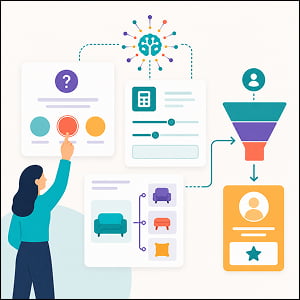
Quizzes and Assessments: Lead generation quizzes are among the highest-converting interactive formats available. According to data compiled by Interact, their platform’s quizzes have a lifetime conversion rate of 40.1%, meaning four out of ten people who complete a quiz opt in to become a lead. That’s dramatically higher than the typical static form conversion rate.
Quizzes work because they tap into curiosity and the desire for personalized feedback. A “What type of marketer are you?” quiz or a “How mature is your data strategy?” assessment doesn’t feel like a lead form, it feels like a useful exercise. The user gets something of value (a personalized result), and you get rich zero-party data you can use for segmentation and follow-up. Product recommendation quizzes are especially powerful for eCommerce, where guiding a customer to the right product reduces decision fatigue and increases purchase confidence.
Calculators and Estimators: Calculators are the workhorse of bottom-of-funnel interactive content. ROI calculators, pricing estimators, savings tools, and cost comparisons all serve a single purpose: helping a prospect quantify the value of your product or service in their specific context. A case study published by Outgrow detailed how Conversion Formula used an interactive calculator built on their platform to increase client conversion rates by 11%. The calculator targeted senior community care centers, asking relevant questions about their operations and then delivering a personalized score. It was promoted through LinkedIn and drove significant traffic back to the company’s website.
Calculators tend to attract users who are closer to a buying decision. Someone searching for an “email marketing ROI calculator” is further down the funnel than someone taking a personality quiz. That makes calculators particularly valuable for B2B marketers and SaaS companies with complex or high-ticket offerings.
Product Configurators and Recommendation Engines: Product configurators let users customize or build a product to their specifications, while recommendation engines guide them to the right product based on their answers. Both formats reduce the paradox of choice, which is a real barrier to conversion when you have a large catalog.
According to Shopify’s guide to AI recommendation systems, beauty company Orveon Global reported an immediate 10% to 15% lift in average order value after rolling out AI-powered product recommendations across its brands. These kinds of results are typical when customers are guided to products that match their needs rather than left to browse aimlessly. AI makes it possible to build recommendation logic that adapts in real time, factoring in user inputs, browsing behavior, and product attributes simultaneously.
How AI Tools Are Changing the Way Marketers Build Interactive Content
Building a quiz or calculator used to be a multi-week project involving copywriters, designers, developers, and QA testing. AI has compressed that timeline to minutes. The current generation of interactive content platforms uses AI to handle everything from question generation to scoring logic to personalized result pages.
Platforms like Involve.me now offer AI agents that build entire interactive funnels from a plain-English prompt. You describe what you want (for example, “a product recommendation quiz for a skincare brand that scores users on skin type and recommends a routine”), and the AI generates the questions, answer options, branching logic, lead capture form, and outcome pages. You can then refine anything manually using a drag-and-drop editor. According to Involve.me, their AI Agent can produce a complete branded funnel in under 90 seconds.
Outgrow takes a similar approach, covering quizzes, calculators, assessments, polls, and recommendation engines on a single platform. Their AI generates content from text prompts and can even suggest optimization improvements after your first 100 completions. For B2B teams that need both a qualification quiz and an ROI calculator, having everything on one platform eliminates the friction of managing multiple tools.
Marquiz focuses specifically on quiz-based lead generation with AI-powered creation. You enter your website URL or describe your business, the AI generates three quiz concepts tailored to your niche, and you pick the one that fits. The platform also supports A/B testing and dynamic content based on UTM tags, which is useful for teams running paid campaigns to multiple audience segments.
For eCommerce brands, AI-powered recommendation engines from platforms like MindStudio allow you to build product recommendation systems that connect directly to your catalog. The AI handles the matching logic, and the system updates automatically as you add or modify products.
The common thread across all of these tools is that AI handles the heavy lifting of content generation, logic building, and personalization, while the marketer retains control over strategy, branding, and messaging. This is the right balance. You’re not outsourcing your marketing brain to a machine, you’re using AI to eliminate the technical bottleneck that kept interactive content out of reach for most teams.
Connecting Interactive Content to Your Marketing Stack
Building the quiz or calculator is only half the job, the real value comes from what happens with the data after someone completes the experience. This is where integration with your existing marketing stack becomes critical.
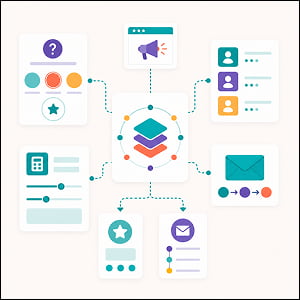
Most modern interactive content platforms offer native integrations with popular CRMs and email marketing tools like HubSpot, Salesforce, ActiveCampaign, Mailchimp, and Klaviyo. The typical workflow looks like this: a user completes a quiz, their responses and lead score flow directly into your CRM, and an automated email sequence triggers based on their specific results. Someone who scores as a “beginner” on your assessment gets a nurture sequence with educational content. Someone who scores as “advanced” gets a demo offer or consultation booking link.
This is where interactive content becomes more than a lead-gen tactic, it becomes a qualification engine. Every answer a user provides is a data point you can use to segment your audience, personalize your outreach, and prioritize your sales team’s time. Instead of treating every new lead the same way, you can route high-intent prospects directly to sales and send everyone else into an appropriate nurture track.
For paid campaign teams, the integration between interactive content and ad platforms is equally important. When you embed a quiz on a landing page tied to a specific ad campaign, you can track not just how many people clicked the ad, but how they answered each question, where they dropped off, and what result they received. This level of granularity lets you optimize both your ad creative and your quiz simultaneously.
The key principle here is that interactive content should never exist in isolation. If the data it collects doesn’t flow into the systems where your team actually works, you’re leaving most of the value on the table.
Best Practices for Getting Interactive Content Right
AI makes it easy to build interactive content. Maybe too easy. The speed of creation can tempt marketers into skipping the strategic thinking that separates a high-performing quiz from a forgettable one, so don’t fall into that trap. Here are some best practices to keep in mind…
- Start with a clear goal, not a format: Don’t build a quiz because quizzes are trendy. Build one because you have a specific audience segment you want to qualify, a product selection problem you want to simplify, or a value proposition you want to quantify. The goal dictates the format. If you need to demonstrate ROI, build a calculator. If you need to segment an audience by need, build an assessment. If you need to reduce product catalog overwhelm, build a recommendation engine.
- Write for your audience, not for the AI: AI-generated questions and results are a strong starting point, but they’ll often need editing to match your brand voice and speak directly to your audience’s language. A quiz generated by AI might use formal, generic phrasing. Your audience might respond better to casual, conversational language (or vice versa). Always review and adjust.
- Gate strategically: The most common approach is to require an email address before revealing results. This works, but placement matters. According to Weavely, interactive quizzes can convert 40% to 60% of visitors when the value exchange feels fair. If your quiz delivers genuinely useful, personalized results, people are happy to provide their email. If the results are generic or unhelpful, you’ll see high drop-off at the gate. Make sure the outcome is worth the exchange.
- Use the data you collect: This seems obvious, but many marketers build interactive content, collect responses, and then do nothing with the insights. Every answer is a signal. If 70% of your quiz takers select “budget” as their biggest concern, that should influence your ad copy, your landing pages, and your sales conversations. Interactive content is a real-time research tool in addition to being a lead-gen tool.
- Test and iterate: A/B test your questions, your result pages, your gating placement, and your follow-up sequences. Small changes, like rewriting a single question or adjusting the number of steps, can have outsized effects on completion and conversion rates. Most AI-powered platforms include built-in analytics that show you exactly where users drop off, so use that data to continuously improve.
- Don’t neglect mobile: A significant portion of your audience will encounter your interactive content on a phone. Make sure the experience works well on smaller screens. This means shorter questions, larger tap targets, and result pages that don’t require excessive scrolling. Most modern platforms handle responsive design automatically, but always preview on mobile before publishing.
Frequently Asked Questions
Interactive content is any digital experience that requires the user to actively participate rather than passively read or watch. In a marketing context, common examples include quizzes, calculators, assessments, polls, product recommendation engines, and configurators. The user provides input (e.g. answers questions, enters data, or makes selections), and the content delivers a personalized output in return.
Zero-party data is information that a customer intentionally and proactively shares with a brand. This includes preferences, quiz answers, purchase intentions, and self-reported feedback. Unlike third-party data (collected by external trackers) or first-party data (observed through behavior like clicks and page views), zero-party data comes directly from the user and reflects what they explicitly tell you about themselves.
A product configurator is an interactive tool that lets users customize a product to their specifications before purchasing. In a marketing context, configurators help users narrow down options from a large catalog by inputting their preferences, needs, or requirements. AI-powered configurators can dynamically adjust recommendations based on the user’s inputs and real-time inventory data.
Lead scoring is the process of assigning a numerical value to each lead based on how likely they are to become a customer. In the context of interactive content, lead scoring happens automatically based on how a user answers quiz or assessment questions. For example, a user who selects “ready to buy in 30 days” might receive a higher score than one who selects “just researching.” These scores help sales and marketing teams prioritize follow-up.
Conditional logic (also called branching logic) is a feature that changes the path a user takes through an interactive experience based on their previous answers. For example, if a user selects “beginner” in question one, they might see a different set of follow-up questions than someone who selects “advanced.” This makes the experience feel more personalized and ensures the results are relevant to each individual.
Involve.me is an AI-powered interactive content platform that lets marketers build quizzes, forms, calculators, and landing pages without code. It includes an AI agent that can generate complete interactive funnels from a text prompt, along with features for lead scoring, A/B testing, CRM integration, and automated email follow-up based on user responses.
Outgrow is an interactive content marketing platform designed for creating quizzes, calculators, assessments, polls, chatbots, and recommendation engines. It’s particularly popular with B2B marketing teams and agencies that need multiple types of interactive content on a single platform. The platform includes AI-powered content generation and optimization features.
Marquiz is an AI-powered quiz builder focused on lead generation. The platform lets marketers generate quizzes by entering a website URL or business description, and the AI creates tailored quiz concepts including questions, logic, and result pages. Marquiz supports A/B testing, dynamic content from UTM tags, and integrations with popular CRM and marketing tools.
MindStudio is an AI-powered platform that lets marketers and eCommerce teams build product recommendation engines without writing code. It connects to existing product catalogs, customer data, and sales channels through APIs, and uses a visual workflow builder to design recommendation logic. MindStudio integrates with platforms like Shopify and WooCommerce and updates automatically as products are added or modified.
Other AI Training Modules You May Be Interested In
Using AI for Video Scripting and Storyboarding in Marketing
Using AI to Improve Accessibility in Marketing Content
Using AI to Design Better Surveys and Unlock Qualitative Research at Scale
Using AI to Curate and Leverage User-Generated Content
The Right Way to Use AI for Content Repurposing Across Channels
