
Content repurposing is the practice of taking a single, substantial piece of content, such as a blog post, webinar recording, podcast episode, or whitepaper, and transforming it into multiple new formats tailored for different platforms and audiences. When AI is introduced into this process, what once took hours of manual reformatting, rewriting, and adapting can happen in a fraction of the time. Rather than creating each social post, email snippet, or video script from scratch, marketers can use AI tools to extract key insights from a long-form asset and reshape them into platform-native content that feels intentional, not recycled.
In this article, we’ll discuss why content repurposing has become a cornerstone of modern marketing strategy, how AI is accelerating and improving the process, and what a practical AI-powered repurposing workflow actually looks like. We’ll walk through real examples of how brands are turning single pieces of content into entire multi-channel campaigns, explore the tools that make this possible, and cover the common pitfalls that trip marketers up when they lean too heavily on automation without enough human oversight. Whether you’re a solo content creator looking to stretch your output or part of a marketing team trying to maximize ROI on every asset you produce, this guide will help you build a repeatable system for getting more mileage out of the content you’ve already created.
TL;DR Snapshot
AI-powered content repurposing is the process of using artificial intelligence tools to transform a single long-form content asset, like a blog post, webinar, or podcast, into multiple derivative pieces optimized for different platforms and formats. Instead of manually rewriting and reformatting your content for every channel, AI handles the heavy lifting of summarizing, reformatting, and adapting tone, while you focus on strategy and quality control. It’s quickly becoming one of the most impactful efficiency strategies in digital marketing.
Key takeaways include…
- Content repurposing strategies improve ROI by an average of 32%, and brands that distribute repurposed content across three or more channels can see engagement increases of over 300%, according to a report from SQ Magazine and research compiled by Roketto.
- According to HubSpot’s State of Marketing report, repurposing content across channels is the fifth most popular digital marketing trend of 2026, with 35% of marketers actively repurposing assets across platforms.
- AI-driven repurposing can reduce content production costs by up to 65%, according to data compiled by AutoFaceless, allowing lean teams to maintain a content footprint that rivals much larger organizations.
Who should read this: Content marketers, marketing managers, solopreneurs, and anyone responsible for getting more value out of the content they create.
Why Repurposing Has Become Non-Negotiable
There was a time when effective content marketing meant publishing a great blog post and sharing a link to it on social media. That time is over. Today’s audiences are fragmented across dozens of platforms, each with its own preferred format, tone, and content length. A LinkedIn audience wants professional insights in carousel or long-form post format. Instagram users scroll for visual storytelling. Email subscribers want concise, actionable takeaways. Podcast listeners want depth and conversation. And trying to reach all of these audiences by creating entirely new content for each platform isn’t just exhausting, for most teams it’s simply not feasible.
This is where repurposing steps in as a strategic multiplier. According to HubSpot’s State of Marketing report, around 94% of marketing teams diversified their channels last year, with 49% reusing the same content across platforms and 40% tailoring it to each platform’s specific requirements. The marketers who tailor, rather than simply copy-paste, are the ones seeing the best results.
The ROI case here is pretty compelling. Content marketing already delivers strong returns on its own, with SQ Magazine reporting an average ROI of $7.65 for every $1 spent in 2025. But when you repurpose strategically, you amplify those returns without proportionally increasing your investment. One blog post can become the foundation for a LinkedIn carousel, a Twitter/X thread, an email newsletter segment, a short-form video script, and an infographic, all reaching different segments of your audience through the formats they prefer. As Roketto’s research notes, brands distributing repurposed content across three or more channels have seen engagement rates increase by over 300%.
The bottom line here is that repurposing isn’t about being lazy with your content, it’s about being strategic with your resources and meeting your audience where they already are.
How AI Changes the Repurposing Game
Before AI entered the picture, repurposing was a manual grind. A content marketer would read through a 2,000-word blog post, mentally extract the key points, rewrite them for LinkedIn, draft a separate email teaser, outline a video script, and then hand everything off to a designer for visuals. It worked, but it was slow, and the process didn’t scale well for teams publishing regularly.

AI accelerates nearly every step of this workflow. Modern AI tools can ingest a long-form asset and generate platform-specific derivatives in minutes. Feed a webinar transcript into an AI writing tool, and it can produce a blog post summarizing the key points, a set of social media posts highlighting individual insights, an email newsletter draft, and even a suggested outline for a short-form video. According to data compiled by AutoFaceless, companies implementing AI-driven content repurposing are reducing production costs by up to 65%.
The tool landscape has matured significantly too. Dedicated repurposing platforms, like Repurpose.io, can automatically redistribute video and audio content across social platforms with the right formatting for each destination. AI writing tools like Jasper offer brand voice features that help maintain consistency across all derivative content. Video-focused tools like Opus Clip can analyze long-form video and automatically identify the most engaging moments for short-form clips. And all-in-one platforms bring repurposing, scheduling, and analytics together in a single workflow.
But the real power of AI in this context isn’t just speed, it’s pattern recognition. AI can analyze your existing content library and identify which pieces have the highest potential for repurposing based on engagement data, search performance, and content depth. It can flag evergreen content that’s ripe for a refresh and redistribution cycle. And it can adapt tone and format in ways that feel native to each platform, rather than producing the kind of generic, one-size-fits-all output that audiences have learned to scroll past.
That said, the most successful implementations always keep a human in the loop. As HubSpot’s report emphasizes, 56% of marketers say the internet is now flooded with AI-generated content, and 65% report that consumers are getting better at recognizing it. The teams seeing the best results are using AI to handle the mechanical aspects of repurposing (e.g. reformatting, summarizing, adapting length, etc.) while they focus on injecting original perspective, verifying accuracy, and ensuring that brand voice stays authentic.
Building a Practical AI Repurposing Workflow
Knowing that AI can help is one thing, knowing how to build a repeatable system around it is another. Here’s a practical framework for turning AI-powered repurposing into a consistent part of your content operations…
- Start by auditing your content library: Not every piece of content is worth repurposing. Look for assets that have already proven their value through strong organic traffic, high engagement, or solid conversion rates. Prioritize content with enough depth and substance to support multiple derivative pieces. A 3,000-word guide packed with statistics and actionable advice is a much better repurposing candidate than a 500-word opinion post. Also consider alignment with current marketing goals, because even a high-performing old post may not be worth repurposing if it doesn’t support what your team is focused on right now.
- Map your formats to your channels: Before you start generating derivatives, decide what formats you need and where each one will live. A single blog post might support a LinkedIn text post extracting one key insight, an Instagram carousel breaking down a framework step by step, a Twitter/X thread presenting the main argument in a conversational tone, an email newsletter teaser driving traffic back to the original, and a short-form video script for TikTok or YouTube Shorts. Each format should feel native to its platform. This is where AI helps enormously, but you need to give it clear direction about the target platform, desired tone, and length constraints.
- Use AI for the first draft, then edit with intention: Let AI handle the initial transformation, taking your blog post and generating a first-pass LinkedIn post, email snippet, or video script. Then review each piece for accuracy, brand voice, and platform fit. Does the LinkedIn post sound like your brand, or does it sound like every other AI-generated post? Does the email teaser create genuine curiosity, or is it just a bland summary? This editing step is where the human value lives, and it’s what separates repurposed content that performs from content that gets ignored.
- Establish a cadence: Typeface recommends reviewing your analytics quarterly to identify top performers and repurpose them across platforms. Evergreen content can be updated and redistributed multiple times per year. Building this rhythm into your content calendar ensures that repurposing becomes a habit, not an afterthought.
- Track performance across formats: One of the biggest advantages of systematic repurposing is the data it generates. You’ll quickly learn which formats resonate with which audiences, which platforms drive the most engagement for your brand, and which types of source content produce the best derivatives. Use these insights to refine both your repurposing workflow and your original content strategy. If your LinkedIn carousels consistently outperform your Twitter threads, that’s a signal worth paying attention to.
Pitfalls to Watch Out For
AI-powered repurposing is powerful, but it’s not foolproof. Here are the most common mistakes to avoid…
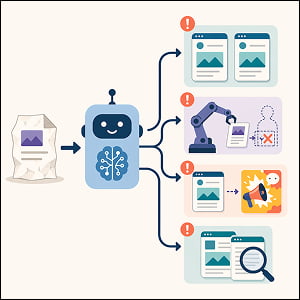
Copy-pasting across platforms: The single biggest error in content repurposing is dumping the same text across every channel without adapting it. As Roketto’s guide on AI content repurposing puts it, posting a raw transcript on LinkedIn and calling it a post isn’t repurposing, it’s being lazy. Each platform has its own audience expectations, and content that ignores those expectations will under-perform.
Over-automating without quality checks: It’s tempting to set up a fully automated pipeline where AI generates derivatives and a scheduler posts them without any human review. But this is a recipe for brand damage. AI can hallucinate facts, miss nuance, or produce content that sounds generic. Always build a human review step into your workflow before anything goes live.
Ignoring brand voice: Many AI tools default to a generic, professional-but-bland tone that could belong to any company. If all your repurposed content sounds the same as everyone else’s, you’re not building a brand, you’re just adding to the noise. Train your AI tools with brand guidelines, feed them examples of your best-performing content, and edit outputs to match your distinctive voice.
Repurposing low-quality source material: AI can’t turn a weak piece of content into a strong one. If the original blog post is thin on insights or poorly researched, the derivatives will be too. Focus your repurposing efforts on your best work, the content that has already demonstrated value with your audience.
Neglecting SEO considerations: When you repurpose content into multiple blog posts or web pages, you risk keyword cannibalization if you’re not careful about targeting. Make sure each derivative piece has a distinct focus and isn’t competing with the original for the same search terms.
Frequently Asked Questions
Content repurposing is the practice of taking an existing piece of content and transforming it into a new format or adapting it for a different platform. For example, turning a webinar recording into a blog post, a series of social media posts, and an email newsletter. The goal is to maximize the value of your original content investment by reaching additional audiences through different channels and formats.
Long-form content assets are substantial, in-depth pieces of content that typically exceed 1,000 words or 10 minutes of audio/video. Common examples include blog posts, whitepapers, case studies, webinar recordings, podcast episodes, research reports, and comprehensive guides. These assets contain enough depth and substance to serve as source material for multiple shorter, platform-specific pieces.
Multi-format assets are the collection of content pieces derived from a single source, each adapted for a different format or platform. From one blog post, you might create a LinkedIn carousel, an Instagram graphic, an X thread, a short-form video, a podcast talking point, and an email newsletter section. Together, these pieces form a multi-format asset library that extends the reach and lifespan of the original content.
Evergreen content is content that remains relevant and useful over a long period of time, regardless of when it’s consumed. Examples include how-to guides, foundational industry concepts, and best-practice frameworks. Evergreen content is particularly well-suited for repurposing because it can be updated and redistributed multiple times without losing its value.
Brand voice is the consistent personality, tone, and style that a company uses across all of its communications. It encompasses word choice, sentence structure, level of formality, use of humor, and overall attitude. Maintaining a consistent brand voice across repurposed content is critical because audiences can tell when content feels disconnected from the brand they know, which undermines trust and engagement.
Keyword cannibalization occurs when multiple pages or pieces of content on the same website target the same keywords or search queries. This can confuse search engines about which page to rank for a given term, potentially diluting the performance of all competing pages. It’s an important consideration when repurposing blog content into additional web-based formats.
Other AI Training Modules You May Be Interested In
The Right Way to Use AI for Cross-Channel Budget Allocation
Using AI for Localization and Multilingual Campaign Adaptation
The Right Way to Prepare for Agentic Marketing
Using AI to Detect Ad Fatigue and Automate Creative Rotation
