Internal marketing enablement is the practice of equipping customer-facing teams, especially sales, with the messaging, content, training, and tools they need to represent your brand accurately and close deals effectively. It’s the bridge between what marketing creates and what sales actually says in the field. When enablement works, every rep sounds like your best rep. When it doesn’t, you get inconsistent pitches, off-brand messaging, and deals that stall because the buyer heard three different value propositions from three different people. AI is now transforming this discipline by making it possible to create enablement assets faster, personalize training at scale, and keep everything current without burning out your marketing and enablement teams.
In this article, we’ll discuss how AI is reshaping the way marketing teams support their sales counterparts from the inside out. We’ll cover how to use AI to build and maintain competitive battlecards that don’t go stale, how AI-powered roleplay and coaching tools are slashing onboarding times for new sales hires, and how to use AI to ensure consistent brand messaging across every customer touchpoint. Whether you’re a one-person enablement team or part of a large marketing org, these are practical, actionable approaches you can start applying today.
TL;DR Snapshot
AI-powered internal marketing enablement helps marketing teams create better sales assets, train reps faster, and maintain messaging consistency at scale. Instead of relying on static PDFs and one-size-fits-all training sessions, AI makes it possible to deliver personalized, always-current enablement that adapts to each rep’s needs, each competitor’s moves, and each buyer’s expectations.
Key takeaways include…
- AI can reduce new sales rep onboarding time by up to 40-67%, turning months of ramp-up into weeks of focused, personalized training through roleplay simulations and adaptive learning paths.
- Competitive battlecards built and maintained with AI stay current in real time, pulling from live market data instead of going stale in a shared drive somewhere.
- Organizations with formal, AI-enhanced enablement programs are up to 3x more effective at hitting sales goals and report up to 49% higher win rates compared to those without structured enablement.
Who should read this: Marketing leaders, sales enablement managers, revenue operations professionals, and entrepreneurs looking to get more out of their go-to-market teams.
Why Static Enablement Is Failing Your Sales Team
If your enablement strategy still revolves around a quarterly slide deck update and a shared Google Drive folder full of one-pagers, you’re not alone, but you are falling behind. The traditional approach to marketing enablement has a fundamental problem, it assumes the market holds still long enough for your content to stay relevant.
It doesn’t. Competitors launch new features. Pricing changes. Buyer expectations shift. And your sales reps are left pitching with materials that were accurate three months ago but miss the mark today.
According to Highspot’s Go-To-Market Performance Gap Report, 39% of go-to-market leaders say content isn’t being used effectively, which slows deal cycles, while 30% say win rates fall short even when they have a clear strategy in place. Meanwhile, industry research compiled by Prospeo shows that between 65% and 80% of sales content goes unused, with only 3% of assets ever crossing 1,000 uses. Most enablement content is created, published, and forgotten.
The disconnect isn’t just wasteful, it’s expensive. Reps spend roughly 60% of their time on non-selling tasks, according to the same research, and a significant chunk of that time goes toward hunting for the right content, second-guessing whether it’s current, or just winging it entirely. As Allego’s guide on consistent sales messaging puts it, inconsistent messaging creates a “credibility tax” that stalls pipelines and burns marketing budgets. When your sales team can’t find, trust, or use what marketing creates, the entire go-to-market engine stalls.
This is exactly where AI changes the equation. Rather than trying to create the perfect static asset and hope it gets used, AI enables a shift toward dynamic, living enablement, where content updates itself, training adapts to each rep, and the gap between what marketing intends and what sales delivers gets dramatically smaller.
Building Smarter Battlecards With AI
Battlecards are one of the most valuable enablement assets a marketing team can produce. They’re concise, deal-ready documents that give reps the competitive positioning, objection-handling language, and differentiators they need to win head-to-head against specific competitors. When done well, the impact is significant. A study cited by Contify found that 71% of businesses have seen higher win rates when using battlecards.
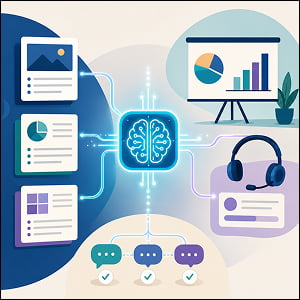
The problem is that traditional battlecards are a nightmare to maintain. They’re usually built as static PowerPoint slides or PDFs, and the moment they’re published, the clock starts ticking on their accuracy. A competitor changes their pricing, launches a new feature, or shifts their messaging, and suddenly your battlecard is doing more harm than good. As Klue’s battlecard guide warns, the moment a seller finds something out-of-date or incorrect in your battlecard, all trust is out the window.
AI solves this in a few key ways. First, AI-powered competitive intelligence platforms can continuously monitor competitor websites, press releases, review sites, and social channels, then automatically flag changes that affect your battlecards. Tools like Klue, Crayon, and Contify use AI to pull real-time intelligence from multiple sources and surface it in formats sales teams can actually use. Instead of a quarterly manual refresh, your battlecards evolve as the market does.
Second, AI can help you build battlecards faster in the first place. What once took hours of manual competitive research can now be done in minutes. AI can synthesize competitor data, extract key differentiators from your own product documentation and win/loss analyses, and draft battlecard content that your team then reviews and refines. The enablement team shifts from being the bottleneck to being the editor.
Third, and this is where it gets really powerful, AI can make battlecards contextual. Rather than handing every rep the same generic competitive overview, AI-enabled platforms can surface the specific battlecard content that’s relevant to a given deal. If a rep is on a call and a prospect mentions a specific competitor, the AI can instantly pull the right talking points, objection responses, and proof points into view. As Spekit describes, AI can pull the top three points and citations from a card based on the live conversation or email thread, so reps don’t have to scroll for answers.
The key to making this work is treating battlecards as living documents within a governed system, not static files floating around in email chains. Centralize them in an enablement platform, assign clear ownership (typically product marketing or competitive intelligence), and let AI handle the monitoring and updating while your team focuses on strategy and messaging quality.
Slashing Onboarding Time With AI-Powered Training and Roleplay
The average onboarding process for a new sales rep takes three to six months, with some industries stretching even longer. According to research compiled by SalesSo, average ramp-up time for SaaS companies grew to 5.7 months in 2025, a 32% increase from 4.3 months in 2020. Every week a rep spends ramping is a week they’re not contributing to pipeline. And with 20% of new sales hires leaving within their first 90 days, often due to poor onboarding, the stakes are enormous.
AI is compressing this timeline dramatically. According to Yoodli, onboarding programs that use AI roleplay and AI tutors have decreased ramp time by up to 40%, allowing reps to practice their pitch with immediate feedback before their first real customer conversation. And the results at specific companies are even more striking: Moxo’s research highlights that Oracle NetSuite saw AI simulations increase opportunities by 32% and cut onboarding time by 20%, while RingCentral reduced ramp time by 60% after implementing AI-powered training through SalesHood.
Here’s how marketers and enablement teams can put AI to work in onboarding…
- AI Roleplay for Messaging Practice: One of the biggest challenges in onboarding is giving new reps enough practice before they’re live with prospects. Managers don’t have the bandwidth to run roleplay sessions with every new hire, and traditional training modules are passive. AI roleplay tools like Hyperbound, Second Nature, and Mindtickle let reps practice discovery calls, objection handling, product demos, and competitive scenarios against AI-simulated buyers. The AI scores their performance on things like tone, question quality, and methodology adherence, then provides instant coaching. Highspot’s research, as cited in Hyperbound’s Sales Practice Report, indicates that organizations using AI in their enablement functions are 3x more effective at achieving their sales goals.
- Adaptive Learning Paths: Instead of putting every new hire through the same generic training sequence regardless of their experience level or role, AI can build personalized learning paths. A new account executive might focus on advanced negotiation and multi-threaded deal management, while a junior SDR might need more time on discovery questioning and product fundamentals. The AI continuously adjusts based on performance, spending more time reinforcing weak areas and accelerating through topics the rep has already mastered.
- Conversation Intelligence for Learning From the Best: Tools like Gong record and analyze real customer conversations, then surface the best examples for training purposes. New reps can study how top performers handle specific objections, run discovery, or position against competitors, all from real calls rather than scripted examples. Highspot’s State of Sales Enablement Report found that compared to the previous year, 164% more companies are using AI in their sales training programs, a clear sign the market is moving in this direction fast.
For marketing teams specifically, this means the messaging frameworks, positioning documents, and talk tracks you create can now be embedded directly into AI training scenarios. Instead of hoping reps read your messaging guide, you can build roleplay exercises that test whether they can actually deliver your value proposition under pressure. It closes the loop between content creation and content adoption in a way that static training never could.
Maintaining Brand and Messaging Consistency at Scale
Here’s a scenario every marketing leader dreads. You spend weeks crafting the perfect product positioning, building a messaging framework, and creating a library of approved talk tracks. You roll it out to the sales team with a training session and a Slack message. A month later, you listen to a few recorded calls and discover that half the team is using language you’ve never seen before, making claims that aren’t accurate, or positioning the product in ways that contradict your strategy entirely.
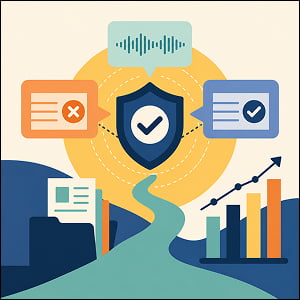
This isn’t a training failure, it’s a systems failure, and it’s incredibly common. Research from 6sense, as cited by Allego, shows that B2B buyers now evaluate an average of five vendors during their purchasing process, and 95% of them ultimately pick a vendor from their initial shortlist. If your team isn’t delivering a consistent, value-driven message from the very first interaction, you’re not just losing that deal, you likely never had a real chance at it.
AI helps solve this problem at multiple levels. At the content level, AI-powered enablement platforms can ensure that every rep has access to the most current, approved messaging and can find it in seconds. Rather than digging through folders, reps can ask an AI assistant a question like “What’s our positioning against Competitor X for enterprise healthcare buyers?” and get the approved response instantly, pulled from your latest battlecards, case studies, and messaging frameworks.
At the coaching level, conversation intelligence tools can automatically flag when reps go off-script or use unapproved messaging during live calls. Managers don’t have to listen to every call to catch inconsistencies, the AI surfaces the moments that need attention. This creates a feedback loop where marketing can see exactly how their messaging is (or isn’t) being used in the field and iterate accordingly.
At the content creation level, AI can help marketing teams build enablement assets that are inherently more consistent. When you use AI to draft email templates, one-pagers, or talk tracks, you can feed it your brand guidelines, messaging framework, and approved terminology so that every output starts from a consistent foundation. Your team still reviews and refines everything, but the baseline is already on-brand rather than starting from scratch each time.
The real power, though, comes from connecting all three levels into a single system. When your battlecards, training modules, coaching insights, and content recommendations all live in one platform, and AI is the thread that ties them together, you get something that’s never been possible before: real-time visibility into whether your messaging strategy is actually being executed the way you designed it. Highspot’s research, as cited by Demand Gen Report, shows that their customers report a 50% average increase in GTM efficiency and a 55% boost in seller confidence when content, training, coaching, and analytics are integrated into a single motion.
Getting Started Without Overcomplicating Things
If you’re reading this and thinking “this sounds great, but we don’t have the budget for an enterprise enablement platform,” don’t worry. You don’t need to go all-in on day one, AI-powered enablement is something you can adopt incrementally.
Start with the pain point that’s costing you the most. If your reps consistently lose deals to a specific competitor, build an AI-assisted battlecard for that competitor first. Use a tool like ChatGPT or Claude to synthesize your competitive research, win/loss notes, and product documentation into a first draft, then refine it with your sales team’s input. Set a calendar reminder to refresh it monthly using AI to scan for competitor updates.
If onboarding time is your bottleneck, experiment with AI roleplay tools. Several platforms, including Yoodli, offer free tiers that individual reps can use without manager approval. Have your newest hires practice their pitch against the AI, get scored, and iterate. You’ll likely see improvements in confidence and message retention almost immediately.
If messaging consistency is the issue, start by using conversation intelligence (even a basic call recording and transcription tool) to audit how your positioning is actually being delivered in the field. The gap between intention and execution is usually wider than you think, and just measuring it is the first step toward closing it.
The organizations that win in enablement aren’t necessarily the ones with the biggest tech stacks, they’re the ones that treat enablement as a system rather than a collection of disconnected assets, and they use AI to keep that system running, current, and continuously improving.
Frequently Asked Questions
Sales enablement is the process of providing sales teams with the content, tools, training, and information they need to effectively engage buyers and close deals. It sits at the intersection of marketing, sales, and operations, and it’s typically owned by a dedicated enablement team or by product marketing. The discipline has grown significantly in recent years.
A sales battlecard is a concise, strategic reference document designed to help sales reps navigate competitive selling situations. Battlecards typically include competitor overviews, key differentiators, objection-handling language, pricing comparisons, and proof points. They’re meant to be quick-reference tools that reps can consult during or before sales conversations to position their product effectively against specific competitors.
Conversation intelligence refers to AI-powered technology that records, transcribes, and analyzes sales conversations (calls, video meetings, and emails) to surface insights about rep performance, buyer behavior, and deal health. Platforms like Gong are leaders in this space. They use natural language processing to identify key moments in conversations, such as objections, competitor mentions, and buying signals, and provide coaching recommendations based on what top-performing reps do differently.
Ramp time (also called ramp-up time) refers to the period between when a new sales rep is hired and when they reach full productivity, typically measured as the point at which they consistently hit their sales quota. Industry benchmarks vary, but for SaaS companies, average ramp time sits around 5.7 months as of the end of 2025. Reducing ramp time is one of the most impactful things an enablement team can do, because every month shaved off translates directly into additional pipeline and revenue.
AI roleplay is a training method where sales reps practice conversations with AI-simulated buyers rather than relying solely on live manager-led practice sessions. The AI can simulate various buyer personas, industries, and objection scenarios, providing instant feedback on the rep’s performance. This allows reps to build confidence and refine their messaging in a low-stakes environment before engaging with real prospects.
Other AI Training Modules You May Be Interested In
Using AI to Build and Manage Thriving Brand Communities
Using AI to Design Smarter Customer Loyalty and Retention Programs
The Right Way to Use AI for Landing Page Optimization
Using AI for PR Outreach and Earned Media Strategy
The Right Way to Build an AI Governance Policy for Your Marketing Team
