
A new paradigm known as agentic marketing is emerging to redefine how brands connect with their customers. This strategy involves the use of autonomous AI agents (i.e. software entities capable of reasoning, planning, and executing multi-step tasks), to manage marketing workflows or represent consumers in the buying process. Unlike traditional automation that follows rigid “if-then” rules, agentic marketing leverages systems that can make independent decisions to achieve a specific goal, such as optimizing a budget in real-time or finding the best product for a user based on complex preferences.
In this article we’ll discuss the shift from simple automation to autonomous agency and how it’ll change the way you think about your marketing funnel. We’ll explore the concept of marketing to machines, where your content must be as readable for an AI agent as it is for a human, and provide a framework for staying ahead of this curve. By the end of this post, you’ll have a clear understanding of how to prepare your data, your content, and your team for a world where AI agents are both the marketers and the customers.
TL;DR Snapshot
Agentic marketing represents the next evolution of AI where autonomous systems move beyond generating text to executing complex strategies with minimal human intervention. As these agents begin to handle everything from lead scoring to personal shopping, brands must pivot from static campaigns to dynamic, machine-readable ecosystems that prioritize trust and structured data.
- AI agents are moving from being creative assistants to becoming independent operators that can plan, launch, and optimize marketing campaigns.
- Marketers should start optimizing content for agentic search, ensuring that AI agents can easily find, verify, and recommend their products to human users.
- Success in an agentic world requires highly structured, modular data that allows AI systems to retrieve and use brand information accurately.
Who should read this: Marketers, Brand Strategists, Data Officers, and Growth Hackers.
Moving From Automation to Autonomy
For years, marketers have relied on automation to handle repetitive tasks like sending welcome emails or posting social media updates. However, these systems are fundamentally passive because they require a human to set every trigger and define every path. Agentic marketing introduces active systems where agents don’t just follow a path, they build one themselves. According to a report by MarketsandMarkets, the AI agents market is projected to grow from 7.84 billion dollars in 2025 to over 52 billion dollars by 2030. This growth is driven by a shift toward multi-step task performers that can interpret complex goals and make contextual decisions.
In a practical sense, this means your marketing tools will soon act more like employees than software. Instead of you setting a manual A/B test for a landing page, an agent might monitor engagement in real-time, identify a drop-off point, and autonomously deploy a pre-approved variant to fix the leak. It’s a shift from “doing the work” to “managing the outcomes.” This level of autonomy requires a high degree of trust in your AI systems, which is why establishing clear guardrails and brand guidelines is more important now than ever before.
The Rise of Marketing to Machines
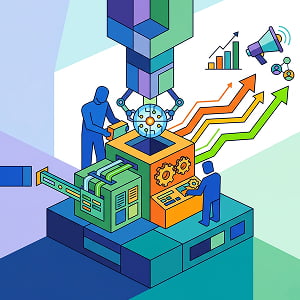
One of the most radical changes in this new era is that your primary customer might not always be a human. As consumers begin using personal AI agents to perform research and make purchases, your marketing must appeal to the logic of a machine. This is often called “agentic SEO” or “Business-to-Bot)” marketing. A recent Gartner prediction suggests that by 2028, 60% of brands will use agentic AI to deliver streamlined one-to-one interactions. If an agent is scanning the web to find the best enterprise CRM for a mid-sized legal firm, your content needs to be structured so that the agent can instantly verify your features, pricing, and compatibility.
To win in this environment, you’ve got to move away from fluff and toward structured transparency. This involves using schema markup, providing clear API access to product data, and ensuring that your content is modular. If your information is buried inside a 40-page PDF, an AI agent might skip over it in favor of a competitor whose data is more easily consumable. You’re no longer just competing for a human’s attention span, you’re competing for a machine’s confidence score.
Building an Agent-Ready Content Infrastructure
Preparing for an agentic future requires a total audit of how you store and publish information. Experts suggest using frameworks like CRISP (i.e. Conversational, Retrievable, Interoperable, Structured, and Personalized) to ensure your brand’s voice survives the jump to AI. As noted by Aha Media Group, content must become a data layer that feeds both people and machines. This means breaking long-form blog posts into modular components like definitions, steps, and FAQs (look familiar?).
When your content is modular, an AI agent can retrieve only the specific answer it needs rather than trying to parse an entire document. It makes your brand more “retrievable” in an age where zero-click searches and AI summaries are becoming the norm. Furthermore, you’ve got to focus on content provenance. With the rise of AI-generated noise, transparency and authenticity aren’t just buzzwords anymore, they’re technical requirement for ranking in an agent-driven world.
Frequently Asked Questions
An AI agent is an autonomous system that uses an LLM (Large Language Model) as its “brain” to plan and execute tasks. Unlike a chatbot that just talks, an agent can use tools, browse the web, and click buttons to finish a job.
Not quite. Automation is a “train on a track” that goes exactly where you tell it. Agentic marketing is more like a self-driving car that knows the destination, and can navigate traffic or road closures on its own to get there.
You can start by using consistent schema markup (standardized code that helps search engines understand your page) and organizing your content into clear headers and modular components that are easily consumable (e.g. definitions, FAQs etc.).
It’s unlikely that AI agents will replace human marketers completely, but they’ll probably have a major impact on existing human workflows. Marketers will shift toward being agent orchestrators, where they focus more on strategy, ethics, and innovation while agents do the heavy lifting for general tasks.
Other AI Training Modules You May Be Interested In
Using AI to Detect Ad Fatigue and Automate Creative Rotation
Using AI to Predict and Prevent Customer Churn
Using AI to Build Smarter Audience Segments for Paid Campaigns
Using AI to Build Marketing Attribution Models That Actually Work
