Quick Definition
An AI-assisted case study workflow is a content production process in which artificial intelligence tools are used to analyze raw customer interview transcripts, extract narrative insights, and generate multiple tailored content assets -- each adapted for a specific buyer persona or distribution channel -- without replacing human editorial judgment or altering factual accuracy.
AI Summary
This article argues that the traditional B2B case study format -- problem, solution, result -- no longer serves modern buying committees or multi-channel distribution needs. It outlines a practical AI-assisted workflow that starts with a customer interview transcript, uses AI to surface the real story and adapt it for different buyer personas (CFO, IT lead, end user), and produces multiple content assets from a single source. The piece emphasizes that AI accelerates and multiplies the workflow, but authenticity -- especially customer quotes and verified data -- must remain human-controlled.
Key Takeaways
- The standard case study template was built for single buyers, but most B2B purchases involve buying committees with different priorities -- one document can't serve all of them.
- A single 30-minute customer interview, processed with AI, can generate long-form web copy, a LinkedIn post, a sales deck summary, email snippets, and social pull-quotes -- most teams only produce one of these.
- The most effective AI prompt isn't "write a case study" -- it's "what's the most surprising thing this customer experienced?" That answer becomes the lead.
The format hasn’t changed in 20 years. Your buyers have.
The Most Skipped Page on Your Website
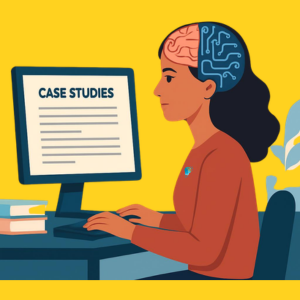 You know the one. It sits under “Resources” or “Success Stories.” It’s got a stock photo of a handshake or a smiling person in front of a monitor. The headline says something like “[Company Name] Achieves 42% Efficiency Gain with [Your Product].”
Nobody reads it. Not really.
Case studies are supposed to be your most powerful proof point. They’re real customers, real results, real stories. But somewhere between the customer interview and the published PDF, the life gets drained out of them. What’s left is a template — problem, solution, results, quote — that reads like it was written by a committee afraid of saying anything too specific.
Here’s the thing: AI doesn’t fix bad strategy. But it can help you write case studies that actually sound like people — and reach the right buyers in the right format.
Why the Classic Format Fails Modern Buyers
The traditional case study was built for a different era of B2B buying. One buyer, one decision, one document. Today, you’ve got buying committees of six to ten people, each reading with a different agenda.
Your CFO wants to see ROI math. Your IT lead wants to know how painful the integration was. Your end users want to know if the product actually makes their day easier. One case study written for “everyone” ends up working for no one.
The format also hasn’t kept up with where buyers actually spend time. A PDF buried on your website competes with a LinkedIn scroll, a sales rep’s email, and a 30-second attention span. The story might be great. The delivery is killing it.
What AI Actually Changes Here
AI won’t write your case study for you — and it shouldn’t. Authenticity is the whole point. What it can do is help you get more out of the raw material you already have and adapt that material for different buyers and channels.
Here’s a practical workflow that actually works:
Start with a 30-minute customer interview. Record it, transcribe it (tools like Otter.ai or Fireflies handle this fast), and drop the transcript into your AI tool of choice.
Extract the real story first. Prompt the AI to identify: What was the customer’s situation before? What almost stopped them from moving forward? What surprised them after they started? What do they tell colleagues who ask about it? These questions surface the narrative that the “problem-solution-result” template buries.
Build persona-specific angles. Use the same transcript to generate three or four summaries, each framed for a different stakeholder. The IT version leads with implementation. The exec version leads with business impact. The end-user version leads with daily experience. You’re not making things up — you’re emphasizing what’s already there.
Adapt for the channel, not just the audience. A 1,200-word web case study needs a 150-word LinkedIn version, a three-slide sales deck summary, and a two-sentence email snippet. AI can draft all of these from the same source material in minutes, not days.
The Prompt That Changes Everything
Most marketers use AI like a copy-polishing tool. They write the draft, then ask AI to clean it up. That’s the wrong sequence.
Try this instead: before you write a single word, give the AI your raw transcript and ask it to answer one question — “What’s the most surprising or counterintuitive thing this customer experienced?”
Nine times out of ten, that answer becomes your lede. It’s specific, it’s true, and it’s not something your competitor can claim because it happened to your customer, not theirs.
Generic case studies fail because they’re built around your product. The best ones are built around your customer’s turning point.
Keeping It Human When AI Is Involved
There’s a real risk here: AI-assisted case studies that sound like AI wrote them. That’s worse than the boring template, because at least the template is clearly human in its awkwardness.
A few rules that help:
- Keep the customer’s exact words in the draft. Don’t let AI paraphrase the quotes. The quote is often the only place where a real person’s voice comes through.
- Fact-check every number and claim. AI will confidently fill gaps. Don’t let it.
- Read it out loud. If you wouldn’t say it in a conversation, your customer wouldn’t either.
The goal isn’t to hide that AI was part of the process. It’s to make sure the output earns trust, and trust comes from specificity, not polish.
The Content Multiplier Most Teams Miss
Here’s where the ROI of this workflow really shows up. One customer interview, handled well, can produce:
- A long-form web case study
- A gated PDF version for demand gen
- A LinkedIn post written in the customer’s voice
- A sales email snippet for outreach sequences
- A slide summary for AE decks
- A pull-quote graphic for social
Most teams produce one. The transcript, the story, and the angles are all there — they just haven’t been extracted yet. AI makes that extraction fast enough to actually do it.
Stop Writing Case Studies. Start Writing Proof.
The buyers you’re trying to reach are skeptical. They’ve read hundreds of “42% efficiency gain” headlines. What they haven’t read is a case study that sounds like a real person talking about a real problem they genuinely had.
That’s your competitive advantage. Not the AI tools — the story underneath them. AI just helps you find it faster and get it in front of the right people in the right format.
Your next case study doesn’t have to read like a case study. It just has to be true and told well. That combination is rarer than you’d think.
Frequently Asked Questions
Won't buyers be able to tell if AI helped write the case study?
Not if you do it right. The risk isn't that AI was involved -- it's that the output sounds generic. Keep the customer's exact quotes intact, verify every data point, and read the copy out loud before publishing. Specificity is what builds trust, not the production method.
How long should a B2B case study be?
It depends on where it lives. A web case study typically works best between 800 and 1,200 words. A LinkedIn version should stay under 200 words. A sales deck summary needs three to five slides. The AI-assisted workflow described here lets you produce all of these from the same source material, so the better question is: what formats do your buyers actually use?
Do I need special AI tools to run this workflow?
No. The workflow described here works with any major AI writing assistant -- Claude, ChatGPT, Gemini, or similar. The key inputs are a clean transcript and well-crafted prompts, not a proprietary platform. Transcription tools like Otter.ai or Fireflies pair well with any of these for the interview-to-text step.
What makes a good customer interview for this kind of content?
Focus on the before, the friction, and the surprise -- not just the results. Ask what almost stopped them from moving forward. Ask what they tell colleagues who are considering the same decision. Ask what they got that they didn't expect. Those answers produce the specificity that generic case studies miss entirely.
