

Voice search optimization is the practice of structuring and refining your digital content so it can be discovered, understood, and delivered by voice-enabled search engines and AI assistants like Google Assistant, Siri, and Alexa. Conversational commerce takes that a step further, it’s the use of messaging apps, chatbots, and voice assistants to facilitate product discovery, customer service, and transactions through natural, two-way conversation rather than traditional website navigation. Together, these two disciplines represent one of the fastest-moving frontiers in digital marketing, and AI is quickly becoming the essential tool for getting both of them right.
In this article, we’ll discuss how marketers can use AI to prepare their content, technical infrastructure, and customer experiences for a world where people increasingly speak their searches and shop through conversations. We’ll cover the current state of voice search and conversational commerce, walk through the specific ways AI can help you optimize your content for voice queries, explore how to build conversational commerce experiences that actually convert, and share practical guidance on structured data, schema markup, and measurement. Whether you’re just starting to think about voice or you’ve already dipped your toes in, this piece will give you a concrete playbook for doing it the right way.
TL;DR Snapshot
Voice search and conversational commerce have crossed from emerging trend to mainstream marketing channel. With over 8.4 billion voice assistants now active worldwide and the conversational commerce market valued at $8.8 billion in 2025 and projected to reach $32.6 billion by 2035, marketers who ignore these channels risk losing visibility at the exact moments when consumers are ready to act. AI is the key to competing here, not just for creating content that voice assistants want to surface, but for building the shopping experiences that consumers increasingly expect.
Key takeaways include…
- Voice search and AI-powered search are converging into a single optimization challenge, meaning the same strategies that help you show up in AI Overviews and featured snippets also help you win voice queries.
- Structured data and schema markup (especially FAQ, HowTo, Local Business, and Speakable schema) are essential for helping voice assistants understand and surface your content as spoken answers.
- Conversational commerce isn’t coming someday, it’s here now. Shoppers who engage with AI during their session are converting at nearly four times the rate of those who don’t, and major platforms like Shopify and ChatGPT are already enabling in-conversation checkout.
Who should read this: Content marketers, SEO strategists, e-commerce managers, and marketing leaders who want to stay visible as search becomes more conversational and commerce becomes more AI-driven.
The State of Voice Search and Conversational Commerce in 2026
To understand why voice search optimization matters right now, it helps to look at the scale of what’s already happening. According to Statista, there are more than 8.4 billion voice-enabled devices in use worldwide, which means the installed base of voice assistants has actually surpassed the global population. In the United States alone, voice assistant users are expected to reach 157.1 million by the end of 2026. These aren’t niche early adopters, according to DemandSage 52% of people use voice search daily or almost daily, and Synup cites a recent PwC survey which found that 71% of consumers say they prefer using voice assistants because it’s efficient and hands-free.

The behavior patterns behind voice search are fundamentally different from traditional text-based search though. Voice queries tend to be longer, more conversational, and more likely to be phrased as complete questions. According to a study of 10,000 voice search results referenced by DemandSage, the average voice search answer is 29 words in length, which tells you something important about the kind of content that wins: it’s concise, direct, and structured to answer a specific question.
Meanwhile, conversational commerce is accelerating alongside voice search. A Visby report notes that the global conversational commerce market reached $8.8 billion in 2025 and is projected to hit $32.6 billion by 2035, growing at a 14.8% compound annual growth rate. On the voice commerce side specifically, projections indicate that voice commerce will grow from an estimated $86 billion in 2025 to $164 billion by 2028. And the convergence is real, Gorgias’s Conversational Commerce Trends report found that only 7% of brands currently use voice assistants for commerce, but 89% expect it to be standard by 2030.
Perhaps the most telling data point is what happens when conversational AI enters the shopping experience. According to Neuwark, 12.3% of shoppers who interact with an AI chatbot complete a purchase, compared to just 3.1% who don’t, representing a nearly 4x lift in conversion. Gorgias found that when their AI Agent recommended a product, 80% of the resulting purchases happened the same day. These numbers make a strong case that conversational commerce isn’t just a nice-to-have, it’s quickly becoming a competitive necessity.
Using AI to Optimize Your Content for Voice Search
The good news is that optimizing for voice search in 2026 is closely related to optimizing for AI-powered search more broadly. As Circle S Studio noted in their voice search guide, voice and AI search have effectively become the same optimization project.
The strategies that help your content get cited in Google’s AI Overviews and ChatGPT’s responses are largely the same ones that help you win voice queries. Here’s how AI can help you execute on each of them…
Start With Conversational Keyword Research
Voice queries are phrased differently than typed searches. Instead of entering a fragmented keyword like “best CRM small business,” a voice searcher is more likely to ask, “What’s the best CRM for a small business?” AI tools can help you identify and prioritize these conversational, question-based queries at scale. Tools like Semrush, Ahrefs, and AnswerThePublic surface real question-based queries along with search volume and difficulty data. You can also use AI to analyze your own customer support tickets, sales call transcripts, and social media comments to extract the natural language questions your audience is actually asking, then build content around those exact phrasings.
The key principle here is to build your keyword research around the “5 Ws and How” (who, what, where, when, why, and how) and the long-tail phrases your customers use when they speak about your industry. According to Marketing LTB, 70% of voice searches happen in natural conversational language, which means your content needs to mirror how people talk, not how they type.
Structure Content for Featured Snippets and Position Zero
Around 41% of voice search results come directly from featured snippets, which makes earning a featured snippet one of the most optimal paths to getting your content read aloud by a voice assistant. AI can help here in several ways. You can use AI writing and optimization tools to analyze the top-ranking pages for your target queries and identify the content structure, word count, heading patterns, and answer formats that are most likely to earn a snippet.
When structuring your content, keep these voice-friendly principles in mind. Lead with a direct, concise answer to the question (aim for 40 to 60 words for the answer itself). Use clear, descriptive headings that match the search intent. Break information into logical sections that a voice assistant can parse easily. Write at approximately an 8th or 9th grade reading level, since content that sounds natural when read aloud performs better for voice. According to DemandSage, voice search results tend to load 52% faster than average search results, so page speed optimization should be part of your voice strategy as well.
Implement Schema Markup and Structured Data
This is where the technical side of voice search optimization gets critical, and where AI can save your team significant time. Schema markup is structured data code that helps search engines and AI systems understand the context and meaning of your content, making it far more likely to be selected as a voice search answer. As NoGood explains in their voice search schema guide, structured data provides a clear roadmap that makes your content easier for voice assistants to parse and deliver.
The most important schema types for voice search include FAQ Schema (ideal for content structured as questions and answers, which maps directly to how voice queries are phrased), HowTo Schema (valuable for step-by-step instructional content that voice assistants can deliver sequentially), Local Business Schema (essential for “near me” queries, which represent a huge share of voice searches, with 76% of smart speaker users performing local searches at least weekly according to Synup), and Speakable Schema (a Google-supported structured data type that specifically identifies sections of your content that are best suited for audio playback using text-to-speech). AI can accelerate schema implementation by generating JSON-LD markup from your existing content, identifying which pages would benefit most from specific schema types, and auditing your current structured data for errors or gaps. Tools like Google’s Structured Data Markup Helper, Schema Markup Generator, and SEO platforms like RankMath or Schema Pro can streamline this process.
Prioritize Local Optimization
Voice search is disproportionately local. According to Synup, nearly 50% of voice searches have local intent, and Digital Applied reports that 58% of consumers who use voice search to find local businesses visit those businesses within 24 hours. AI tools can help you optimize your Google Business Profile, ensure your name/address/phone number (NAP) data is consistent across directories, and generate locally relevant content that answers the “near me” queries your audience is asking by voice. For businesses with multiple locations, AI can scale this process by generating location-specific landing pages, FAQ content, and schema markup across your entire footprint.
Building Conversational Commerce Experiences That Convert
Optimizing your content for voice discovery is only half of the equation, the other half is building the conversational commerce experiences that let customers actually transact through voice and chat interfaces. This is where the marketing landscape is shifting most rapidly.
The Rise of Agentic Commerce: The biggest development in conversational commerce over the past year has been the rise of what the industry is calling “agentic commerce,” where AI doesn’t just answer questions about products but actively facilitates transactions within a conversational flow. The most visible example is the Shopify and OpenAI integration, launched in September 2025, which enables over 1 million U.S. Shopify merchants to sell products directly within ChatGPT conversations via Instant Checkout. Shoppers can discover, compare, and purchase products without ever leaving the chat. In 2026, Shopify expanded this vision further with the Universal Commerce Protocol (UCP), co-developed with Google, to bring commerce to AI agents at scale, rolling out native shopping on Google surfaces including AI Mode in Google Search and the Gemini app.
This isn’t limited to just Shopify though. According to Salesforce, during the 2025 holiday season, global and U.S. e-commerce traffic from AI chatbots and browsers doubled compared to 2024, and AI was credited with driving 20% of all retail sales during the season. Adobe reported that traffic to U.S. retail sites from generative AI sources increased 4,700% year-over-year. Bearing all of this in mind, conversational AI is clearly becoming a vital commerce channel, and marketers need to treat it like one.
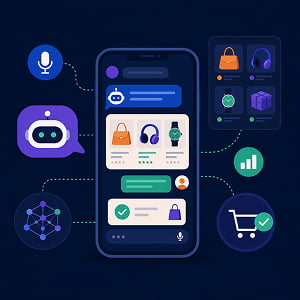
Using AI to Power On-Site Conversational Experiences: Even if you’re not ready for in-chat checkout on third-party platforms, there’s enormous value in adding AI-powered conversational elements to your own digital properties. AI chatbots embedded on your website can answer product questions in real time, handle objections, offer personalized recommendations, and guide shoppers toward checkout. According to Neuwark, chatbot-powered websites see a 23% boost in conversion rate compared to those without.
The most effective approach in 2026 is a hybrid model where AI handles the majority of conversations autonomously (typically 60-80% of interactions) and seamlessly hands off complex or sensitive cases to human agents with full context. Gorgias’s report found that 62% of e-commerce brands are planning to grow their customer experience teams, not cut them, but the scope of those teams is changing as AI takes on more of the routine interactions.
When implementing conversational commerce on your own site, use AI to analyze visitor behavior (pages viewed, time on site, scroll depth, return visits) and trigger proactive conversations based on intent signals like exit intent, cart value thresholds, or product page dwell time. Gorgias found that on-site features such as suggested product questions, recommendations triggered by search results, and open-ended input bars drove 50% of conversation-driven purchases during Black Friday/Cyber Monday 2025.
Preparing Your Product Data for Voice and AI Commerce: For your products to show up in voice search results and AI-powered shopping experiences, your product data needs to be clean, comprehensive, and structured for machine readability. This means writing product descriptions in natural, conversational language that mirrors how a shopper would ask about the product by voice. It means implementing Product schema markup with detailed attributes (price, availability, ratings, specifications). And it means making sure your product catalog is accessible to AI systems through feeds, APIs, or platform integrations.
AI can help you audit and enrich your existing product data at scale, identifying gaps in descriptions, missing schema attributes, or inconsistencies that would prevent your products from being surfaced in voice or conversational shopping experiences. For Shopify merchants specifically, the integration with ChatGPT and Google’s AI surfaces pulls directly from live catalog data including pricing, inventory, and images, so keeping that data accurate and complete is essential.
Measuring Success and Avoiding Common Mistakes
Measuring voice search performance requires a different mindset than traditional SEO reporting. Since voice search typically delivers a single answer rather than a list of links, the traditional metrics of ranking position and click-through rate don’t tell the full story.

The most direct measure of voice search success is featured snippet ownership. Use SEO tools like Semrush, Ahrefs, or Google Search Console to monitor how many featured snippets your site holds and for which queries. An increase in “Position Zero” rankings is a strong indicator that your voice strategy is working. Beyond snippets, track impressions for long-tail, question-based queries in Google Search Console. Filter for conversational queries to see which ones are driving visibility. For local businesses, monitor Google Business Profile actions (calls, directions, website clicks) since these are often the direct result of voice searches.
For conversational commerce, track conversion rate by channel (chat vs. non-chat visitors), average order value for AI-assisted sessions, resolution rate and hand-off rate for your chatbot, and revenue attributed to conversational interactions. According to Triple Whale, visitors arriving from generative AI sources spend significantly more time on site than those from paid search, email, affiliates, organic, or social, which suggests that the quality of AI-driven traffic can be exceptionally high.
The biggest mistake marketers make with voice search optimization is treating it as a separate project from their broader SEO and content strategy. In 2026, voice optimization is content optimization. If your content clearly answers real questions, is structured for machine readability, loads quickly, and is backed by solid schema markup, you’re already doing most of what voice search requires.
Other common pitfalls include ignoring mobile optimization (most voice searches happen on mobile devices, so a slow or poorly formatted mobile experience undermines everything else), stuffing content with keywords instead of writing in natural, conversational language, neglecting local SEO fundamentals like Google Business Profile accuracy and NAP consistency, and implementing schema markup but never testing or validating it with tools like Google’s Rich Results Test. On the conversational commerce side, the most common mistake is waiting for the technology to “mature” before investing. The brands winning in this space are the ones who started building conversational experiences early, learned from real customer interactions, and iterated from there.
Frequently Asked Questions
Voice search optimization (sometimes called Voice SEO or VSEO) is the process of adjusting your content, technical setup, and keyword strategy so your website is more likely to be selected and delivered as an answer by voice assistants like Google Assistant, Siri, and Alexa. It involves writing in conversational language, targeting question-based queries, implementing structured data, optimizing for featured snippets, and ensuring your site loads quickly on mobile devices.
Conversational commerce is the use of messaging apps, AI chatbots, and voice assistants to facilitate online shopping and customer service through natural, two-way conversation. Rather than browsing a traditional website with search bars and filters, consumers ask questions in natural language, and the AI understands their intent, recommends products, answers follow-up questions, and can even complete purchases without the user leaving the conversation.
Agentic commerce refers to AI agents acting autonomously on behalf of shoppers, browsing products, comparing prices, and even completing purchases without requiring constant human input. Unlike assistive AI that helps you shop, agentic AI can shop for you based on your preferences and instructions. Shopify and OpenAI’s integration is one of the most prominent examples, enabling in-chat product discovery and checkout directly within ChatGPT.
Schema markup is a form of structured data code (typically written in JSON-LD format) that you add to your web pages to help search engines and AI systems understand the context and meaning of your content. It uses a standardized vocabulary from Schema.org to label things like business information, product details, FAQs, how-to steps, and more. For voice search, schema markup helps voice assistants extract and deliver precise answers from your content.
Speakable schema is a specific type of structured data defined by Schema.org and supported by Google. It allows you to tag the sections of your content that are best suited for audio playback using text-to-speech (TTS). When implemented, it helps Google Assistant and other voice platforms identify exactly which parts of your page to read aloud, making your content more accessible and more likely to be surfaced in voice search results.
A featured snippet (also called “Position Zero”) is a special search result that appears at the very top of Google’s results page, above the standard organic listings. It provides a direct answer to a user’s query, typically pulled from a relevant web page. Featured snippets are especially important for voice search because voice assistants frequently read them aloud as the answer to a spoken query. Earning featured snippets requires well-structured content that directly and concisely answers specific questions.
Answer Engine Optimization is the practice of creating and structuring content so it can be easily understood and delivered by AI-powered answer engines, including voice assistants, Google’s AI Overviews, ChatGPT, and other generative AI platforms. While traditional SEO focuses on ranking in a list of links, AEO focuses on being the source that AI uses to provide a direct answer. In 2026, voice search optimization and AEO have largely converged into a single discipline.
Google AI Overviews are AI-generated answer summaries that appear at the top of Google search results for many queries. They synthesize information from multiple web sources to provide a direct answer to the user’s question. Voice assistants powered by Google (including Google Assistant) increasingly pull their spoken answers from these AI Overviews, which makes optimizing your content for inclusion in AI Overviews a critical part of any voice search strategy.
The Universal Commerce Protocol is an open standard co-developed by Shopify and Google that enables AI agents to facilitate commerce at scale across different platforms and interfaces. It provides a standardized way for AI agents to access product catalogs, manage checkout flows, and complete transactions on behalf of consumers, whether within Google Search’s AI Mode, the Gemini app, ChatGPT, Microsoft Copilot, or other AI-powered surfaces.
Other AI Training Modules You May Be Interested In
Using AI to Identify and Evaluate Co-Marketing and Partnership Opportunities
Using AI to Run Win-Back and Re-Engagement Campaigns
How to Measure the ROI of Your AI Marketing Tools
The Right Way to Use AI for Brand Positioning and Messaging Architecture
