Seasonal and moment marketing is the practice of aligning your brand’s campaigns, messaging, and offers with specific times of the year, cultural events, trending conversations, or real-time happenings that your audience already cares about. It goes beyond slapping a pumpkin on your October emails or running a generic “Happy Holidays” ad. Done well, it’s about tapping into the emotional and behavioral shifts that happen around holidays, sporting events, viral social moments, and cultural milestones to make your brand feel timely, relevant, and worth paying attention to. Done poorly, it can land your brand in a PR crisis overnight. AI is now making it possible to spot these moments earlier, produce creative faster, and scale campaigns across channels in ways that weren’t realistic even two years ago. But speed without cultural awareness is a recipe for disaster.
In this article, we’ll discuss how AI can help you identify the seasonal and cultural moments worth building campaigns around, how to use AI-powered tools to produce creative and launch campaigns fast enough to actually capitalize on those moments, and how to build guardrails that prevent your brand from stepping into cultural landmines along the way. We’ll look at real examples of brands that nailed moment marketing with AI and brands that stumbled badly, what separates the two, and which tools and workflows can help you stay on the right side of that line.
TL;DR Snapshot
Seasonal and moment marketing is about meeting your audience where their attention already is, whether that’s a holiday shopping window, a major sporting event, or a trending cultural conversation. AI can help you detect these moments earlier, create campaign assets faster, and personalize messaging at scale. But the same speed that makes AI powerful also makes it dangerous if you skip the cultural sensitivity checks. The brands winning at this right now aren’t just fast, they’re fast and thoughtful.
Key takeaways include…
- AI-powered social listening tools can detect emerging cultural moments and sentiment shifts in real time, giving marketing teams the lead time they need to plan campaigns around moments that actually matter to their audience.
- Generative AI has compressed campaign production timelines from weeks to days, but the brands seeing the best results still keep humans in control of strategy, cultural context, and final approval.
- Speed without cultural guardrails is the fastest way to a PR crisis. The most effective AI-powered seasonal marketing workflows bake sensitivity reviews and diverse perspectives into the process, not as an afterthought, but as a required step before anything goes live.
Who should read this: Marketers, content strategists, brand managers, and marketing leaders looking to use AI for timely, culturally relevant campaigns.
Why Seasonal and Moment Marketing Deserves More of Your Attention (and Budget)
Seasonal moments drive enormous consumer spending, and the numbers keep climbing. According to the National Retail Federation, Mother’s Day spending in the U.S. was expected to hit a record $38 billion in 2026, up from $34.1 billion the year before. Halloween spending reached a record $13.1 billion in 2025, and the NRF noted that event-driven spending across Valentine’s Day, Mother’s Day, Father’s Day, back-to-school, and Halloween was at or near record levels throughout 2025. These aren’t just retail moments, they’re windows of heightened consumer attention when people are actively looking for brands that show up with something relevant.
But seasonal marketing isn’t just about the big holidays on the calendar, some of the most effective campaigns are built around cultural micro-moments (e.g. a competitor’s product launch, a viral social media trend, a sporting event, or a cultural conversation that your audience is already engaged in). The challenge has always been speed. By the time a traditional campaign goes through ideation, production, legal review, and distribution, the moment has probably already passed. According to The 2025 Sprout Social Index, 90% of consumers use social media to keep up with trends and cultural moments, making it the number one source for cultural awareness, ahead of TV, friends and family, and other digital media. That same report found that 27% of consumers believe brands are only effective at participating in trends if they do so within 24 to 48 hours.
This is where AI changes the equation. It doesn’t replace the need for good strategy or cultural judgment, but it compresses the timeline between “something is happening” and “we have a campaign ready.” That compression is what turns your seasonal and moment marketing into a genuine competitive advantage.
How AI Helps You Spot the Right Moments (and Skip the Wrong Ones)
Not every trending topic is worth jumping on, and one of the most important things AI can do for your seasonal marketing strategy is help you figure out which moments are actually relevant to your brand and audience. There are two categories of seasonal moments to think about: planned and reactive. Planned moments are the ones you can see coming, like holidays, industry events, back-to-school season, or major product launches. Reactive moments are the ones you can’t predict, like a competitor making a surprise announcement, a viral meme that’s relevant to your product category, or a cultural conversation that blows up overnight.
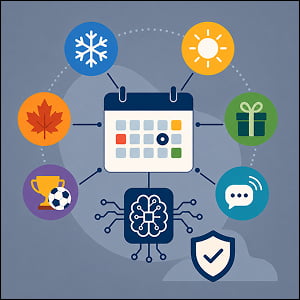
For planned moments, AI can help you build a smarter seasonal calendar by analyzing historical engagement data, search trends, and past campaign performance to identify which holidays and events actually drive results for your specific audience. Not every seasonal moment makes sense for every brand. As Odicci’s seasonal marketing strategy guide put it, the better approach is to ask a simple question: would this moment feel natural to your customers? If the answer is yes, it’s probably worth exploring. If not, leave it alone. AI can help you answer that question with data instead of gut instinct by surfacing patterns in how your audience behaves around different seasonal windows.
For reactive moments, AI-powered social listening platforms are the real game-changer. Tools like Brandwatch and Talkwalker (now part of Hootsuite) use AI to monitor millions of online conversations in real time, detecting spikes in mentions, shifts in sentiment, and emerging topics before they peak. Brandwatch uses an AI assistant called Iris that automatically detects changes in mentions and delivers smart, real-time alerts showing who influenced those changes. Talkwalker monitors over 150 million websites in 187 languages and uses AI-powered sentiment analysis to differentiate between sarcasm, context, and genuine cultural signals. These tools don’t just tell you what’s trending. They help you understand why something is trending and whether your audience is part of that conversation.
The key insight here is that AI is most valuable not when it identifies trending hashtag, but when it helps you be selective. The 2025 Sprout Social Index found that a third of consumers think it’s embarrassing when brands jump on trends just for the sake of it, and 93% of consumers believe it’s important for brands to keep up with online culture. That’s a tension only smart filtering can resolve, and AI-powered tools are increasingly good at separating signals from noise so your team can focus on the moments that genuinely align with your brand.
The Speed Advantage: How AI Compresses Campaign Production
Once you’ve identified the right moment, you need to move fast. This is where generative AI has fundamentally changes what’s possible.
Consider the Popeyes “Wrap Battle” campaign from July 2025. When McDonald’s announced the return of its Snack Wrap just one day after Popeyes launched its own Chicken Wraps, Popeyes responded with a full AI-generated rap diss track video. According to TechRadar, AI filmmaker PJ Accetturo scripted the campaign and produced it using Google’s Veo 3 for video and Suno for AI music production. The entire campaign, including music, visuals, and editing, was completed in under three days. Accetturo explained that his team initially tried image-to-video tools but found them too slow, so they switched entirely to Veo 3 to meet the deadline. The campaign went viral across TikTok, Instagram, and X.
What makes this case study instructive isn’t the viral outcome, it’s the production model. A traditional reactive campaign with that level of polish would normally take weeks and a substantial production budget. AI compressed that timeline to under 72 hours with a small team. As Creatify’s analysis noted, Popeyes is an early example of AI enabling reactive advertising at a quality level previously reserved for well-resourced agencies with long timelines. That’s the core value proposition of AI in moment marketing, it makes it possible for your brand to show up in the right conversation at the right time with creative that actually looks finished.
But it’s worth noting that the Popeyes campaign also drew backlash from viewers who felt the brand should have hired real actors and musicians instead of relying on AI. According to Mashed, the video racked up 3.1 million views on TikTok but generated significant criticism, with commenters calling it “AI slop” and questioning why a company with Popeyes’ resources would choose AI over human creators. This tension between speed and audience perception is something every marketer using AI for moment marketing needs to think about carefully.
The broader lesson is that AI is best used as a production accelerator, not a replacement for the creative and strategic thinking that makes campaigns resonate. As Superside’s analysis of AI marketing campaigns concluded, the brands getting the most from AI in moment marketing use it to handle the time-consuming production steps (e.g. generating visual assets, producing variations for different platforms, and editing video) while keeping humans in charge of the concept, the messaging, and the cultural judgment calls.
The Cultural Guardrails: How to Be Fast Without Being Tone-Deaf
Speed is only an advantage if you don’t run headfirst into a cultural wall. The recent history of moment marketing is littered with examples of brands that moved too fast and broke things they shouldn’t have.

In April 2025, Nike ran billboards along the London Marathon route with the slogan “Never Again. Until Next Year.” The copy was intended as a playful nod to the common runner joke about swearing off marathons after finishing one. But as Adweek reported, the phrase is globally recognized as a vow tied to Holocaust remembrance, and the red-and-black color scheme made the insensitivity even more pronounced. The backlash was immediate. Investor Bill Ackman and human rights advocates condemned the ad publicly. Nike apologized and removed the billboards. The timing of the fiasco made things even worse, as the marathon fell near Holocaust Remembrance Day, and the billboard coincided with the 80th anniversary of the liberation of Bergen-Belsen concentration camp. As exchange4media noted, brand expert Chandramouli, CEO of TRA Research, offered a balanced assessment: “Nike’s intent was to reflect the runner’s emotional arc, but it failed to account for the historical and emotional weight the phrase ‘Never Again’ carries. Creative liberty must always be grounded in cultural understanding.”
Meanwhile, Coca-Cola’s two consecutive years of AI-generated Christmas ads (2024 and 2025) became a case study in how not to use AI for emotionally loaded seasonal moments. According to Forbes, social media users called the ads “soulless” and called for boycotts, with many arguing that using AI for a deeply nostalgic holiday tradition felt cheap and impersonal. NBC News reported that Neeraj Arora, chair of marketing research and education at the University of Wisconsin-Madison, explained the backlash by noting that holidays are about connection and community, and AI was “not a fit” for that emotional context.
These examples point to a critical principle, AI can help you move faster but it can’t replace the cultural intelligence that keeps your brand out of trouble. Here’s how to build that intelligence into your AI-powered seasonal marketing workflow…
First, use AI for cultural sensitivity screening before you publish: Social listening tools with AI-powered sentiment analysis can flag phrases, imagery, or themes that carry unintended historical or cultural context. Run your campaign concepts through these tools the same way you’d run copy through a spell checker. It won’t catch everything, but it can surface obvious red flags.
Second, build diverse review into your approval process: The Nike “Never Again” debacle is a textbook example of what happens when everyone in the room shares the same frame of reference. As columnist Jonathan Sacerdoti wrote in The Spectator, “It would have taken just one set of discerning eyes, one solitary voice, one ‘sensitivity reader’ to raise a gentle objection.” AI can accelerate production, but the final sign-off should always involve people with different cultural backgrounds, historical knowledge, and lived experiences.
Next, match your tools to the emotional weight of the moment: Reactive campaigns built around playful competitive moments (like the Popeyes example) are lower-risk environments for AI-generated creative. Campaigns built around deeply emotional, nostalgic, or culturally significant moments (like Christmas traditions or memorial observances) demand more human involvement and more careful creative judgment. The Coca-Cola backlash wasn’t just about AI quality, it was about using AI in a context where audiences felt human craftsmanship was part of the tradition itself.
Finally, use AI to pre-test your campaign before it goes wide: Tools like Zappi apply AI to automate concept screening and creative testing, providing rapid consumer feedback on campaign concepts before launch. Running a quick sentiment check or audience reaction test on your seasonal creative can identify problems that your internal team might miss.
The brands that will win at AI-powered seasonal marketing aren’t the ones that move the fastest, they’re the ones that move fast and think carefully about context, history, and audience expectations before hitting publish.
Frequently Asked Questions
Seasonal marketing is a strategy built around aligning your campaigns, messaging, and offers with specific times of the year that matter to your audience. These moments can include holidays like Christmas or Mother’s Day, shopping events like Black Friday, cultural milestones, sporting events, or seasonal lifestyle shifts like back-to-school or summer travel. The goal is to meet your audience when their attention and purchase intent are naturally elevated.
Moment marketing (sometimes called real-time marketing) is the practice of creating and launching campaigns in response to unplanned or emerging cultural moments, like a competitor’s surprise announcement, a viral social media trend, or a breaking news event relevant to your audience. Unlike seasonal marketing, which can be planned months in advance, moment marketing requires the ability to move quickly and often involves reactive creative production.
Social listening is the process of monitoring online conversations across social media platforms, forums, news sites, blogs, and other digital channels to understand what people are saying about your brand, your competitors, your industry, or specific topics. AI-powered social listening tools go beyond simple keyword tracking to analyze sentiment, detect emerging trends, cluster conversations into themes, and surface insights about why certain topics are gaining traction.
Veo 3 is a video generation AI model made by Google. It produces video content from text prompts and gained attention in 2025 for its use in commercial campaigns, most notably the Popeyes “Wrap Battle” diss track campaign where it was used to generate all of the video content in under three days.
Suno is an AI music production platform that generates songs, instrumentals, and vocal tracks from text prompts. It was used alongside Google’s Veo 3 in the Popeyes “Wrap Battle” campaign, where it helped produce the diss track’s musical elements.
Brandwatch is one of the leading enterprise social listening and consumer intelligence platforms. It uses an AI assistant called Iris to detect changes in mentions and surface real-time insights, and it’s known for deep consumer research, historical data analysis, and audience segmentation.
Talkwalker is another one of the leading enterprise social listening and consumer intelligence platforms. Now part of Hootsuite, it monitors over 150 million websites in 187 languages and is known for its AI-powered sentiment analysis, visual recognition technology that can identify brand logos in images, and real-time crisis alerting capabilities.
Zappi is an AI-powered consumer research platform that automates traditional research workflows like concept screening, creative testing, and innovation forecasting. Instead of relying on open web data, it focuses on structured consumer input at speed, allowing marketers to pre-test campaign concepts and creative assets before launch to gauge likely audience reception.
The Sprout Social Index is an annual research report published by Sprout Social that surveys consumers, social media practitioners, and marketing leaders to uncover trends in how people use social media and what they expect from brands. The 2025 edition surveyed over 4,000 consumers, 900 social practitioners, and 300 marketing leaders across the United States, United Kingdom, Canada, and Australia.
Other AI Training Modules You May Be Interested In
Using AI to Optimize for Voice Search and Conversational Commerce
Using AI to Identify and Evaluate Co-Marketing and Partnership Opportunities
Using AI to Run Win-Back and Re-Engagement Campaigns
How to Measure the ROI of Your AI Marketing Tools
The Right Way to Use AI for Brand Positioning and Messaging Architecture
