
An AI-powered content calendar is a planning system that uses artificial intelligence to help marketers research topics, identify trends, schedule posts, and maintain a consistent publishing rhythm across channels. Unlike a traditional spreadsheet-based calendar that relies entirely on manual brainstorming and guesswork, an AI-driven content calendar draws on data (e.g. keyword insights, audience behavior patterns, competitor activity, and seasonal trends) to recommend what to publish, when to publish it, and where it will have the greatest impact. Think of it as the difference between planning a road trip with a paper map versus using a GPS that accounts for traffic, weather, and construction in real time.
In this article, we’ll discuss why traditional content calendars often fall short, how AI transforms the planning process from reactive to strategic, practical steps you can take to build your own AI-assisted calendar, and the pitfalls you need to avoid to make sure your content still sounds like you. Whether you’re a solo creator juggling multiple platforms, or a marketing team trying to scale output without sacrificing quality, this guide will show you how to use AI as a collaborator – not a replacement – in your content planning workflow.
TL;DR Snapshot
AI content calendars combine automation and data analysis with human creativity to make content planning faster, smarter, and more strategic. By using AI to handle the heavy lifting of research, trend-spotting, and scheduling optimization, marketers can spend less time staring at blank spreadsheets and more time crafting content that connects with their audience. The secret is using AI to inform your decisions, not to make them for you.
Key takeaways include…
- AI eliminates the guesswork in topic selection by analyzing search data, audience behavior, and competitive gaps, so that every piece of content you plan has a reason behind it.
- Consistency becomes automatic, not exhausting. AI tools can recommend posting cadences, optimal publishing times, and content formats tailored to each platform.
- Human oversight remains essential. AI-generated calendars trained on similar data will produce similar outputs. Your brand voice, editorial judgment, and firsthand experience are what make your calendar uniquely yours.
Who should read this: Marketers, content strategists, solopreneurs, small business owners, and anyone looking to publish more consistently without burning out.
Why Traditional Content Calendars Break Down
If you’ve ever sat down on a Sunday night to map out the week’s posts and drawn a complete blank, you already know the core problem with traditional content calendars. They depend entirely on you having the right idea at the right time. That works when inspiration strikes, but it falls apart during a busy quarter, a product launch, or the third consecutive week where “thought leadership” feels like a chore.
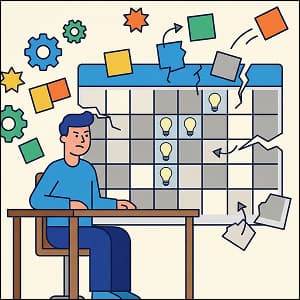
Traditional calendars also tend to be static. You fill them in at the beginning of the month and then stick to the plan regardless of what happens, even when a trending topic in your industry makes half your scheduled posts feel irrelevant. There’s no feedback loop. No signal telling you that your audience just shifted their attention to a different conversation.
The result is a familiar pattern: bursts of activity followed by long silences, content that doesn’t connect because it was planned in a vacuum, and a creeping sense that you’re always behind. These aren’t creative failures, they’re planning failures. And that’s precisely where AI enters the picture. Not to generate your content for you, but to give your planning process the structure and intelligence it’s been missing (though it’s a powerful tool for ad design ideation and testing as well).
How AI Transforms the Content Planning Process
AI doesn’t just speed up the old way of planning, it changes the process itself. Where a traditional calendar starts with “what should we post this week?” an AI-assisted calendar starts with data. What is your audience searching for, what topics are gaining traction in your space, where do your competitors have content gaps, and what formats are driving the most engagement on each platform?
At the research phase, AI tools can surface keyword trends and seasonal patterns that would take hours to find manually. Instead of guessing that “summer marketing tips” might perform well in June, an AI tool can tell you that search volume for that phrase peaks in early May. It can also identify related long-tail keywords, helping you build topic clusters instead of disconnected one-off posts.
At the scheduling phase, AI analyzes when your audience is most active across different platforms and recommends posting windows. This eliminates the common problem of publishing at the same time on every channel, regardless of whether that timing actually matches each platform’s engagement patterns.
Perhaps most importantly, AI introduces a feedback loop that traditional calendars lack. By tracking which posts perform well and which fall flat, AI tools can refine their recommendations over time. Your calendar becomes a living document that learns from your results, not a static grid you fill in and forget.
Building Your AI-Assisted Content Calendar: A Practical Approach
You don’t need a massive tech stack to build an AI-powered content calendar. In fact, over-tooling is one of the biggest mistakes marketers make. The goal is to integrate AI at the points where it adds the most value, not to automate every step.
- Start with your goals: Before you prompt any AI tool, get clear on what your content is supposed to accomplish this quarter. Are you driving organic traffic? Building brand awareness? Nurturing leads through email? AI is excellent at generating ideas, but it needs direction. Tell it your business objectives, your target audience, and your content pillars, and the output improves dramatically.
- Use AI for research, not just ideation: The most underrated use of AI in content planning isn’t generating topic lists, it’s analyzing what already exists. Feed an AI tool your past content and ask it to identify patterns: which topics drove the most engagement, which formats underperformed, where you have gaps in your content coverage. This audit gives you a baseline that makes every future decision smarter.
- Build in themes and clusters: AI can help you organize your calendar around content pillars, broad themes that you revisit throughout the quarter with different angles, formats, and depths. Instead of a random assortment of posts, you get a strategic arc that builds authority on specific topics over time. This is particularly effective for SEO, where topical clusters signal expertise to search engines.
- Keep your prompts specific: A prompt like “give me content ideas for my SaaS business” will produce generic results. A prompt like “suggest ten blog post topics for a B2B SaaS company targeting mid-market HR directors who are evaluating employee engagement platforms, focused on bottom-of-funnel content” will produce ideas you can actually use. The quality of your AI-assisted calendar is directly proportional to the quality of the context you provide.
Humanizing Your AI-Generated Calendar
Here’s where most marketers stumble: they let AI build the calendar and then publish it as-is. The problem is that when every brand uses the same AI tools trained on the same data, their calendars start to look remarkably similar. You end up with a sea of content that hits the same themes on the same schedule, and none of it stands out.
The fix is to treat AI output as a first draft, not a final plan. Once your AI tool generates a calendar framework, run it through your editorial filter. Does the tone match your brand voice? Are the topics aligned with your unique perspective, or are they generic takes that any company in your industry could publish? Does the calendar include opportunities for reactive content, the kind of posts that respond to what’s happening in your industry right now?
Your brand voice should be visible from the planning stage. If your voice is conversational and direct, your titles shouldn’t read like corporate press releases just because an AI tool wrote them. Experiment with headlines during the planning phase. It’s much easier to adjust your tone at the calendar stage than to try and inject personality after the content is already written.
Also make sure your calendar reflects your business reality, not just content best practices. Map company milestones, product launches, industry events, and relevant seasonal moments to your calendar. AI won’t know that your company is sponsoring a conference in September or that your product team is shipping a major feature in Q3, but those events should absolutely shape your content plan.
Reviewing, Iterating, and Keeping Your Calendar Alive
The best content calendars aren’t the ones with the most posts scheduled, they’re the ones that get reviewed and updated regularly. AI makes this easier by surfacing performance data and flagging what’s working, but the review process itself should stay in human hands.

Set a weekly review cadence. Look at what you published, how it performed, and whether the upcoming plan still makes sense given what you’ve learned. Did a particular topic outperform expectations? Consider creating a follow-up or repurposing it for a different channel. Did something under perform? Dig into why before writing it off completely, sometimes timing or distribution is the issue rather than the content itself.
Leave room in your calendar for spontaneous content. Over-planning is just as dangerous as under-planning. If every slot is filled weeks in advance, you have no capacity to respond to industry news, jump on a viral trend, or address a question your audience just started asking. A good rule of thumb is to plan roughly 70–80% of your calendar in advance, and leave the remaining slots flexible (but have a plan in place to fill them of course; you don’t want to be left scrambling to throw something together at the last minute).
Finally, use AI to close the loop. After a month or a quarter, ask your AI tool to analyze your publishing history and suggest adjustments. Which content pillars are driving results? Which formats deserve more investment? Are there audiences or topics you’ve been neglecting? This kind of retrospective analysis turns your calendar from a simple scheduling tool into a genuine strategic asset.
Frequently Asked Questions
A content calendar is a planning tool (often a spreadsheet, project board, or dedicated software) that maps out what content you’ll publish, when you’ll publish it, and on which channels. It serves as a shared source of truth for marketing teams and solo creators alike, helping ensure that content efforts stay organized, consistent, and aligned with business goals.
Content pillars are the core themes or subject areas that your brand consistently publishes around. For example, a fitness brand might have pillars like nutrition, workout routines, mental health, and product reviews. Pillars give your content strategy structure and help ensure that you’re building topical authority rather than publishing randomly.
Not necessarily. While there are dedicated AI content calendar tools on the market, you can get started with a general-purpose AI assistant like Claude, ChatGPT, or Gemini paired with a standard spreadsheet or project management platform. The most important factor isn’t the tool, it’s the quality of the context and direction you give it.
A topic cluster is a content strategy where you create one comprehensive “pillar” piece on a broad subject, and then produce multiple supporting pieces that dive deeper into related subtopics. All the pieces interlink, signaling to search engines that your site has deep expertise on the subject. AI is particularly useful for identifying cluster opportunities because it can analyze search data to reveal related questions and subtopics you might not think of on your own.
No. AI is excellent at processing data, identifying patterns, and generating suggestions at speed. But it cannot replicate the editorial judgment, brand intuition, audience empathy, and creative risk-taking that human strategists bring to the table. The most effective approach is a partnership: AI handles the research-heavy, time-consuming parts of planning while humans make the final strategic and creative decisions.
SGE stands for Search Generative Experience, which refers to Google’s integration of AI-generated summaries at the top of search results. SGE changes how content gets surfaced in search. Instead of just ranking links, Google may pull information directly from your content to answer a user’s query. Planning your content calendar with SGE in mind means creating content that answers specific questions clearly and authoritatively, increasing the chances that your content is cited in these AI-generated summaries.
A weekly review is a good baseline for most teams. During that review, check recent performance data, adjust upcoming topics if needed, and make sure your plan still reflects current priorities. Teams publishing at high volume or across many channels may benefit from shorter review cycles of every few days. The important thing is to treat your calendar as a living document, not something you set once and leave untouched.
