
An “AI selloff” refers to a broad decline in the stock prices of major technology companies driven by investor concerns about the financial sustainability of artificial intelligence spending. In June 2026, nine of the biggest names in the AI space collectively lost roughly $2.7 trillion in market value as Wall Street began questioning whether the enormous capital being poured into AI infrastructure would ever translate into proportional returns. The companies caught in this correction include Google (Alphabet), Amazon, Broadcom, Oracle, Nvidia, Tesla, Microsoft, Apple, and Meta, a group that essentially represents the backbone of the modern AI economy.
In this article, we’ll discuss what triggered this historic wave of losses, why investors are suddenly demanding proof instead of promises, and what it all means for the future of AI spending. We’ll break down the staggering capital expenditure numbers behind the AI build-out, explore how free cash flow is evaporating at some of the world’s most profitable companies, and examine whether this correction signals a healthy market re-calibration or something more troubling.
TL;DR Snapshot
The AI boom has entered a new phase. After years of rewarding Big Tech for pouring money into artificial intelligence, investors are now scrutinizing whether trillions of dollars in spending can actually deliver the returns that sky-high valuations have been pricing in. Nine major AI-linked companies have shed trillions in market value recently, marking one of the sharpest sector-specific corrections in recent memory.
Key takeaways include…
- The “Magnificent Seven” plus Broadcom and Oracle have lost approximately $2.7 trillion in combined market value in June 2026, as investors reprice the companies funding and powering the AI space.
- The four largest hyperscalers (Microsoft, Alphabet, Amazon, and Meta) are on track to spend up to $725 billion on capital expenditures in 2026, a 77% increase from the previous year’s already record-breaking $410 billion.
- Only about 3% of American households currently pay for AI services, raising questions about how quickly consumer adoption can catch up to corporate investment.
Who should read this: Investors, tech professionals, financial analysts, and anyone following the AI industry’s impact on global markets.
The $2.7 Trillion Correction: What Happened?
The selloff didn’t arrive overnight. It built up gradually over the course of June 2026, as a series of catalysts shook investor confidence in the AI trade.
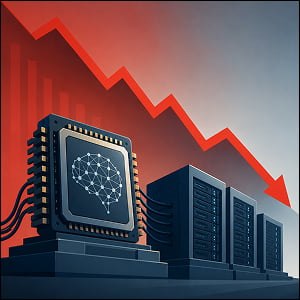
According to Yahoo Finance, the initial reset focused on the “Magnificent Seven” (Apple, Microsoft, Alphabet, Amazon, Nvidia, Tesla, and Meta). But the pressure quickly expanded to capture Broadcom and Oracle as well, two companies deeply tied to AI infrastructure. The selloff cut across all sides of the AI complex, with Nvidia and Broadcom being linked to the hardware boom, Microsoft, Alphabet, Amazon, Meta, and Oracle representing the spending boom, and Apple and Tesla being treated by investors as AI-adjacent proxies.
One of the most dramatic single-day events came on June 22, when Alphabet lost roughly $225 billion in market value in a single session, as CBS News reported. The trigger was a combination of factors, including key AI researchers departing Alphabet for competitors (including Noam Shazeer, a Gemini co-lead and co-author of the original transformer paper, who left for OpenAI), and investors grappling with the company’s projected AI spending.
The pain wasn’t limited to just the United States though. As NPR reported, the sell-off spilled into Asian markets too, with South Korea’s Kospi index crashing 10%, and semiconductor stocks Samsung and SK Hynix each falling 12%.
Nigel Green, CEO of financial consultancy deVere Group, told CBS News “What we’re witnessing now is investors demanding proof instead of promises. That shift can be uncomfortable, but it’s ultimately healthy.”
The Spending Problem: $725 Billion and Counting
At the heart of the correction is a simple tension, the companies building AI are spending money at a pace that’s difficult to comprehend, and the returns haven’t yet caught up.
A Yahoo Finance report on Q1 2026 earnings revealed that Microsoft, Alphabet, Amazon, and Meta collectively plan to spend up to $725 billion on capital expenditures in 2026. That figure is up 77% from the previous year’s $410 billion. To put it in perspective, as CNBC noted, that $725 billion figure is larger than the total GDP of many mid-sized European countries, and roughly 1.5 times the economy of Singapore.
The spending is primarily going toward GPUs, data centers, networking equipment, power infrastructure, and custom AI chips. Approximately 75% of it is directly tied to AI-specific infrastructure, according to estimates compiled by Intellectia (citing multiple analysts).
And the splurging doesn’t look like it’ll be slowing down anytime soon. Goldman Sachs expects cumulative AI spending by the four largest hyperscalers to reach $5.3 trillion by fiscal year 2030.
The result? Free cash flow, the money left over after operating a business and funding investments, is getting crushed. Amazon’s trailing 12-month free cash flow plunged 95%, falling from roughly $26 billion to just $1.2 billion, even as operating cash flow grew 30%, according to MarketWatch data cited by Yahoo Finance. The culprit was a $59.3 billion year-over-year increase in property and equipment purchases, nearly all of it directed at AI infrastructure. Alphabet’s Q1 2026 free cash flow fell 47% year over year to $10.12 billion, Yahoo Finance reported.
As Nomura cross-asset strategist Charlie McElligott framed it in Yahoo Finance’s analysis, the hyperscalers are essentially “the funding shorts” behind AI bottleneck trades across chips, memory, optical networks, servers, and power infrastructure. In plain English, the companies spending on AI are also the revenue sources for many of the stocks investors have been chasing. When those spenders start looking stretched, the entire chain feels it.
The Adoption Gap: Who’s Actually Paying for AI?
Perhaps the most uncomfortable data point for AI bulls isn’t about spending at all, it’s about demand.

A Bank of America Institute report found that only about 3% of American households currently pay for AI services. The paying customers skew heavily toward higher-income households (those earning more than $125,000 annually) and younger generations. While apps like ChatGPT, Claude, Gemini, and Grok have attracted millions of users, the vast majority rely on free tiers.
There are some encouraging signs however. The number of households making AI payments has increased 38% compared to the 2024 average, and the share paying $21 to $40 per month has jumped 50%, according to the same Bank of America Institute analysis. But when you’re spending $725 billion on AI infrastructure in a single year, and only 3% of consumers are paying for your AI products, investors are naturally going to start asking some pretty tough questions about return on investment.
It’s not just a consumer story though, enterprise AI is undoubtedly generating real revenue. Microsoft has turned Copilot into a broad enterprise push, Amazon is selling AI infrastructure through AWS (which grew 28% in Q1 2026), and Google Cloud has been posting strong growth as well. But the question investors are asking is whether enterprise revenue alone can justify the current scale of spending.
Is This a Bubble, or a Healthy Reset?
There’s a strong temptation to draw comparisons to the dot-com bubble of the late 1990s. The parallels are easy to spot (e.g. massive capital expenditure, sky-high valuations, and technology that everyone agrees is transformative but whose business model hasn’t fully materialized). According to CBS News, Meta and Microsoft have entered “bear market territory,” with shares dropping at least 20% from their recent peaks.
But there are important differences to account for. Today’s hyperscalers are enormously profitable operating companies, not startups running on venture capital and hope. AWS, Azure, Google Cloud, and Meta’s advertising machine are real businesses generating real revenue. Yahoo Finance noted that Amazon’s Q1 earnings beat expectations across the board despite the cash flow squeeze, with AWS growth at its fastest pace in 15 quarters.
Several analysts have pushed back on the bubble narrative as well. Brock Weimer, an investment strategy analyst at Edward Jones, told CBS News that the recent pullback follows a massive rally, stating “The Nasdaq had gained 26% from March 30 through yesterday’s close, while the PHLX Semiconductor Index had advanced more than 100% over the same period. Viewed through this lens, a period of consolidation is reasonable.”
Still, the math is getting harder to ignore. Startup Fortune reported that free cash flow for the five big hyperscalers is expected to drop 91% in 2026 to about $16 billion, even as net income is projected to rise 25% to $506 billion. That gap tells you everything about what the AI build-out is costing shareholders.
As Yahoo Finance’s Jared Blikre wrote, the biggest AI names are no longer trading solely on the promise of future revenue. They’re finally starting to trade on the cost of actually delivering.
Frequently Asked Questions
The “Magnificent Seven” is a term used by investors and financial media to refer to seven of the most influential and highly valued technology stocks in the U.S. market: Apple, Microsoft, Alphabet (Google), Amazon, Nvidia, Tesla, and Meta (Facebook). These companies have driven a disproportionate share of the S&P 500’s gains in recent years, largely on the strength of their AI-related growth narratives.
A hyperscaler is a large technology company that operates massive-scale cloud computing and data center infrastructure. In the context of AI, the term typically refers to Amazon (AWS), Microsoft (Azure), Alphabet (Google Cloud), Meta, and Oracle. These companies are the primary buyers of AI chips and the builders of the data centers that power AI workloads. Their capital expenditure decisions have an outsized influence on the entire AI supply chain.
Free cash flow is the amount of cash a company has left after paying for its operating expenses and capital investments (like buying equipment, building data centers, and other infrastructure). It’s a key metric for investors because it represents the money available for stock buybacks, dividends, acquisitions, and paying down debt. When free cash flow shrinks dramatically, as it has for several hyperscalers in 2026, it signals that a company’s spending is consuming nearly all of the cash its business generates.
Capital expenditure, often shortened to “capex,” refers to the money a company spends on acquiring, maintaining, or upgrading physical assets like data centers, servers, chips, and networking equipment. In 2026, AI-related capex by the largest tech companies has reached unprecedented levels, with the four biggest hyperscalers collectively planning to spend up to $725 billion in a single year.
The Nasdaq Composite is a stock market index that includes nearly all of the stocks listed on the Nasdaq stock exchange. Because the Nasdaq is home to many of the world’s largest technology companies, it’s considered a key barometer of the tech sector’s overall health. When the Nasdaq drops sharply, it typically reflects broad investor concern about technology stocks specifically.
Other Enterprise AI Articles You May Be Interested In
OpenAI Enters the Chip Game: Everything You Need to Know About Jalapeño
Oracle Cuts 21,000 Jobs as AI Transforms the Tech Workforce
Public Ownership of Big AI? Breaking Down Sanders’ Bold New Bill
SpaceX Acquires Cursor for $60 Billion: What Developers Need to Know
Fable 5 and Mythos 5 Shutdown: Why the U.S. Government Pulled Anthropic’s Most Powerful AI Offline
