

On June 12, 2026, the U.S. Commerce Department issued an export control directive ordering Anthropic to suspend worldwide access to Claude Fable 5 and Claude Mythos 5, their two most advanced AI models. The directive, which cited national security concerns over a reported method of bypassing Fable 5’s safety guardrails, forced Anthropic to disable the models for all customers just three days after their public launch. It marked the first time the federal government has used export control authority to pull a commercially deployed frontier AI model offline, setting a precedent that has sent ripples through the AI industry.
In this article, we’ll discuss how the Fable 5 suspension unfolded, from the model’s origins in Anthropic’s cybersecurity-focused Project Glasswing to the jailbreak allegations that triggered the government’s response. We’ll also examine the competing narratives from Anthropic and the White House, explore the role that Amazon reportedly played in flagging the vulnerability, and consider what the episode means for the future of AI regulation and deployment.
TL;DR Snapshot
Claude Fable 5 was Anthropic’s first attempt at making its extraordinarily capable Mythos-class AI available to the general public, complete with safety guardrails designed to prevent misuse of the model’s advanced cybersecurity capabilities. Three days after its launch, the U.S. government ordered a shut down over concerns that those guardrails could be bypassed, forcing Anthropic to disable the model globally because it couldn’t selectively block access to foreign nationals in real time.
Key takeaways include…
- The U.S. Commerce Department used export control authority to force Anthropic to disable Fable 5 and Mythos 5 worldwide after a reported jailbreak exposed potential access to the model’s restricted cyber capabilities.
- Anthropic publicly disagreed with the government’s action, arguing that the jailbreak was narrow, non-universal, and reproducible on competing models like OpenAI’s GPT-5.5.
- The episode raises major questions about whether “deemed export” law is an appropriate tool for regulating frontier AI, and what happens when a single vulnerability can trigger a global shutdown of a commercial product used by hundreds of millions of people.
Who should read this: AI developers, enterprise technology leaders, cybersecurity professionals, policy analysts, and anyone following the intersection of AI regulation and national security.
From Mythos to Fable: The Origins of a Dual-Use Dilemma
To understand the Fable 5 shutdown, you need to start with Project Glasswing. In April 2026, Anthropic unveiled Claude Mythos Preview, a frontier model it described as a potential turning point for cybersecurity. According to Anthropic’s Project Glasswing announcement, the model had already “found thousands of high-severity vulnerabilities, including some in every major operating system and web browser.” Some of those flaws had gone undetected for decades. Anthropic committed up to $100 million in usage credits for Mythos Preview across Glasswing initiatives, along with $4 million in direct donations to open-source security organizations.
The power of Mythos created a classic dual-use problem. A model capable of finding software vulnerabilities and writing patches for defenders could also, in the wrong hands, be used to exploit those same weaknesses. Anthropic’s solution was to restrict Mythos Preview to a curated set of partners. The initial group of roughly 50 organizations included major names like Amazon, Apple, Cisco, CrowdStrike, Microsoft, and Palo Alto Networks. As reported by Cybersecurity Dive, the program later expanded to approximately 150 organizations across more than 15 countries, including critical infrastructure operators in power, water, healthcare, and telecommunications.
When Anthropic launched Claude Fable 5 on June 9, 2026, the idea was to bring Mythos-class intelligence to the broader public while keeping the dangerous capabilities of Mythos locked away. Fable 5 shares the same underlying architecture as Mythos 5 (the latest version of Mythos), but with safety classifiers layered on top to block responses in high-risk areas like offensive cybersecurity and biotechnology. The full-strength version Mythos 5 remains restricted to Project Glasswing participants. The dual-release approach was supposed to offer the best of both worlds. It lasted three days.
The Shutdown: What Happened on June 12
According to Anthropic’s official statement, the company received the government’s export control directive at 5:21 PM ET on June 12, 2026. As reported by CNBC, Commerce Secretary Howard Lutnick sent a letter to Anthropic CEO Dario Amodei notifying the company that Fable 5 and Mythos 5 would be subject to export controls barring access by any foreign national, whether inside or outside the United States. The restriction even applied to Anthropic’s own foreign-born employees.
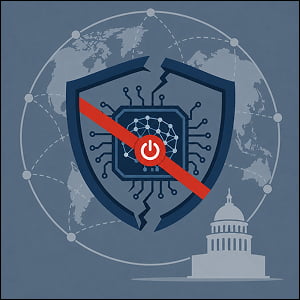
The scope of the order created an impossible operational challenge. As multiple outlets reported, Anthropic couldn’t selectively verify the nationality of every user in real time, so its only option for compliance was to turn off both models entirely. AWS confirmed in a blog post that access to Fable 5 and Mythos 5 on Amazon Bedrock had been revoked for all users. All other Anthropic models, including Opus 4.8 and Sonnet 4.6, remained unaffected.
The underlying legal mechanism at play here is something known as “deemed export” law. Under this framework, when a foreign national accesses controlled technology on U.S. soil, it counts as an export. As ToxSec’s analysis explained, once the government determined that Fable 5’s outputs could constitute controlled information, any foreign national reading those outputs would technically be receiving an “export,” and you can’t license that interaction on a prompt-by-prompt basis. The practical result was that a single vulnerability turned into a global blackout.
Anthropic’s public response was pointed. In their official statement they explained that they were complying with the government’s directive, but emphasized that they “disagree that the finding of a narrow potential jailbreak should be cause for recalling a commercial model deployed to hundreds of millions of people.” They also noted that “if this standard was applied across the industry, we believe it would essentially halt all new model deployments for all frontier model providers.”
Behind the Scenes: Amazon, the Jailbreak, and the White House
The story of how the government learned about the jailbreak is itself a point of contention. On Saturday, June 13, David Sacks, co-chair of the President’s Council of Advisors on Science and Technology and the administration’s former AI czar, offered his account on X. According to a report from Semafor, Sacks said that a “highly credible, trusted partner” of both Anthropic and the U.S. government had come forward with evidence that Fable 5’s guardrails could be bypassed, exposing the unrestricted cyber capabilities of the underlying Mythos model.
Multiple reports, including from Fortune and Tom’s Hardware, identified that partner as Amazon. According to Fortune’s reporting, Amazon CEO Andy Jassy raised concerns about the model with senior administration officials on Thursday, June 11, after Amazon researchers used a series of prompts to get the Mythos-class model to produce information about cyberattacks that was supposed to be restricted. Amazon, which has invested billions of dollars in Anthropic and supplies much of its cloud computing infrastructure, didn’t confirm the specifics. An Amazon spokesperson told Semafor that “it’s not uncommon for governments to seek our counsel on potential security risks.”
According to Sacks, when the administration notified Anthropic about the jailbreak and asked the company to either patch the vulnerability or temporarily remove the model, Amodei refused, calling the jailbreak “not serious.” Sacks wrote that the export control was issued “reluctantly” after that refusal, adding that “the ball is in Anthropic’s court” and that the government would lift restrictions once the issue is addressed.
Anthropic’s position was reportedly that the jailbreak was narrow and non-universal, amounting to asking the model to read a codebase and identify software flaws. They argued that the same results can be produced on other publicly available models, including OpenAI’s GPT-5.5. According to Tom’s Hardware, Sacks rejected that framing, arguing that “a bypass enabling operation of a cyberweapon is difficult to define as anything other than serious.”
Adding another layer of complexity, Semafor reported that the White House acted partly over suspicion that a China-linked group had accessed Mythos, raising concerns about the model being reverse-engineered or distilled. Anthropic told Semafor that the White House “didn’t raise Chinese access to Mythos in its conversations around the Fable jailbreak and export controls.” It’s also worth noting that this wasn’t the first time unauthorized access to Mythos became an issue. Per Tom’s Hardware, unauthorized third parties reached the restricted model in April using information obtained from a data breach.
What Comes Next: Regulation, Restoration, and Precedent
As of June 15, 2026, Fable 5 and Mythos 5 remain offline with no official restoration date. Anthropic has said it’s working to restore access but hasn’t provided a specific timeline. Prediction markets tracked by Polymarket and others suggest that most observers expect Fable 5 to return for U.S. customers before July 1.

The broader implications extend well beyond one model. This episode is the first time the U.S. government has used export controls to force a frontier AI company to pull a live commercial product. It sets a precedent that could apply to any AI model whose capabilities cross certain thresholds. As Anthropic warned in their official statement, if this standard were applied uniformly, it could effectively halt new model deployments across the entire frontier AI industry.
It’s also important to keep the larger context between Anthropic and the current administration in mind. Earlier in 2026, the Pentagon attempted to ban government use of Claude after Anthropic refused to allow its models to be used for lethal autonomous weapons or mass surveillance. A federal judge in San Francisco blocked that ban in March, with Judge Rita Lin calling it “classic illegal First Amendment retaliation,” according to NBC’s reporting of the court proceedings. The Fable 5 situation is technically separate, but it adds yet another chapter to an increasingly complicated relationship between the most valuable AI company in the world (as of the writing of this article) and the federal government.
For AI developers and enterprise customers, the immediate lesson is one of contingency planning. Models can be pulled without warning. If your product or workflow depends on a single frontier model, you need a fallback strategy. Anthropic itself has recommended that developers using the claude-fable-5 API string switch to claude-opus-4-8 as an interim solution.
For policymakers, the questions are even thornier. Deemed-export law was designed for physical goods and tangible technology transfers, not for AI model outputs. The Fable 5 case exposes how poorly that legal framework maps onto the reality of cloud-based AI services, where distinguishing between a U.S. citizen and a foreign national in real time is practically impossible without invasive identity verification. Whether Congress or the courts will update that framework remains to be seen, but the conversation has now undeniably started.
Frequently Asked Questions
Claude Fable 5 is an AI model developed by Anthropic and launched publicly on June 9, 2026. It’s built on the same architecture as Anthropic’s Mythos-class models but includes safety classifiers designed to block the model from responding in high-risk areas like offensive cybersecurity and biotechnology. It was intended to bring Mythos-level intelligence to the general public in a safer form.
Claude Mythos 5 is the full-capability version of Anthropic’s Mythos-class model, released alongside Fable 5 but restricted to participants in Anthropic’s Project Glasswing initiative. Unlike Fable 5, Mythos 5 doesn’t have the same safety classifiers limiting its cybersecurity capabilities, which is why access was limited to vetted organizations.
Project Glasswing is an Anthropic-led cybersecurity initiative launched in April 2026. Its purpose is to use Mythos-class models to find and fix vulnerabilities in critical software, giving defenders an advantage in an era of increasingly AI-capable cyberattacks. Partners include major technology companies like Amazon, Apple, Microsoft, Cisco, and CrowdStrike, as well as critical infrastructure operators and open-source software maintainers.
A jailbreak refers to a technique for bypassing the safety guardrails built into an AI model, causing it to produce responses it was designed to block. In this case, the alleged jailbreak involved prompting Fable 5 in a way that circumvented the safety classifiers separating it from the unrestricted cybersecurity capabilities of the underlying Mythos model.
An export control directive is a government order restricting the transfer of certain technologies or information to foreign nationals or foreign countries. In this case, the U.S. Commerce Department issued a directive under national security authority that barred any foreign national from accessing Fable 5 and Mythos 5, effectively forcing Anthropic to shut the models down globally.
Deemed-export law is a U.S. regulatory framework under which sharing controlled technology or information with a foreign national on U.S. soil is treated as an “export” to that person’s home country. Applied to AI models, it means that if a foreign national accesses a controlled model’s output, that access counts as an export, even if the person is physically located in the United States.
Amazon is Anthropic’s largest investor, with a cumulative investment of roughly $13 billion. Amazon also supplies much of Anthropic’s cloud computing infrastructure through AWS. Amazon Bedrock, its managed AI service, was one of the platforms where Fable 5 was available before the shutdown. According to multiple reports, Amazon researchers flagged the Fable 5 jailbreak to the administration, playing a key role in the events that led to the export control directive.
Other Enterprise AI Articles You May Be Interested In
OpenAI Weighs Drastic Price Cuts as the AI War With Anthropic Heats Up
Claude Fable 5 and Mythos 5: A Complete Guide to Anthropic’s New Models
Apple’s New Siri AI: Everything You Need to Know About the Biggest Siri Overhaul in Over a Decade
Why Corning’s Amazon Deal Makes It the Most Important AI Infrastructure Stock of 2026
Broadcom Stock Plunges on Soft AI Semiconductor Guidance: Full Breakdown
