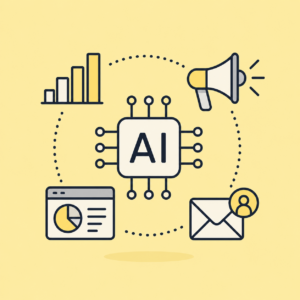
 TL;DR: Ask marketers what the most impressive AI marketing use cases are, and surprisingly few mention writing blog posts or generating social media content. Instead, many of the biggest productivity gains are happening behind the scenes through reporting, analytics, workflow automation, campaign planning, landing page creation, and operational efficiency. The biggest AI success stories in marketing are increasingly about improving systems—not replacing marketers.
The AI Conversation Is Maturing
When generative AI first entered marketing, most conversations revolved around content creation. Marketers experimented with blog writing, ad copy, email subject lines, product descriptions, and social media posts. The excitement centered on how quickly AI could generate words.
Fast forward to 2026, and the discussion is noticeably different.
Across marketing communities, experienced practitioners are increasingly pointing to operational improvements rather than content generation as AI’s most valuable contribution. Instead of asking, “Can AI write this?” they’re asking, “Can AI eliminate this manual process?”
That shift says a lot about where AI adoption is heading.
Reporting Is Becoming One of AI’s Biggest Wins
One of the most frequently mentioned use cases is reporting.
Many marketers describe AI helping consolidate data from multiple advertising platforms, CRM systems, analytics tools, and marketing channels into unified dashboards. Instead of manually exporting spreadsheets and building reports every week, AI can summarize performance, explain changes, identify anomalies, and even suggest optimization opportunities.
The time savings are significant, but so is the quality of the analysis. Rather than simply presenting numbers, AI increasingly helps answer the questions marketers actually care about: what changed, why it changed, and what should happen next.
AI Is Becoming a Marketing Analyst
Perhaps the most interesting shift is that AI is moving beyond execution and into interpretation.
Several marketers describe using AI to connect data across advertising platforms, CRM systems, website analytics, email performance, and customer behavior to identify trends that might otherwise go unnoticed.
Instead of replacing analysts, AI is acting more like an assistant that quickly surfaces insights, highlights unusual performance, and accelerates decision-making.
That represents a much bigger leap than simply generating another piece of copy.
Workflow Automation Is Delivering Quiet Productivity Gains
Some of the most impressive examples have very little to do with public-facing marketing.
Teams are building AI-assisted workflows that automate recurring operational tasks like campaign reporting, content approvals, dashboard creation, CRM updates, landing page production, internal documentation, and customer communications.
Individually, each automation may save only a few minutes.
Collectively, they can free up hours every week that marketers can spend on strategy, experimentation, and creative work.
AI Is Helping Marketers Build Faster
Another recurring theme is speed.
Marketers are increasingly using AI-powered tools to create landing pages, presentations, campaign assets, dashboards, internal tools, and prototypes in a fraction of the time previously required.
Rather than replacing designers or developers, these tools allow teams to move from idea to working draft much faster, shortening campaign timelines and making experimentation less expensive.
The result is that marketers can test more ideas instead of spending weeks building each one.
Custom AI Systems Are Becoming a Competitive Advantage
Several experienced marketers also described building their own internal AI solutions rather than relying exclusively on off-the-shelf products.
Examples included custom reporting dashboards, AI-powered content management systems, internal knowledge bases, client reporting tools, website auditing platforms, and business-specific assistants trained on company data.
This reflects another important trend.
The competitive advantage is becoming less about having access to AI and more about tailoring AI to your own business processes.
Human Expertise Is Still the Differentiator
Interestingly, one point generated almost universal agreement.
Even marketers who rely heavily on AI emphasized that human expertise remains essential.
AI can draft presentations, summarize reports, generate first drafts, and automate repetitive work. What it cannot consistently replace is strategic judgment, customer understanding, positioning, creativity, and experience.
Most successful teams appear to be using AI as a collaborator rather than an autonomous marketer.
The technology accelerates execution while humans continue making the important decisions.
The Biggest AI Trend Isn’t Content Generation
Looking across these discussions, one pattern becomes clear.
The most exciting AI use cases are becoming increasingly invisible.
They happen inside reporting systems, workflows, dashboards, planning documents, internal tools, campaign operations, and marketing infrastructure rather than on public-facing websites.
In many organizations, AI is becoming less of a content creator and more of an operational engine.
That may ultimately have a much bigger impact on marketing productivity than any AI-written blog post ever could.
Final Takeaway
For the past two years, much of the conversation around AI marketing has focused on replacing content creation.
Today’s discussions suggest something different.
The marketers seeing the biggest gains are using AI to remove friction, automate repetitive work, connect disconnected systems, analyze data faster, and accelerate execution.
Content generation still has its place.
But the biggest competitive advantage may come from something far less visible: building marketing operations that run smarter behind the scenes.
FAQs
What are the best AI marketing use cases in 2026?
Many marketers report that AI delivers the most value through reporting, analytics, workflow automation, dashboard creation, campaign planning, landing page generation, and operational efficiency rather than simply writing content.
Is AI replacing marketers?
Most experienced marketers say no. AI is primarily helping automate repetitive work while allowing marketers to spend more time on strategy, creativity, experimentation, and customer understanding.
How are marketers using AI for reporting?
AI is increasingly being used to consolidate cross-platform marketing data, generate dashboards, summarize campaign performance, explain changes in metrics, identify trends, and recommend optimization opportunities.
What is the biggest AI trend in digital marketing?
One emerging trend is the shift from AI-powered content generation toward AI-powered operations. Marketers are investing more heavily in automation, analytics, reporting, and internal workflows that improve productivity across the entire marketing organization.
