

AI-powered marketing analytics is the practice of applying artificial intelligence (specifically machine learning, natural language processing, and predictive modeling) to the mountains of data your marketing efforts generate, in order to extract clear, usable intelligence that drives real decisions. Rather than staring at spreadsheets full of click-through rates, bounce rates, and conversion numbers and trying to figure out what they mean, AI does the pattern recognition for you at a speed and scale that no human team can match. It’s the difference between having data and actually understanding data.
In this article, we’ll discuss why so many marketing teams are drowning in dashboards but starving for clarity, and how AI bridges that gap. We’ll walk through the core problem with traditional analytics, explore the specific ways AI transforms raw numbers into strategic direction, look at the tools making this possible right now, and cover the practical steps you need to take to get started, even if you don’t have a data science team on staff.
TL;DR Snapshot
Most marketing teams today have more data than they know what to do with. They track dozens of KPIs across multiple platforms, but the sheer volume of information often leads to analysis paralysis rather than better decisions. AI-powered analytics solves this by automatically identifying patterns across your data, surfacing what actually matters, and translating raw metrics into specific, actionable recommendations (e.g. which audience segments are most likely to convert, which creative elements are driving downstream revenue, and where your budget is being wasted).
Key takeaways include…
- AI shifts marketing analytics from reactive reporting (what happened?) to predictive intelligence (what’s about to happen, and what should we do about it?), giving teams a compounding strategic advantage over time.
- Clean, centralized data is the non-negotiable foundation. AI model outputs are only as good as the data they analyze, so unifying your data sources and maintaining data hygiene comes before any tool selection.
- You don’t need a data science degree or a six-figure platform to get started. Free and affordable AI-powered tools can deliver meaningful insights for teams of any size.
Who should read this: Marketers, marketing managers, small business owners, agency leads, and anyone who has ever opened a dashboard and thought, “Okay, but what does this actually mean?”
The Problem: More Data, Fewer Answers
Here’s a scenario that will sound familiar to almost every marketer. You run a campaign across three or four channels. You check your dashboards. You’ve got impressions, clicks, conversions, bounce rates, session durations, cost-per-click, cost-per-acquisition, engagement rates, and a dozen other metrics staring back at you. And somehow, you’re still not sure whether the campaign was actually successful.
This is what industry professionals call the “analysis paralysis” problem, and it’s pervasive. Teams collect more numbers than they know what to do with, and mistake that volume for value. Research from Gartner has shown that poor data quality and the resulting bad decisions cost organizations millions annually. But the issue isn’t just inaccurate data, it’s too much data without enough context.
Traditional analytics is fundamentally backward-looking. You see where you’ve been, but you’re essentially driving blind into what comes next. You know someone clicked your ad, visited your site, and eventually converted. But did that click actually matter, or would they have found you anyway through organic search three days later? Standard dashboards can’t answer that question. They show you what happened without explaining why it happened, and they certainly can’t tell you what to do next.
The result is that many marketing teams end up spending more time building and interpreting reports than actually acting on them. Dashboards that were supposed to clarify things end up raising more questions than they answer. And when everyone on the team is debating whether to optimize for CTR, bounce rate, or time-on-page, that’s time spent on analysis instead of execution.
How AI Transforms Data Into Direction
AI-powered analytics doesn’t just give you a prettier dashboard, it fundamentally changes the relationship between your team and your data by doing three things traditional tools can’t…
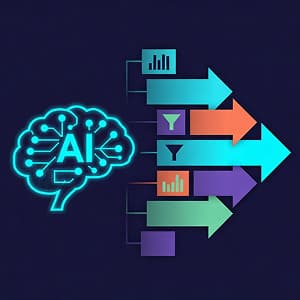
First, it finds patterns humans miss. Machine learning algorithms can analyze thousands of customer journeys simultaneously, and identify which combinations of touchpoints, content, timing, and channels actually lead to conversions. For example, traditional analysis might tell you that your email campaigns targeting IT decision-makers have a 15% conversion rate. But AI analysis can go deeper, revealing that IT managers who visited your pricing page twice, engaged with video content, and came from LinkedIn converted at four times the rate of those who don’t exhibit those behaviors. That’s not a metric, it’s a strategy.
Second, it shifts you from reactive to predictive. Instead of telling you what happened last quarter, AI models can forecast what’s likely to happen next week. Predictive analytics can identify which audience segments are most likely to convert, flag early warning signs of customer churn before it shows up in your revenue numbers, and recommend budget reallocation based on projected returns rather than historical averages. This is where the compounding advantage kicks in. Better predictions lead to better decisions, which generate better data, which improves the AI’s recommendations further.
Third, it automates the “so what.” The most advanced AI analytics tools don’t just surface data, they surface recommendations. Rather than showing you a chart and leaving you to interpret it, they tell you things like, “Your paid social spend on Platform X is generating clicks but not downstream conversions. Consider reallocating 20% of that budget to email nurture sequences, which are converting at 3x the rate for this audience segment.” That’s the kind of insight that used to require a dedicated analyst spending hours with the data. Now it can happen in seconds.
The Tools Making This Possible
You don’t need an enterprise budget to start using AI for marketing analytics. The ecosystem has matured significantly, and there are strong options at every price point.
Google Analytics 4 (GA4) is the most accessible starting point for most teams. It’s free, and it uses machine learning to automatically identify trends, estimate churn probabilities, and flag anomalies in your traffic patterns. If you’re running any kind of digital marketing and aren’t using GA4’s predictive audiences and automated insights features, you’re leaving value on the table.
HubSpot offers AI-enhanced analytics built into its CRM, which is powerful because it connects your marketing activities directly to sales outcomes without needing third-party integrations. Its multi-touch attribution reports help you see which marketing touchpoints actually contribute to revenue, not just leads. For small-to-mid-size teams that want everything in one ecosystem, it’s a strong choice.
For more advanced needs, platforms like Amplitude specialize in behavioral analytics with AI-powered root cause analysis. When your conversion rates shift or engagement drops, the platform automatically investigates which user segments, behaviors, and external factors caused the change, without you needing to dig through the data manually. Tools like Supermetrics focus on unifying data from multiple ad platforms and analytics sources into a single view, using deterministic guardrails on top of AI reasoning to ensure the numbers are accurate and reproducible.
On the enterprise end, Adobe Analytics uses its AI engine (Adobe Sensei) to continuously monitor metrics and alert you to statistically significant changes before you notice them. When something anomalous happens, its contribution analysis feature automatically identifies which segments, channels, or variables caused it.
The right tool depends on your team’s size, budget, and technical comfort level. But the important thing to understand is that every one of these tools is trying to solve the same core problem: getting you from “here’s the data” to “here’s what to do about it” faster.
Getting Started: Practical Steps for Any Team
Adopting AI-powered analytics doesn’t require a complete overhaul of your marketing stack. It requires a shift in approach. Here’s a step-by-step plan for how to begin…

- Centralize your data: This is the foundation, and it’s non-negotiable. If your Google Ads data lives in one place, your email metrics in another, and your CRM in a third, no AI tool is going to save you. Before selecting any platform, invest the time in connecting your data sources into a unified view. This might mean using a tool like Supermetrics or Adverity to pull everything into one dashboard, or it might simply mean ensuring your GA4 property is properly linked to your ad platforms and CRM.
- Clean the data you already have: AI models are only as good as their inputs. If your UTM parameters are inconsistent, your tracking pixels are misconfigured, or your CRM is full of duplicate records, the insights you get will be unreliable. Run an audit on your current data hygiene before layering on any AI tools. Check for duplicate tags, missing events, inconsistent naming conventions, and outdated customer information.
- Start with one clear question: Don’t try to boil the ocean. Pick a single business question that matters to your team right now. Something like “Which of our marketing channels is actually driving revenue, not just clicks?” or “What content types are most effective at moving leads through the funnel?” Then, use your AI tools to answer that question exhaustively. Once you see the value, you can expand from there.
- Act on the insights, then measure the outcome: The entire point of AI analytics is to move faster from data to decision. When your tool surfaces a recommendation, say reallocating budget from an under-performing channel, act on it. Then measure whether the change produced the expected result. This creates a feedback loop that makes both your team and your AI tools smarter over time.
- Build organizational literacy: AI analytics only creates value if your team understands and trusts the insights. Invest in training, even if it’s informal. Make sure the people making decisions know how to read the outputs, understand what the AI is and isn’t telling them, and feel confident acting on the recommendations. A dashboard that nobody uses is just an expensive decoration.
Frequently Asked Questions
Google Analytics 4 is Google’s current analytics platform (as of the writing of this post), which replaced Universal Analytics in 2023. It uses machine learning to automatically surface insights, predict user behavior, and track engagement across websites and apps. It’s free for most users and integrates with other Google products like Google Ads.
HubSpot is an all-in-one marketing, sales, and CRM platform. It offers tools for email marketing, content management, social media, and analytics; all connected to a built-in customer relationship management system. HubSpot offers both free and paid tiers, making it accessible to businesses of different sizes.
Adobe Analytics is an enterprise-grade analytics platform that’s part of the Adobe Experience Cloud. It’s designed for large organizations with complex data needs and uses an AI engine called Adobe Sensei to power features like anomaly detection and automated contribution analysis.
Amplitude is a product and behavioral analytics platform designed to help teams understand how users interact with their digital products. It’s especially popular with product-led growth companies and offers AI-powered features for root cause analysis and predictive segmentation.
Supermetrics is a data integration platform that pulls marketing data from multiple sources (like Google Ads, Meta Ads, and LinkedIn) into centralized destinations like spreadsheets, dashboards, or data warehouses for analysis. It uses a hybrid AI architecture that combines machine learning reasoning with deterministic calculations for accuracy.
Predictive analytics uses historical data, statistical algorithms, and machine learning to forecast future outcomes. In marketing, this might mean predicting which leads are most likely to convert, forecasting campaign performance before launch, or identifying customers who are at risk of churning; allowing teams to take action before problems show up in their revenue.
A Customer Data Platform is a software system that collects and unifies customer data from multiple sources into a single, coherent customer profile. This unified view allows marketers to segment audiences more accurately, personalize experiences, and run more targeted campaigns.
Analysis paralysis occurs when teams become so overwhelmed by the volume of available data that they struggle to make timely decisions. Instead of enabling better choices, excessive information leads to overthinking, second-guessing, and delays. AI-powered analytics helps combat this by prioritizing the most relevant insights and delivering clear recommendations.
No. Many modern AI analytics tools are built specifically for marketers, not data scientists. Platforms like GA4, HubSpot, and DashThis offer AI-driven insights through intuitive interfaces that don’t require SQL, coding, or advanced statistical knowledge. The barrier to entry is lower than ever.
