
AI Was Supposed to Reduce Costs. Why Are Companies Spending More Than Ever?

Quick Definition

As enterprises scale artificial intelligence across workflows and departments, many organizations are discovering that AI infrastructure, inference workloads, governance requirements, and energy consumption can cost more than the human labor AI was expected to replace.

AI Summary

Artificial intelligence was initially positioned as a cost-saving technology capable of reducing payroll expenses and automating repetitive business tasks. However, enterprises are now facing a new reality where AI systems require expensive infrastructure, continuous inference workloads, GPU resources, cloud scaling, governance frameworks, and human oversight. Instead of eliminating operational costs, AI is often creating entirely new layers of expense that organizations must manage carefully. This shift is changing the enterprise conversation around AI adoption. Businesses are no longer focused only on model capability and automation potential. They are increasingly evaluating infrastructure economics, sustainability concerns, ROI measurement, energy consumption, and long-term scalability. In many cases, companies are discovering that strategic, targeted AI deployment may be more cost-effective than attempting to automate every workflow with large-scale AI systems.

Key Takeaways

  • AI infrastructure and inference workloads are becoming major operational expenses for enterprises scaling AI across departments.
  • The future of enterprise AI will likely focus on balancing human expertise with sustainable and cost-efficient AI deployment strategies.
  • Many organizations still require significant human oversight for AI-generated outputs, reducing the expected labor cost savings.

Who Should Read This

CIOs, IT leaders, AI infrastructure teams, enterprise architects, sustainability leaders, operations managers, data center professionals, cloud strategists, and business decision-makers evaluating the long-term economics of AI adoption.
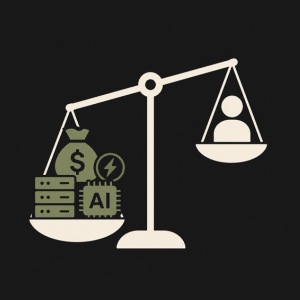
The Rising Operational Cost of Enterprise AIFor years, artificial intelligence was positioned as the ultimate cost-cutting technology. Companies were told AI would automate repetitive work, reduce payroll expenses, increase productivity, and streamline operations across nearly every department. From customer service to marketing to software development, the promise was simple: fewer human costs and greater efficiency.

Now that enterprises are moving beyond experimentation and into full-scale AI deployment, many organizations are discovering something unexpected. In some cases, AI systems are costing more to operate than the salaries of the employees they were meant to replace. What began as a labor-saving initiative is rapidly becoming a major infrastructure, operations, and sustainability challenge.

The conversation around AI is shifting. Enterprises are no longer asking whether AI can generate content, automate workflows, or assist employees. They are asking whether the economics of large-scale AI adoption actually make sense long term. As inference workloads scale, infrastructure requirements grow, and governance demands increase, many organizations are realizing that AI is not replacing operational costs. It is creating entirely new ones.

The AI Cost Narrative Is Changing

The first wave of enterprise AI adoption focused heavily on productivity gains. Executives saw demonstrations of chatbots answering customer questions, copilots generating code, and generative AI tools creating reports, marketing content, and analytics summaries in seconds. On paper, it looked like a direct reduction in labor.

The reality inside enterprises has proven far more complicated. AI systems require continuous compute resources, expensive subscriptions, API access, infrastructure scaling, data management, human oversight, security controls, and workflow orchestration. Unlike a salaried employee, AI systems generate operational costs every second they are running.

One of the biggest misconceptions about enterprise AI is that automation immediately eliminates headcount. In practice, most organizations are not fully replacing employees. They are augmenting existing teams while simultaneously adding AI infrastructure expenses on top of current labor costs. The result is a rapidly expanding operational budget that many companies did not anticipate.

Inference Is Becoming the Real Expense

Much of the public conversation around AI has focused on model training. Training large language models certainly requires enormous compute power, but enterprises are increasingly discovering that inference is where long-term costs begin to spiral.

Inference refers to the actual day-to-day use of AI systems. Every chatbot interaction, AI-generated summary, automated workflow, image generation request, and AI agent action requires compute resources. Once AI tools become embedded across departments, those costs compound continuously.

Unlike traditional software platforms that operate with relatively stable infrastructure requirements, generative AI systems are computationally expensive at scale. Organizations deploying AI copilots to thousands of employees may be processing millions of prompts every month. AI agents that continuously monitor systems, generate responses, analyze data, or automate tasks create constant workloads that require significant GPU infrastructure.

This creates a difficult economic reality. A salaried employee has a relatively predictable annual cost. AI systems, however, scale based on usage, token consumption, workload intensity, and infrastructure demand. The more successful the deployment becomes, the more expensive it often becomes to maintain.

AI Infrastructure Is Expensive by Design

Behind every AI-powered workflow is an increasingly complex infrastructure stack. Enterprises are now investing heavily in:

  • GPU clusters
  • High-density compute environments
  • AI cloud subscriptions
  • Vector databases
  • Data pipelines
  • Storage infrastructure
  • Networking upgrades
  • AI orchestration platforms
  • Governance and compliance tooling
  • Real-time inference systems

Many organizations initially assumed they could simply plug AI into existing infrastructure environments. Instead, AI workloads are forcing major upgrades across data centers, networking systems, storage architectures, and cloud environments.

This is especially true for companies deploying internal AI assistants or autonomous AI agents. Always-on AI systems require constant processing availability, which dramatically increases infrastructure utilization and energy consumption. In many cases, the cost of maintaining these systems begins to rival or exceed the operational cost of the teams they were designed to support.

The Hidden Human Cost of AI

Another overlooked factor in enterprise AI adoption is the continued need for human oversight. AI systems are not fully autonomous business replacements. They still require employees to validate outputs, correct inaccuracies, monitor compliance, review security risks, and manage workflows. In many organizations, AI has not eliminated jobs. It has changed the nature of them. Employees increasingly spend time acting as what some analysts now call “human middleware” between disconnected AI systems and business operations.

Marketing teams still edit AI-generated content. Developers still review AI-generated code. Security teams still validate AI-driven alerts. Customer service agents still intervene when AI systems fail to understand context or intent. Legal and compliance teams now spend additional time reviewing AI usage policies, governance frameworks, and regulatory exposure. Rather than fully removing labor costs, AI often introduces additional layers of operational complexity that require new forms of management and oversight.

Sustainability Is Becoming Part of the Cost Equation

The economic challenges surrounding AI are also becoming sustainability challenges. AI workloads consume enormous amounts of energy, particularly as enterprises scale inference operations across thousands of users and systems. Modern AI infrastructure is pushing data centers toward unprecedented power densities. Cooling requirements are increasing rapidly, energy demand is rising, and organizations are beginning to face questions about the environmental impact of always-on AI operations.

This creates a contradiction for many enterprises. Companies may simultaneously pursue aggressive ESG goals while dramatically increasing the energy consumption associated with AI initiatives. The more AI becomes integrated into everyday operations, the harder it becomes to ignore its infrastructure footprint. Sustainability is no longer just a public relations issue in AI. It is becoming a financial and operational concern tied directly to infrastructure costs, energy availability, and long-term scalability.

AI ROI Is Becoming Harder to Measure

One of the biggest enterprise challenges now emerging is proving measurable return on investment from AI deployments. Early AI adoption was often driven by urgency and fear of falling behind competitors. Many organizations implemented AI tools before fully understanding their long-term operational costs.

Now executives are beginning to ask harder questions:

  • Is AI actually reducing costs?
  • Are productivity gains measurable?
  • Which workflows justify AI spending?
  • Are AI systems replacing labor or simply adding another expense layer?
  • What is the cost per AI-generated task?
  • How much infrastructure growth will future AI adoption require?

These questions are becoming increasingly important as enterprises face rising cloud costs, infrastructure constraints, and economic pressure to demonstrate efficiency. In some cases, organizations are discovering that smaller, focused teams of skilled employees may still be more cost-effective than maintaining large-scale AI systems for every workflow imaginable.

The Future May Be Hybrid, Not Fully Automated

The long-term future of enterprise AI may not be about replacing humans entirely. Instead, it may involve finding the right balance between human expertise and AI-assisted workflows. Not every business process requires a massive generative AI model. Not every task benefits from continuous inference workloads. Many organizations are beginning to realize that strategic AI deployment matters far more than simply maximizing automation.

The next phase of enterprise AI will likely focus less on replacing employees and more on optimizing where AI truly provides measurable value. Efficiency, sustainability, governance, and infrastructure economics are becoming just as important as model capability. The companies that succeed with AI long term may not be the ones deploying the most AI. They may be the organizations that learn when human intelligence is still the more efficient, scalable, and cost-effective solution.

Final Thoughts

Artificial intelligence is undoubtedly transforming enterprise operations, but the economics of AI are proving far more complex than early hype suggested. AI systems are not free employees. They are resource-intensive infrastructure platforms that require continuous investment, oversight, energy, and operational management.

As enterprises move deeper into the era of autonomous agents, always-on inference, and AI-driven workflows, the conversation is shifting from capability to sustainability. Businesses are beginning to understand that replacing human labor with AI does not automatically reduce costs. In many cases, it simply shifts those costs into infrastructure, energy, and operational complexity. The real challenge moving forward will not be whether companies can deploy AI. It will be whether they can afford to operate it at scale responsibly, efficiently, and sustainably.

Frequently Asked Questions

Why is AI becoming so expensive for enterprises?

AI systems require continuous compute resources, GPU infrastructure, cloud scaling, data pipelines, storage environments, security controls, and governance platforms. As AI usage grows across an organization, inference costs and operational complexity increase significantly.

Is AI actually replacing employees?

In many cases, AI is augmenting employees rather than fully replacing them. Organizations still require human oversight for validation, compliance, editing, security reviews, and workflow management, which means labor costs often remain alongside new AI expenses.

What is the biggest long-term challenge for enterprise AI?

One of the biggest challenges is sustainability and scalability. Enterprises must balance AI performance with infrastructure costs, energy consumption, operational efficiency, and measurable ROI to ensure AI deployments remain economically viable over time.