
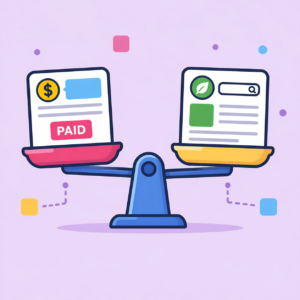
 As budgets tighten across B2B marketing teams, there is more pressure than ever to justify spend. Paid programs are being scrutinized more closely, organic efforts are expected to do more heavy lifting, and the line between the two is becoming more important to get right. The question is no longer just how much to invest in paid versus organic. It is what each channel is actually responsible for in driving pipeline.
For a long time, the default approach leaned heavily on paid lead generation. The goal was to generate as many leads as possible, often measured by cost per lead or total volume. That model worked when access to information was limited and capturing contact data created a meaningful advantage. Today, that dynamic has changed. Information is widely available, buyers are more independent, and a form fill does not carry the same weight it once did.
Why Paying for MQLs Is Losing Its Value
In today’s environment, paying for MQLs often means paying for access to information, not true interest. A buyer may download a piece of content, but that does not mean they are evaluating solutions or ready to engage with sales. In many cases, it reflects early-stage research or simple curiosity. When budgets are constrained, paying for that type of interaction becomes harder to justify.
This is where many paid strategies fall short. They optimize for conversions at the top of the funnel, but those conversions do not always translate into pipeline. Marketing teams can generate large volumes of leads while sales teams struggle to turn them into opportunities. The disconnect is not always due to execution. It is often due to what is being measured and what is being purchased.
Why Paying for SQLs Changes the Equation
Shifting paid strategy toward SQLs changes the conversation entirely. Instead of paying for a moment of engagement, you are paying for validated interest. That may include confirmation of fit, intent, timing, or willingness to engage. The volume may be lower, and the cost per lead may be higher, but the downstream impact is significantly different.
When paid efforts are tied more closely to qualified opportunities, the relationship between marketing spend and revenue becomes clearer. Sales teams spend less time filtering through low-quality leads, and more time engaging with accounts that are actually moving. In a constrained budget environment, that efficiency matters more than raw lead volume.
Where Organic Plays a Different Role
While paid strategies are shifting toward quality and intent, organic efforts play a different but equally important role. Organic marketing builds familiarity over time. It allows buyers to encounter your brand multiple times, engage with your content at their own pace, and build context before ever converting.
This is especially important in a market where buyers are doing more research independently. By the time they are ready to engage, they are often already aware of the vendors they are considering. Organic content, whether through blogs, social posts, or thought leadership, helps shape that early perception.
Unlike paid campaigns, organic efforts are not tied to immediate conversion. Their value is cumulative. They create the foundation that makes later interactions, including paid ones, more effective.
When It Still Makes Sense to Pay for Top-of-Funnel Activity
That does not mean paid top-of-funnel activity has no place. There are specific scenarios where it still makes sense to invest in broader lead generation. One of the most common is when entering a new market or targeting a new segment. In those cases, the goal is not immediate pipeline. It is exposure and learning.
Paid programs can help identify which audiences engage, which messaging resonates, and which segments are worth pursuing further. Similarly, when launching a new product, paid distribution can accelerate awareness and give the market a reason to engage. In both cases, the value is not just the leads themselves, but the insight they provide.
The key is understanding the objective. Paying for top-of-funnel activity makes sense when you are building or testing. It becomes less effective when it is treated as a primary pipeline driver without the necessary demand behind it.
The Balance Between Paid and Organic
Balancing paid and organic is less about splitting budget evenly and more about aligning each channel with the right role. Organic builds awareness and familiarity. Paid accelerates reach and captures moments of intent. When those roles are clearly defined, the two approaches reinforce each other rather than compete.
For example, a buyer may encounter your brand through organic content multiple times before engaging with a paid campaign. When that paid interaction happens, it is no longer a cold introduction. It is a continuation of an existing journey. That context improves both conversion rates and lead quality.
What This Means in a Constrained Budget Environment
In a tighter budget environment, the margin for error is smaller. Teams cannot afford to invest heavily in programs that generate activity without producing meaningful outcomes. This makes it more important to focus paid efforts on signals that correlate with pipeline, while allowing organic efforts to build long-term demand.
It also requires a shift in how success is measured. Instead of focusing on cost per lead or total lead volume, teams need to evaluate how paid and organic efforts contribute to opportunity creation, sales conversations, and revenue. This is where the distinction between interest and information becomes critical.
Final Thought
The balance between paid and organic marketing is not static. It evolves based on market conditions, business goals, and buyer behavior. What matters is not choosing one over the other, but understanding what each is actually driving.
In today’s B2B environment, paying for information is no longer enough. Buyers can access that on their own. The real value comes from identifying and engaging with those who are showing real interest. That is where paid efforts should focus, and where organic efforts can make that engagement more likely in the first place.
