Structured Interviewing: How to Architect an Effective Process and Get Organizational Buy-In

There has been vast literature that calls into question the validity of an unstructured process—namely, these interviews are not reliable predictors of a candidate’s success on the job. A structured process, on the other hand, offers innumerable benefits to your company, ranging from the increase of predictive accuracy to the decrease of interviewer bias.

Jan Fiegel, Head of Recruiting at Oscar Health, is an expert on architecting a structured interview process, and has recently shared his case study at the Recruiting Optimization Roadshow in New York City.

In this webinar, Jan shares:

  • How to structure your interview process to systematically assess the drivers of success
  • A detailed look into how he has architected the interview process at Oscar Health
  • Ways to get buy-in from hiring managers and the rest of your organization

Watch this webinar on-demand now!

Request Free!

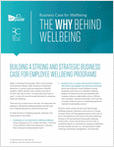
The Why Behind Wellbeing

Eighty-six thousand four hundred. That’s not the number of annual heart attacks, yearly incidences of employee depression, or amount spent per employee on benefits programs. Rather, 86,400 is the number of seconds in one day. How they’re used— not necessarily how much is spent—is what will move the needle decisively for employee health and wellbeing.

Request Free!

The Do’s and Don’ts of Workplace Health and Wellbeing Programs

These elements underscore the need to build a program that is unique to the company’s culture, grounded in science, well designed, properly resourced, and appropriately evaluated. On top of this, researchers like me have a hard time proving health promotion programs save money because there are so many other things companies do in conjunction with these programs. They change their insurance benefit plan designs and absence policies; they restructure business operations; bring in new vendors; and respond to changing business conditions.

And yet, despite this background noise, we’ve figured out ways to conduct “real-world” research and figure out the Value-On-Investment (VOI) from workplace wellness programs.

Download this White Paper to learn more!

Request Free!

The Why Behind Wellbeing

Eighty-six thousand four hundred. That’s not the number of annual heart attacks, yearly incidences of employee depression, or amount spent per employee on benefits programs. Rather, 86,400 is the number of seconds in one day. How they’re used— not necessarily how much is spent—is what will move the needle decisively for employee health and wellbeing.

Request Free!

The Do’s and Don’ts of Workplace Health and Wellbeing Programs

These elements underscore the need to build a program that is unique to the company’s culture, grounded in science, well designed, properly resourced, and appropriately evaluated. On top of this, researchers like me have a hard time proving health promotion programs save money because there are so many other things companies do in conjunction with these programs. They change their insurance benefit plan designs and absence policies; they restructure business operations; bring in new vendors; and respond to changing business conditions.

And yet, despite this background noise, we’ve figured out ways to conduct “real-world” research and figure out the Value-On-Investment (VOI) from workplace wellness programs.

Download this White Paper to learn more!

Request Free!