
Quick Definition
BANT Qualification Framework: A B2B sales qualification methodology that evaluates leads based on four criteria -- Budget, Authority, Need, and Timeline -- to determine whether a prospect is a viable sales opportunity. Originally developed by IBM, it's now widely used across industries as a foundation for pipeline management and lead scoring.
AI Summary
This article argues that BANT remains a valid B2B qualification framework but needs to be rebuilt around AI-driven data inputs rather than manual discovery. It covers how AI can score each BANT dimension using firmographic data, intent signals, NLP analysis, and behavioral triggers. It also addresses the limitations of single-buyer BANT models in committee-driven buying cycles, and explains how demand generation programs that deliver content-engaged leads -- like those from Knowledge Hub Media -- feed directly into a smarter qualification engine.
Key Takeaways
- Manual BANT qualification relies on self-reported data from prospects, which is inherently inconsistent. AI replaces that with observable behavioral and firmographic signals that score each dimension before a sales conversation starts.
- Modern B2B buying committees require account-level qualification scoring, not just contact-level. Authority and engagement need to be mapped across multiple stakeholders to get an accurate pipeline read.
- Demand generation programs that deliver content-engaged leads give AI qualification models better inputs, which means more accurate scoring and less time wasted on poorly-qualified pipeline.
BANT isn’t dead. It’s just overdue for an upgrade.
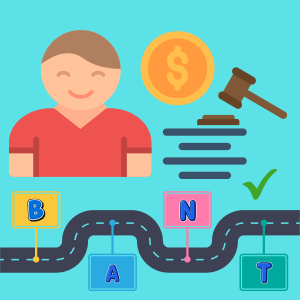 Budget, Authority, Need, and Timeline. Four words that have shaped B2B sales conversations for the better part of six decades. And yet, most sales teams are still applying this framework the same way they did in 1960 — by asking a handful of qualifying questions in a discovery call and hoping the answers are honest. The problem isn’t BANT itself. The problem is that manual, conversation-dependent qualification is inconsistent, subjective, and increasingly out of step with how modern B2B buying actually works. AI changes that. Not by replacing the framework, but by making it smarter, faster, and a lot harder to game.
Why BANT Keeps Failing in the Field
The core issue with traditional BANT isn’t the criteria — it’s the execution. When qualification depends entirely on what a prospect tells you, you’re building your pipeline on self-reported data. Buyers often don’t know their exact budget at the early stage. Decision-making authority is spread across three to seven stakeholders in most enterprise deals. Need is frequently understated because buyers don’t want to show urgency. And timeline? That’s almost always aspirational.
What most teams get is a scorecard full of soft signals dressed up as hard data. That leads to bloated pipelines, wasted sales cycles, and forecasts that look great until they don’t.
What AI Actually Brings to BANT Qualification
AI doesn’t guess — it correlates. When you feed it the right inputs, it can score each BANT dimension based on observed behavior and third-party data rather than what someone said on a call. That’s a fundamentally different kind of intelligence.
Here’s how that breaks down across each dimension:
- Budget: AI cross-references firmographic data — company size, revenue range, funding stage, recent hiring patterns — to model likely budget availability. If a Series B SaaS company with 200 employees just hired a VP of Marketing, the budget signal is there even if they haven’t said a number out loud.
- Authority: Natural language processing applied to email threads, LinkedIn engagement, and CRM contact history can identify who’s actually driving the conversation versus who’s just on the CC line. Multi-threaded engagement scoring helps you see whether you’re talking to the decision-maker or the researcher.
- Need: Intent data is the clearest window into need that exists right now. When a target account is consuming content around a specific pain point across multiple channels, that’s a need signal that didn’t require a single sales conversation to surface.
- Timeline: Behavioral triggers — like demo requests, pricing page visits, or a spike in content consumption — are stronger timeline indicators than anything a prospect will volunteer. AI models trained on historical deal data can weight these signals to estimate how close to a buying decision a prospect actually is.
The Committee Problem: Adapting BANT for Modern Buying Groups
One of BANT’s most significant structural weaknesses is that it was designed for single-buyer deals. In reality, the average purchase decision now involves a buying committee, and authority is distributed — not assigned. An AI-driven qualification model has to account for this by mapping stakeholder engagement across the full account, not just a single contact.
This is where account-level scoring becomes essential. Rather than qualifying a lead, you’re qualifying an account by measuring engagement breadth and depth across multiple contacts. If your champion is engaged but the CFO and IT lead haven’t touched a single piece of content, that account isn’t as qualified as the pipeline report suggests.
Where Demand Generation Feeds the Model
None of this works without the right content infrastructure behind it. To score Need and Timeline accurately, you need leads arriving with a behavioral footprint — a content consumption history that tells the AI what they care about and how close they are to a decision.
This is exactly where a demand generation partner like Knowledge Hub Media becomes a direct input to your qualification engine. Leads sourced through content syndication programs arrive with documented engagement data: which topics they consumed, what stage of the funnel the content addressed, and how recently they engaged. That’s not just lead data — it’s qualification fuel. When that behavioral history gets fed into your CRM alongside firmographic enrichment and intent signals, your AI model has enough to work with before a sales rep makes a single call.
Building the Framework: A Practical Starting Point
If you’re ready to move from manual BANT to an AI-assisted model, here’s where to start:
- Audit your data sources. Your model is only as good as its inputs. Map what’s currently flowing into your CRM — contact data, engagement history, firmographics, intent feeds — and identify the gaps.
- Define your BANT scoring rules. Work with your sales and RevOps teams to agree on what a strong signal looks like for each dimension. What firmographic profile suggests adequate budget? What engagement patterns indicate real authority? This has to be a deliberate, sales-informed decision, not a default setting.
- Build account-level views, not just contact-level. Make sure your CRM or MAP can aggregate engagement data at the account level so your qualification score reflects the buying group, not just your primary contact.
- Calibrate with closed-won data. Train your model on the deals you’ve won and lost. The patterns in that data will tell you which signals actually predicted outcomes and which were just noise.
- Create a feedback loop. AI qualification models drift over time. Build a process where sales reps flag misqualified leads so the model keeps improving.
BANT Still Matters — It Just Needs Better Inputs
The instinct to retire BANT is understandable, but it’s the wrong conclusion. The framework is sound. What’s broken is the manual process around it. AI doesn’t replace the judgment calls your best salespeople make — it gives everyone on your team access to the same quality of signal that your top performers were picking up intuitively.
When your qualification engine is fed by high-intent, content-engaged leads and enriched with the right data layers, BANT stops being a checklist and starts being a competitive advantage.
Frequently Asked Questions
Is BANT still relevant for modern B2B sales?
Yes -- but only if it's applied with better data. The criteria themselves are still sound; the problem is that most teams rely on self-reported information to score them. AI-assisted qualification addresses that by using behavioral and third-party data to score each dimension independently of what a prospect tells you.
What data does an AI BANT model need to work effectively?
At minimum, you need firmographic data (company size, industry, revenue range), intent data (content consumption across third-party channels), CRM engagement history (email opens, meeting history, contact roles), and behavioral signals (website activity, pricing page visits, demo requests). The more complete those inputs, the more accurate the scoring.
How does content syndication improve lead qualification?
Content syndication programs deliver leads who have already engaged with specific topic-relevant content, which means they arrive with a documented interest signal. That engagement history feeds directly into your Need and Timeline scoring, giving your AI model a head start over cold inbound leads with no behavioral footprint.
What's the biggest mistake teams make when setting up AI-assisted BANT scoring?
Relying on default settings rather than calibrating the model against their own closed-won and closed-lost data. Every market and product has different qualifying patterns. An off-the-shelf model won't reflect those nuances until it's trained on your actual deal history.
